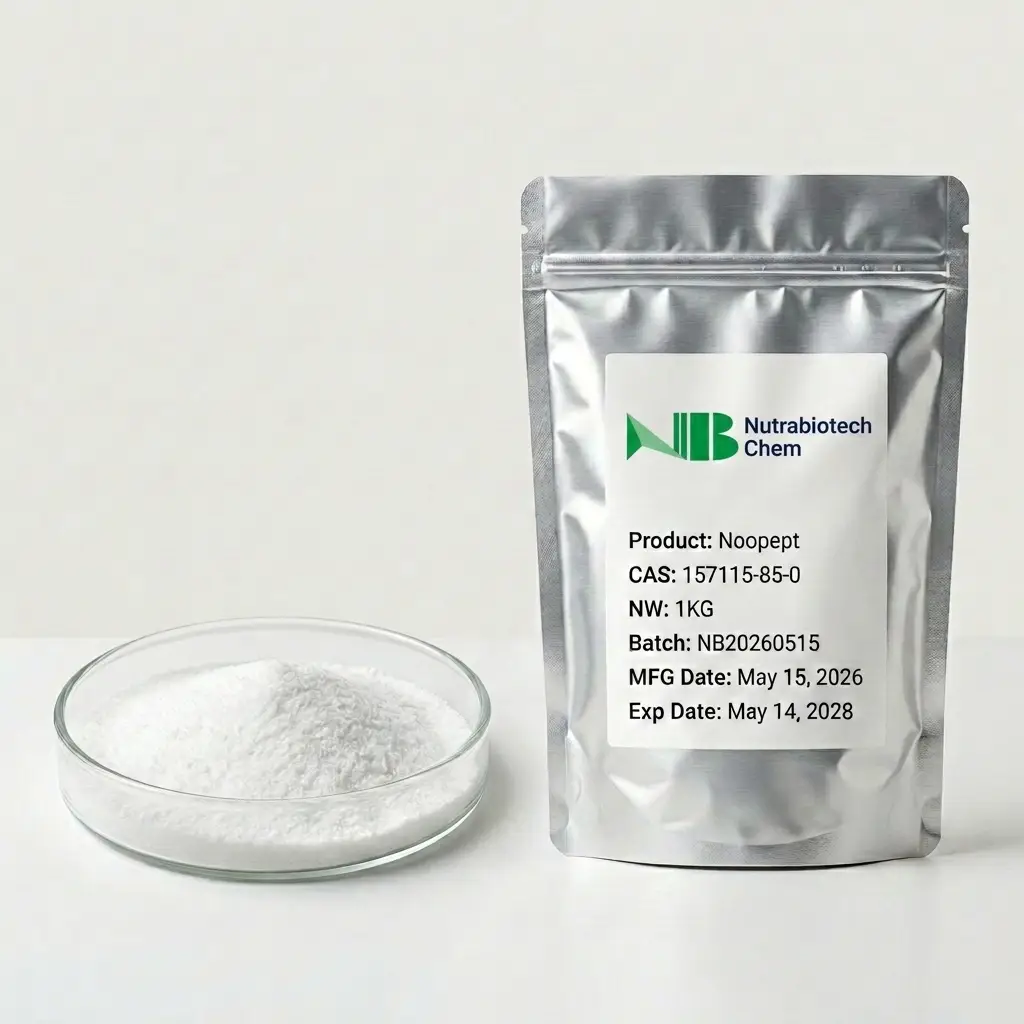
Noopept (GVS-111) CAS 157115-85-0
Potent Peptide-Derived Nootropic for Cognition & Neuroprotection Research
Noopept (CAS 157115-85-0), also known as GVS-111, is a potent, peptide-derived nootropic — the ethyl ester of N-phenylacetyl-L-prolylglycine. Roughly 1,000× more potent than piracetam by weight, it enhances learning and memory by modulating acetylcholine and glutamate (AMPA) signaling while upregulating BDNF and NGF. Formula C17H22N2O4, MW 318.37. Research grade with COA.
Molecular Information
CAS: 157115-85-0
Formula: C17H22N2O4
MW: 318.37 g/mol
IUPAC: ethyl (2S)-2-[[(2S)-1-oxo-1-(2-phenylacetyl)pyrrolidin-2-yl]carbonylamino]acetate
SMILES: CCOC(=O)CNC(=O)[C@H]1CCCN1C(=O)Cc1ccccc1
Class: Peptide-derived nootropic (dipeptide analog)
Core: Prolylglycine ethyl ester + phenylacetyl
Target: Cholinergic / glutamatergic / neurotrophic
Activity: Cognition, LTP, neuroprotection
Appearance: White to off-white crystalline powder
Synonyms: GVS-111
Storage: -20°C, dry, protect from light
Product Technical Specifications
Complete physicochemical properties and QC parameters for Noopept (GVS-111, CAS 157115-85-0)
📋 Physicochemical Properties
- Product NameNoopept (GVS-111)
- IUPAC Nameethyl (2S)-2-[[(2S)-1-oxo-1-(2-phenylacetyl)pyrrolidin-2-yl]carbonylamino]acetate
- CAS Number157115-85-0
- SynonymsGVS-111; N-Phenylacetyl-L-prolylglycine ethyl ester
- Molecular FormulaC17H22N2O4
- Molecular Weight318.37 g/mol
- SourceSynthetic (small-molecule nootropic)
- AppearanceWhite to off-white crystalline powder
- Water SolubilityLow to moderate (DMSO/ethanol recommended)
- Organic SolubilityDMSO, ethanol, methanol
- Compound ClassPeptide-derived nootropic (prolylglycine analog)
- HS Code2933.99
🔬 Quality Control & Handling
- Purity (HPLC)>=98%
- FormPowder (research grade)
- Primary TargetCholinergic / glutamatergic / neurotrophic
- Assay ReadoutACh release; LTP; BDNF/NGF; cognition models
- SelectivityMultimodal cognitive / neuroprotective
- Storage Condition-20°C, sealed, dry, protect from light
- Solution StabilityDMSO stock stable at -20°C; avoid freeze-thaw
- ShippingAmbient or cold chain
- QC DocumentationCOA / HPLC / NMR / MS / MSDS
- Pack Sizes100G / 1KG / 10KG / 25KG / 1 ton
- Stock StatusIn Stock
- Use StatementResearch use only; not for human consumption or therapeutic use
Key Molecular Targets & Biology Nodes
Noopept acts through a multimodal cognitive axis — simultaneously engaging cholinergic and glutamatergic transmission, synaptic plasticity (LTP) and endogenous neurotrophic support (BDNF/NGF).
How Noopept Works: A Multimodal Cognitive-Enhancement Profile
Unlike single-target agents, Noopept tunes several interconnected brain signaling systems that together support memory, learning and neuronal resilience.
Cholinergic Modulation
Noopept promotes acetylcholine (ACh) release and signaling in hippocampus and cortex — the same neurotransmitter system central to attention, learning and memory that underpins the racetam family.
Glutamate / AMPA Up-Regulation
A defining feature: Noopept increases the density and sensitivity of AMPA receptors and supports NMDA function, strengthening long-term potentiation (LTP) — the cellular basis of learning and memory formation.
Neurotrophic Support (BDNF / NGF)
Noopept upregulates brain-derived and nerve growth factors (BDNF, NGF), promoting synaptic plasticity, neurogenesis and the survival of existing neurons — effects that outlast the compound's acute presence.
Neuroprotection & Antioxidant
By calming excitotoxic glutamate signaling and reducing oxidative stress, Noopept protects neurons in ischemia, trauma and neurodegenerative models, supporting recovery of cognitive function.
⚖️ Noopept vs Piracetam
- Noopept (this product)Dipeptide analog; ~1000x potency; ACh + strong AMPA/BDNF
- PiracetamTrue 2-pyrrolidone racetam; gram-scale dosing
- PotencyNoopept far more potent by mass
- MechanismBoth cholinergic; Noopept adds glutamatergic & neurotrophic
- StructureNoopept is NOT a true racetam
- Research NicheCognitive enhancement & neuroprotection
♻️ Downstream Biological Consequences
- TransmitterACh up; glutamate balanced
- ReceptorAMPA density/sensitivity up
- PlasticityLTP enhanced
- TrophicBDNF / NGF increased
- FunctionMemory, learning, focus improved
- ResilienceAntioxidant / neuroprotective
Noopept vs Piracetam: How They Compare
A side-by-side view of how Noopept relates to the classic racetam benchmark, piracetam — the comparison most researchers search for.
🧪 Noopept (this product)
- Chemical ClassPeptide-derived dipeptide analog
- True Racetam?No (racetam-like only)
- Relative Potency~1,000× piracetam by weight
- Core MechanismACh + AMPA up + BDNF/NGF
- Key EdgeAMPA-receptor & neurotrophic drive
- Research UseCognition & neuroprotection
🧪 Piracetam (benchmark)
- Chemical Class2-Pyrrolidone (true racetam)
- True Racetam?Yes
- Relative PotencyBaseline (gram-scale dosing)
- Core MechanismPrimarily cholinergic / membrane
- Key EdgeLong safety history, mild effect
- Research UseCognitive reference compound
Research & Application Areas
Noopept is a versatile cognitive-research reagent spanning memory, synaptic plasticity, neurotrophic biology, neuroprotection and behavioral models.
Memory & Learning
Core tool for studying acquisition, consolidation and recall in cognitive models.
CognitionSynaptic Plasticity (LTP)
Probe AMPA-receptor and LTP mechanisms underlying learning.
PlasticityNeurotrophic Research
Quantify BDNF/NGF induction and neurogenesis endpoints.
NeurotrophinsNeuroprotection
Ischemia, TBI and excitotoxicity models of neuronal resilience.
ProtectionAnxiolytic / Mood Models
Anxiolytic-like and monoamine-modulating effects in research.
BehaviorNootropic Stack Studies
Combination research with choline sources and other cognitive agents.
StackingNoopept in Nootropic Research & Combination Studies
Noopept is frequently studied alongside complementary cognitive agents. The combinations below are described at the preclinical / research level — the material supplied here is strictly for laboratory use.
🔗 With Choline Sources
Noopept is often paired with choline donors (e.g., alpha-GPC, citicoline) in cognitive research to support the acetylcholine limb of its mechanism.
Cholinergic support🔗 With Other Racetams
Studied in combination with piracetam, aniracetam or phenylpiracetam to compare and amplify cognitive signaling pathways.
Racetam family🌱 With Neurotrophic Agents
Paired with compounds that also raise BDNF/NGF to investigate synaptogenesis and recovery paradigms.
Neurogenesis🛡 ️ With Antioxidants
Combined with antioxidant agents in neuroprotection and ischemia-reperfusion research.
AntioxidantKey Literature & Landmark Publications
Representative and landmark work on Noopept mechanism, neurotrophic effects, neuroprotection and cognitive enhancement.
Available Sizes & Ordering
Research-grade Noopept (CAS 157115-85-0) with full QC documentation; standard packs and bulk custom quantities supported.
| Tier | Pack Size | Stock Status | Suitable For | Lead Time |
|---|---|---|---|---|
| Standard | 100G | In Stock | Lab screening / pilot sampling | Same/next-day ship |
| Medium | 1KG | In Stock | Pilot / small-batch production | Same/next-day ship |
| Large | 10KG | In Stock | Production / process development | Same/next-day ship |
| Bulk | 25KG | In Stock | Commercial-scale supply | Quote to confirm |
| Industrial | 1 ton | Made to order | Full-scale manufacturing | Batch delivery |
💡 Reference sizes shown above; for exact pricing and availability please contact us for a quote. Bulk orders qualify for tiered discounts.
Frequently Asked Questions (FAQ)
What is Noopept and what is it used for?
How does Noopept work (mechanism of action)?
Noopept vs Piracetam — what is the difference?
Is Noopept a racetam?
How soluble is Noopept and how should it be prepared?
Does Noopept affect BDNF and NGF (neurotrophic effects)?
Is Noopept neuroprotective?
Can Noopept be combined with choline or other nootropics (stacking)?
What is the regulatory / legal status of Noopept?
Is QC documentation provided?
Need Noopept (GVS-111) for Your Research?
Research-grade Noopept (CAS 157115-85-0) — purity >=98% HPLC, COA included
Potent peptide-derived nootropic for cognition & neuroprotection — request a quote today