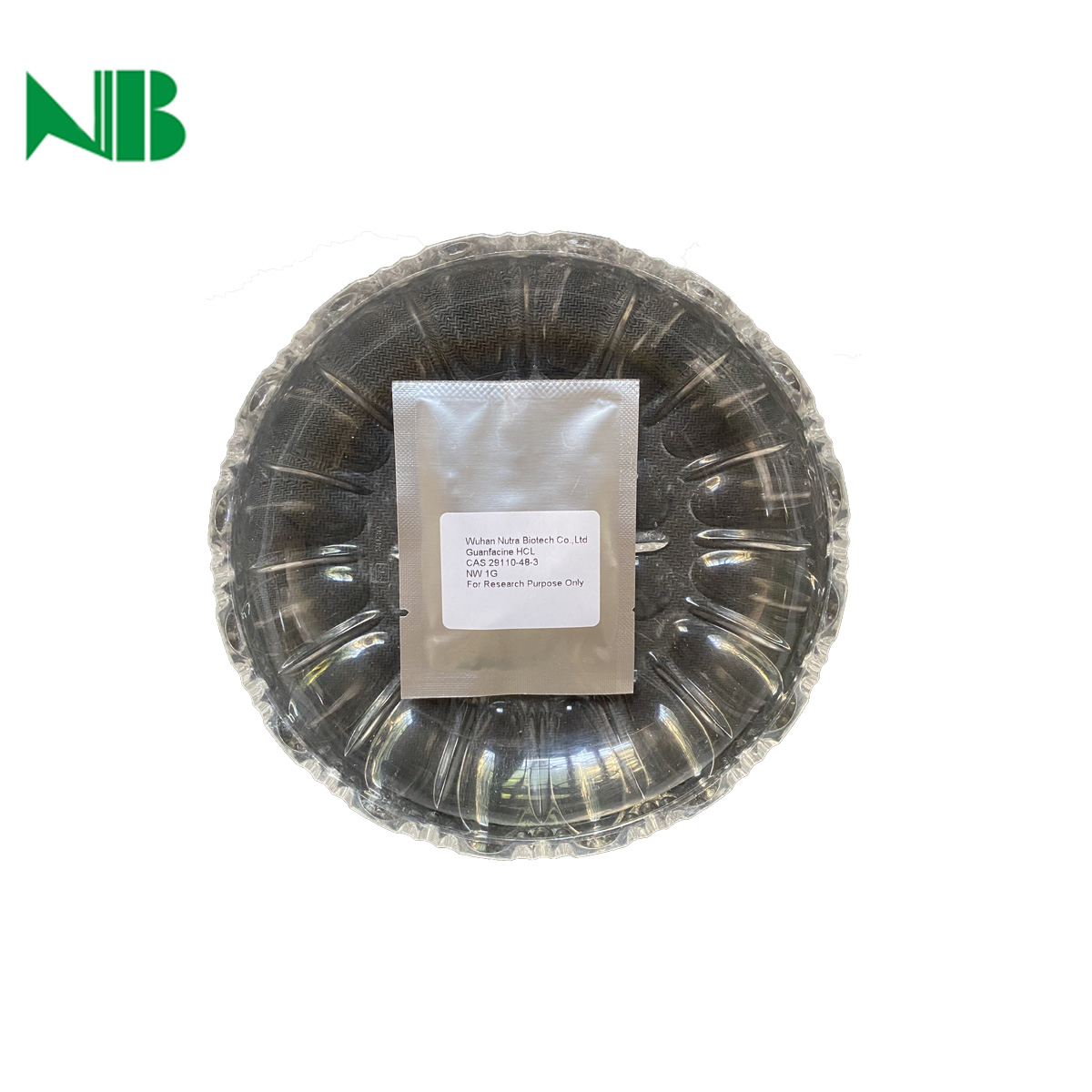
Guanfacine Hydrochloride CAS 29110-48-3
Selective α2A-Adrenoceptor Agonist
A centrally acting, highly α2A-selective adrenergic agonist (Kd ~31 nM, ~60-fold selective over α2B) and the active pharmaceutical ingredient in Tenex and Intuniv. Guanfacine HCl is the preferred research probe for prefrontal cortical network connectivity, noradrenergic signalling, working memory and ADHD-related executive-function models — delivering clonidine-like sympatholysis with markedly less sedation.
Molecular Information
CAS: 29110-48-3
Formula: C9H10Cl3N3O (HCl)
MW: 282.55 g/mol
Purity: ≥98% (HPLC)
SMILES: Clc1cccc(Cl)c1
CC(=O)N=C(N)N.Cl
InChIKey: DGFYECXYGUIODH
-UHFFFAOYSA-N
Appearance: White to off-white
crystalline powder
Solubility: Water / DMSO (≥28 mg/mL)
Target: α2A-Adrenoceptor (ADRA2A)
Storage: RT, desiccated, dark
Guanfacine Hydrochloride Technical Specifications & QC Parameters
Complete physicochemical data and quality-control profile for research-grade Guanfacine Hydrochloride (CAS 29110-48-3)
📋 Physicochemical Properties
- Product NameGuanfacine Hydrochloride
- IUPAC NameN-(diaminomethylidene)-2-(2,6-dichlorophenyl)acetamide;hydrochloride
- CAS Number29110-48-3
- SynonymsTenex / Intuniv / Estulic / BS 100-141
- Molecular Formula (HCl)C9H10Cl3N3O
- Molecular Formula (Free Base)C9H9Cl2N3O
- Molecular Weight282.55 g/mol
- Exact Mass280.987 Da (HCl salt)
- SMILESClc1cccc(Cl)c1CC(=O)N=C(N)N.Cl
- InChIKeyDGFYECXYGUIODH-UHFFFAOYSA-N
- AppearanceWhite to off-white crystalline powder
- Melting Point~213°C (dec., lit.)
- Chemical ClassArylacetamide / guanidine
- MDL NumberMFCD00798230
🔬 Quality Control & Handling
- Purity (HPLC)≥98%
- FormCrystalline powder (HCl salt)
- Biological PotencyKd ≈ 31 nM (α2A); ~60-fold α2A/α2B selectivity
- Receptor Selectivityα2A > α2B (~60×) > α2C (~40×)
- Functional EffectGi/o-coupled; lowers cAMP; PFC network strengthening
- SolubilityWater ≥28 mg/mL (~100 mM); DMSO ≥28 mg/mL
- Storage ConditionRT (15-25°C), desiccated, protect from light
- Stock Solution Storage4°C (weeks) or -20°C (long term), avoid freeze-thaw
- QC DocumentationCOA / HPLC / NMR / MS / MSDS
- Pack Sizes1g / 5g / 10g / 100g / 1KG
- Stock StatusIn Stock
- Use StatementResearch use only; not for human or clinical use
Molecular Targets & Downstream Signalling Nodes
Guanfacine recruits postsynaptic α2A adrenoceptors in the prefrontal cortex and presynaptic autoreceptors in the brainstem — a compact pathway that links receptor binding to cognition, attention and sympathetic tone
Guanfacine Mechanism of Action: From α2A Binding to Prefrontal Output
How a single α2A-adrenoceptor binding event translates into PFC network strengthening, attention and reduced sympathetic drive
α2A-Adrenoceptor Binding
Guanfacine binds the orthosteric pocket of postsynaptic α2A adrenoceptors (ADRA2A) on prefrontal cortical pyramidal neurons with a Kd of ~31 nM, showing ~60-fold selectivity over α2B and ~40-fold over α2C — the basis of its clean, cognition-focused profile.
Gi/o Coupling & cAMP Inhibition
Engaged α2A receptors couple via Gi/o proteins to inhibit adenylyl cyclase, lowering intracellular cAMP and protein kinase A activity. Reduced cAMP signalling is the first intracellular step that stabilises membrane excitability.
Suppressed HCN Channel Current (Ih)
Lower cAMP closes hyperpolarization-activated cyclic-nucleotide-gated (HCN) channels, reducing the inward Ih current. This dampens distal-dendritic leak conductance, making PFC neurons less distractible and more able to sustain recurrent network firing.
Strengthened PFC Network Connectivity
Membrane stabilization raises the signal-to-noise ratio of PFC processing, increases dendritic-spine density and reinforces the top-down connections that govern working memory, attentional control and behavioural inhibition.
Reduced Sympathetic Outflow
In the brainstem vasomotor center, α2A agonism inhibits central sympathetic drive and lowers locus-coeruleus norepinephrine release. Heart rate, peripheral vascular resistance and blood pressure fall — the antihypertensive (Tenex) action.
Prefrontal Cognitive & Behavioural Output
The combined cortical and autonomic effects yield improved executive function, sustained attention and impulse control with minimal sedation — the experimental signature exploited in ADHD, autism and PTSD-nightmare research models.
Research Applications of Guanfacine Hydrochloride
From prefrontal cognition and ADHD models to sympathetic control and pain, guanfacine is the selective α2A probe of choice wherever noradrenergic tone matters
ADHD & Executive Function
The active ingredient of Intuniv. Guanfacine HCl is used to model ADHD pharmacotherapy, measuring improvements in sustained attention, impulse control and working memory in rodent and translational assays — a cleaner α2A-selective comparator to stimulant and clonidine treatments.
NeurodevelopmentalPrefrontal Cortex & Cognition
A cornerstone tool for studying how α2A receptors strengthen PFC network connectivity and dendritic-spine density. Standard in electrophysiology and two-photon imaging studies of top-down attentional control and cognitive flexibility.
Cognitive NeuroscienceNoradrenergic Signalling
Used to dissect the norepinephrine→α2A→Gi/o→cAMP axis and to separate α2A-mediated cortical effects from α1/β-adrenergic and imidazoline signalling — essential for receptor-pharmacology and intracellular second-messenger studies.
Receptor PharmacologyHypertension & Autonomic Control
As the centrally acting antihypertensive Tenex, guanfacine HCl models sympatholytic blood-pressure lowering and baroreflex modulation in cardiovascular and autonomic-neuroscience research.
CardiovascularAutism & Tic Disorders
Investigated for irritability, hyperactivity and tic suppression in neurodevelopmental models. Guanfacine's α2A selectivity supports studies of repetitive behaviour and emotional dysregulation without the sedation profile of clonidine.
Pediatric PsychiatryPTSD & Trauma-Related Nightmares
κ-receptor-sparing α2A agonism is studied for reducing trauma-associated nightmares and improving sleep architecture in PTSD models — a well-cited repurposing application distinct from its ADHD use.
Sleep / TraumaPain & Opioid-Sparing
α2A agonism produces analgesia via spinal and supraspinal noradrenergic pathways. Guanfacine is tested as an opioid-sparing adjuvant in acute and chronic pain models and in anaesthesia/analgesia research.
AnalgesiaSchizophrenia & Cognitive Adjunct
Studied as a pro-cognitive adjunct to address negative and cognitive symptoms unmet by dopaminergic antipsychotics, leveraging α2A-mediated PFC enhancement in translational psychiatry.
PsychiatryBinding Assays & Radioligand Profiling
Used as a reference α2A ligand in [3H]RX821002 and [3H]rauwolscine competition binding, receptor-subtype delineation (α2A vs α2B vs α2C) and functional cAMP/β-arrestin assays for lead optimisation.
Assay StandardKey Publications Citing Guanfacine
Foundational and translational papers on α2A selectivity, prefrontal mechanisms and clinical research applications
Guanfacine Hydrochloride Pack Sizes & Ordering Information
Research-grade Guanfacine Hydrochloride (CAS 29110-48-3) supplied with full QC documentation — available in 1g / 5g / 10g / 100g / 1KG
| Tier | Pack Size | Stock Status | Typical Use Case | Shipping Notes |
|---|---|---|---|---|
| Standard | 1 g | In Stock | Radioligand binding and cAMP assays, acute in vivo dosing solutions | Same/next-day dispatch; ambient shipping, foil pouch |
| Medium | 5 g | In Stock | Behavioural ADHD/cognition studies, multi-week electrophysiology programmes | Same/next-day dispatch; desiccant included |
| Large | 10 g | In Stock | Rodent pharmacology cohorts, combination with psychostimulant studies | 1-2 business days; amber container, light-protected |
| Bulk | 100 g | In Stock | Formulation development, large animal studies, chronic dosing paradigms | Quote to confirm; double-bagged HDPE drum |
| Industrial | 1 KG | Made to order | Pilot-scale synthesis, CRO/CMO supply agreements, contract manufacturing | Batch delivery on campaign schedule; export documents and COA per lot |
💡 Reference pack sizes shown above; for current pricing, lot availability and bulk Guanfacine Hydrochloride quotations please contact us for a quote. Tiered discounts apply to 100 g and 1 KG orders.
Guanfacine Hydrochloride Frequently Asked Questions (FAQ)
What is Guanfacine Hydrochloride and why is it used in research?
How is guanfacine different from clonidine?
Why does α2A selectivity matter for cognition?
What is the mechanism of guanfacine in ADHD and prefrontal cognition?
What is Intuniv and how does it relate to guanfacine?
How should Guanfacine Hydrochloride be dissolved and stored?
What concentrations and doses of guanfacine are typically used?
What controls should I include when using guanfacine?
Is guanfacine suitable for pain and PTSD-nightmare models?
What QC documentation is supplied, and can I order bulk quantities?
Need Guanfacine Hydrochloride for Your Research?
Research-grade Guanfacine Hydrochloride (CAS 29110-48-3) — purity ≥98% HPLC, COA included, 1g to 1KG
A selective α2A-adrenoceptor agonist and prefrontal cognition / noradrenergic signalling tool — request your quote today