7,8-Dihydroxyflavone CAS 38183-03-8
Potent TrkB Receptor Agonist (7,8-DHF) — BDNF-Mimetic Neurotrophic Flavone
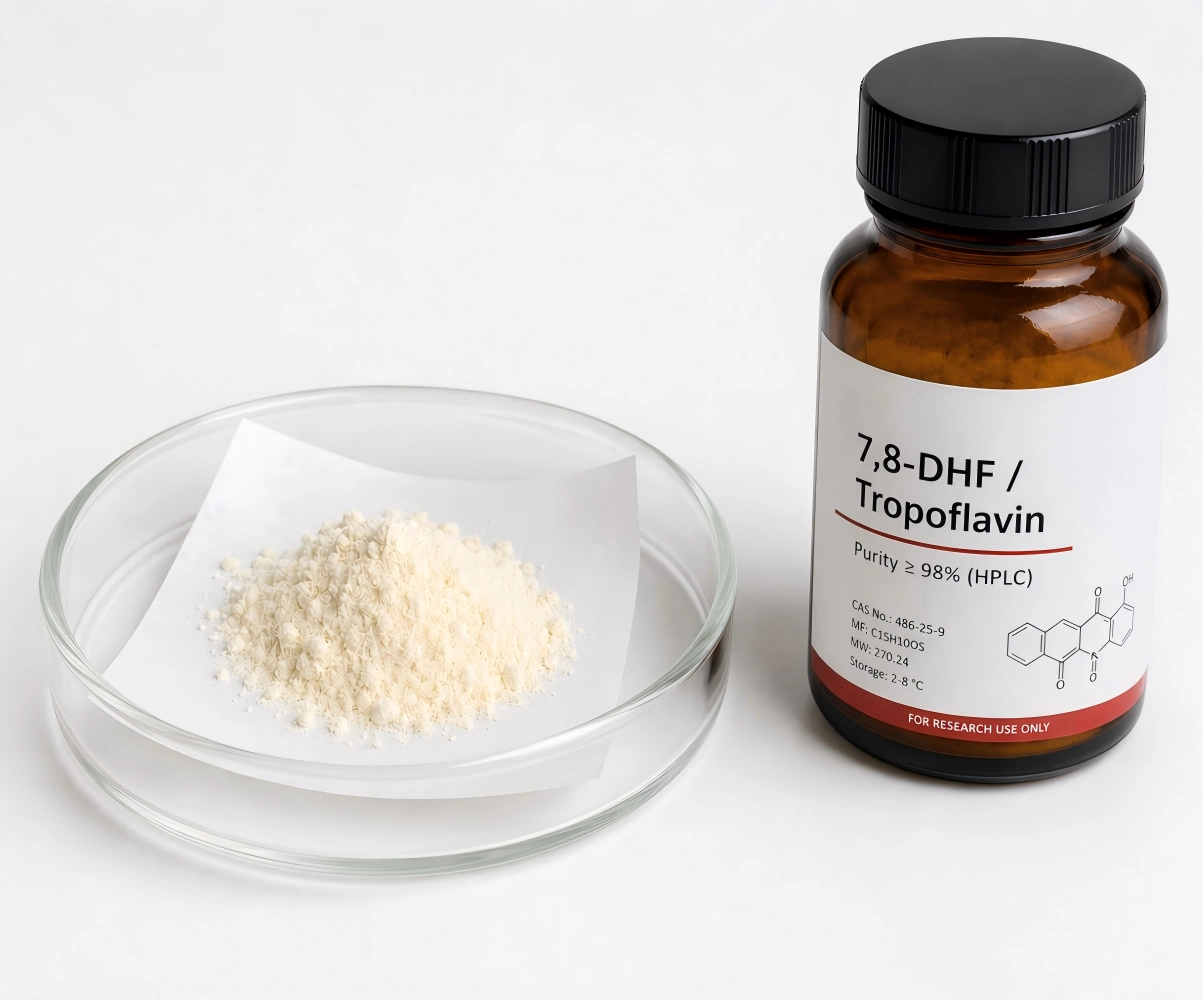
7,8-Dihydroxyflavone (CAS 38183-03-8; 7,8-DHF) is a naturally-occurring cell-permeable flavone that acts as a potent and selective small-molecule agonist of the TrkB receptor (Kd ~320 nM), the principal signaling receptor for brain-derived neurotrophic factor (BDNF). It crosses the BBB, induces TrkB dimerization and autophosphorylation, and suppresses neuronal apoptosis (EC50 ~35 nM). Molecular formula C15H10O4, MW 254.24. Research-grade with COA.
Molecular Information
CAS: 38183-03-8
Formula: C15H10O4
MW: 254.24 g/mol
Class: Flavone / TrkB agonist
Core: 7,8-dihydroxy-2-phenylchromen-4-one
Target: TrkB (NTRK2, BDNF receptor)
Kd: ~320 nM (TrkB)
EC50: ~35 nM (T48 TrkB anti-apoptosis)
Appearance: Yellow powder
Selectivity: TrkB only (not TrkA/TrkC)
Synonyms: 7,8-DHF / TrkB Agonist
Storage: 2-8 C, protect from light
Product Technical Specifications
Complete physicochemical properties and QC parameters for 7,8-Dihydroxyflavone (CAS 38183-03-8)
📋 Physicochemical Properties
- Product Name7,8-Dihydroxyflavone
- IUPAC Core7,8-dihydroxy-2-phenyl-4H-chromen-4-one
- CAS Number38183-03-8
- Synonyms7,8-DHF; TrkB Agonist
- Molecular FormulaC15H10O4
- Molecular Weight254.24 g/mol
- SourceNaturally-occurring flavone (e.g. Godmania aesculifolia, tree extracts)
- AppearanceYellow powder
- MDL NumberMFCD00006836
- InChIKeyCOCYGNDCWFKTMF-UHFFFAOYSA-N
- Compound ClassFlavone / TrkB agonist
- SMILESOc1cccc2c1C(=O)C=C(O2)c3ccccc3O
- Cell PermeabilityCell-permeable; BBB-permeable (i.p. / oral)
- SolubilityDMSO 50-100 mg/mL; ethanol ~4 mg/mL; water insoluble
- HS Code2933.99
🔬 Quality Control & Handling
- Purity (HPLC)≥98%
- FormPowder (packaged under inert gas)
- Primary TargetTrkB receptor (NTRK2 / TrkB tyrosine kinase)
- Receptor BindingKd ~320 nM at TrkB extracellular domain
- SelectivityActivates TrkB; not TrkA or TrkC at 250 nM
- Pathway ReadoutTrkB autophosphorylation; p-Akt; p-ERK1/2
- Functional ReadoutAnti-apoptotic EC50 ~35 nM (TrkB-T48 cells)
- Negative ControlK252a abolishes activity (Trk inhibitor)
- Storage Condition2-8 C, protect from light, do not freeze solid
- Solution Stability-20 C stock solutions up to 3 months; aliquot
- ShippingRoom temperature / blue ice
- QC DocumentationCOA / HPLC / NMR / MS / MSDS
- Pack Sizes10G / 100G / 1KG / 10KG / 25KG / 1Ton
- Stock StatusIn Stock
- Use StatementResearch use only; not for human/clinical use
Key Molecular Targets & Pathway Nodes
7,8-DHF's pharmacology is anchored on the TrkB receptor (NTRK2), the canonical signaling receptor for BDNF, with downstream survival and synaptic-plasticity cascades in cortical, hippocampal, retinal and neuromuscular tissues.
How 7,8-DHF Works: Mimicking BDNF at the TrkB Receptor
7,8-DHF engages the extracellular domain of TrkB, driving receptor dimerization, autophosphorylation, and the PI3K/Akt & MAPK survival cascades — replicating BDNF signaling without the delivery limits of a large protein.
TrkB — The BDNF Signaling Hub
TrkB (NTRK2) is a receptor tyrosine kinase that mediates the survival, differentiation, and synaptic-plasticity effects of brain-derived neurotrophic factor (BDNF). Its activation drives the PI3K/Akt, MAPK/ERK, and PLCγ cascades that protect neurons and consolidate long-term potentiation in the hippocampus and cortex.
Direct TrkB Agonism
7,8-DHF binds the extracellular domain of TrkB with high affinity (Kd ~320 nM), promoting receptor dimerization and trans-autophosphorylation. It selectively activates TrkB — not TrkA or TrkC at 250 nM — and its neurotrophic effects are abolished by the Trk inhibitor K252a, confirming on-target activity. Activity is further verified by Akt and ERK1/2 phosphorylation in vivo.
Survival, Plasticity & BBB Penetration
Through TrkB-driven PI3K/Akt signaling, 7,8-DHF suppresses caspase-dependent apoptosis in cortical/hippocampal neurons, RGCs, and PC12 cells against excitotoxic, oxidative (H2O2, 6-OHDA), and traumatic insults. Because it is lipophilic, it crosses the BBB after i.p. or oral dosing, enabling chronic in vivo neuroprotection without recombinant protein delivery.
⚖️ 7,8-DHF vs Recombinant BDNF vs 7,8-DHF-Br
- 7,8-DHF (this product)Small molecule; BBB-permeable; Kd ~320 nM; oral/i.p.
- Recombinant BDNFProtein; does not cross BBB; rapid clearance
- 7,8-DHF prodrug (e.g. Br derivative)Improved oral bioavailability, converted to 7,8-DHF in vivo
- Shared TargetAll engage TrkB extracellular domain
- Key Distinction7,8-DHF is the prototypical brain-penetrant TrkB small-molecule agonist
- Off-targetSelectively suppresses presynaptic GABA release; no effect on glutamate
♻️ Downstream Biological Consequences
- Receptor EventTrkB dimerization & trans-autophosphorylation (Tyr816)
- Survival PathwayPI3K / Akt activation → ↑ neuronal survival, ↓ apoptosis
- Plasticity PathwayMAPK / ERK & PLCγ / CREB → ↑ synaptic plasticity & LTP
- Apoptosis↓ Caspase-3; ↑ BCL-2 (T48 EC50 ~35 nM)
- NeurotransmissionSelective ↓ presynaptic GABA release
- BehaviorRescues memory, depression, TBI, obesity
Research Applications & Models
From Alzheimer's cognition to traumatic brain injury and depression, 7,8-DHF is the prototypical BDNF-mimetic for neurotrophic signaling research.
Alzheimer's Disease Models
Reproduces BDNF-driven cortical/hippocampal survival; rescues cognitive decline and synaptic loss in AD rodent models where endogenous BDNF signaling is deficient.
TrkB / ADTraumatic Brain Injury
Given 3 h post-TBI, 7,8-DHF reduces tissue damage and cortical apoptosis via PI3K/Akt, improving functional recovery in rodent models.
PI3K / AktDepression & Anxiety Models
Mimics the BDNF-dependent antidepressant mechanism; rescues learned helplessness and forced-swim behavior via TrkB engagement in limbic circuits.
TrkB / moodRetinal Ganglion Cell Protection
Protects RGCs from oxidative and excitotoxic apoptosis, supporting glaucoma and optic-neuropathy research where BDNF is neuroprotective.
RGC / opticObesity / Muscle TrkB
Activates TrkB in skeletal muscle to inhibit diet-induced obesity in mice — a unique non-neuronal application of BDNF-mimetic signaling.
Muscle TrkBTrkB Pharmacology & Probe Screening
A fiducial small-molecule TrkB agonist for binding, autophosphorylation, and survival assays; K252a is the canonical negative control.
TrkB panelKey Literature & Landmark Publications
The pharmacology and validation of 7,8-DHF as a selective TrkB agonist and BDNF mimetic.
Available Sizes & Ordering
Research-grade 7,8-Dihydroxyflavone (CAS 38183-03-8) with full QC documentation; standard packs and bulk custom quantities supported.
| Tier | Pack Size | Stock Status | Suitable For | Lead Time |
|---|---|---|---|---|
| Standard | 10G | In Stock | TrkB binding & cell survival assays | Same/next-day ship |
| Medium | 100G | In Stock | Behavioral & neuroprotection studies | Same/next-day ship |
| Large | 1KG | In Stock | Chronic in vivo dosing & formulation | Same/next-day ship |
| Bulk | 10KG | Made to order | Formulation, process development, CMO | Quote to confirm |
| Industrial | 25KG | Made to order | Production-scale supply | Batch delivery |
| Industrial | 1Ton | Made to order | Production-scale synthesis | Batch delivery |
💡 Reference sizes shown above; for exact pricing and availability please contact us for a quote. Bulk orders qualify for tiered discounts.
Frequently Asked Questions (FAQ)
What is 7,8-dihydroxyflavone and what does it do?
How is 7,8-DHF different from recombinant BDNF?
What is the mechanism of neuroprotection?
What are the key experimental readouts?
How soluble is 7,8-dihydroxyflavone and how should it be prepared?
Is QC documentation provided? Can I request a sample?
Need 7,8-Dihydroxyflavone (TrkB Agonist) for Your Research?
Research-grade 7,8-Dihydroxyflavone (CAS 38183-03-8) — purity ≥98% HPLC, COA included
The brain-penetrant BDNF-mimetic TrkB agonist for neurotrophic, neuroprotective, and cognitive research — request a quote today