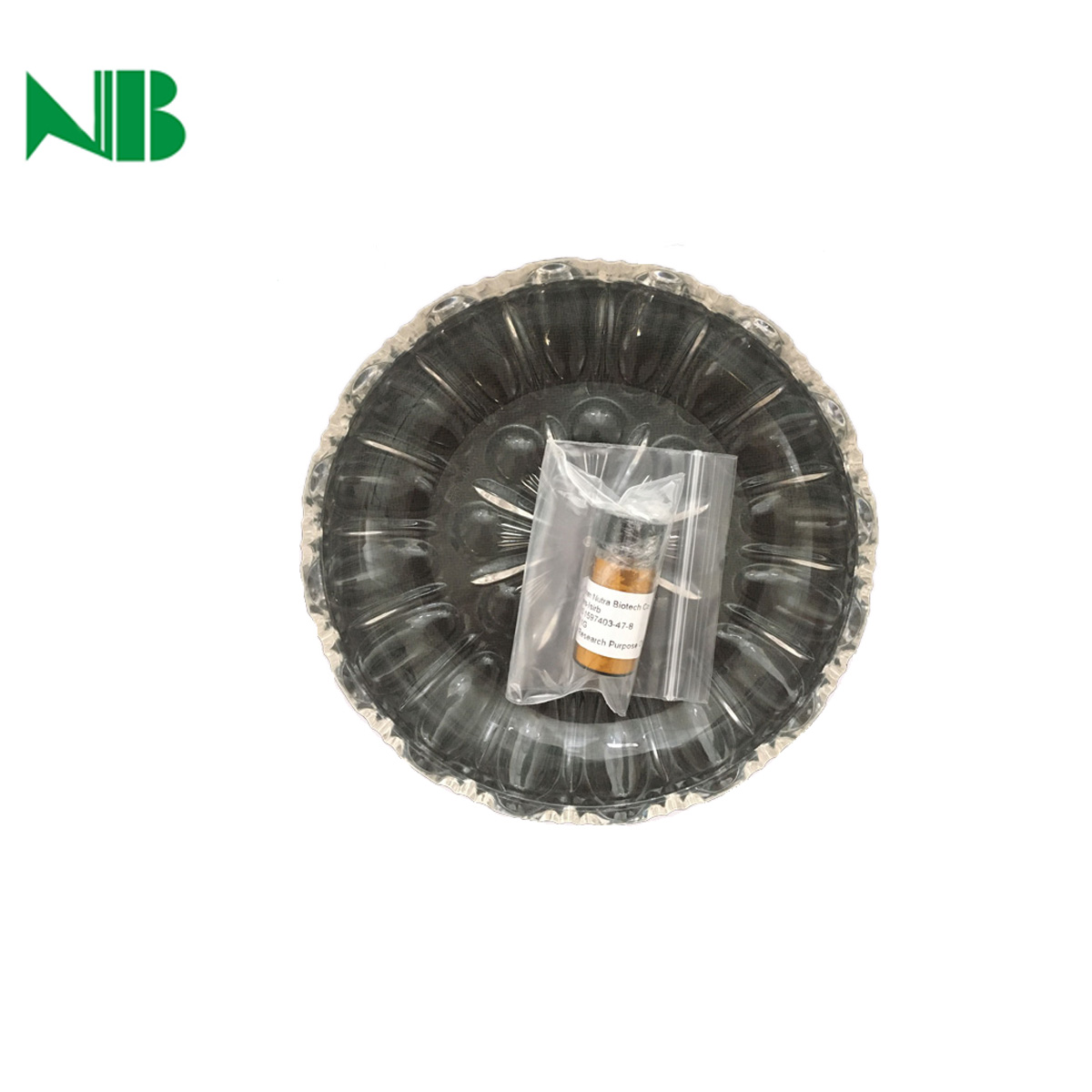
Trans-ISRIB (ISRIB, trans isomer) CAS 1597403-47-8
Integrated Stress Response (ISR) Inhibitor / eIF2B Potentiator — Protein-Synthesis & Neurocognition Research
Trans-ISRIB (ISRIB, trans isomer; CAS 1597403-47-8) is a potent inhibitor of the integrated stress response that potently activates eIF2B (the GEF for eIF2), restoring protein synthesis blocked by phosphorylated eIF2α. Molecular formula C18H18N2O2, MW 294.35. Research-grade with COA.
Molecular Information
CAS: 1597403-47-8
Formula: C18H18N2O2
MW: 294.35 g/mol
Class: Bicyclic imidazolinone
Core: trans-(1,2,3,4-tetrahydro-1,4-dioxonaphthalene)-derived ISR scaffold
Target: eIF2B (eIF2 GEF)
Appearance: White to off-white solid
Synonyms: ISRIB (trans isomer)
Storage: -20 °C
Product Technical Specifications
Complete physicochemical properties and QC parameters for Trans-ISRIB (ISRIB, trans isomer) (CAS 1597403-47-8)
📋 Physicochemical Properties
- Product NameTrans-ISRIB (ISRIB, trans isomer)
- IUPAC Core(trans)-1,2,3,4-tetrahydro-1,4-dioxo-2,3-bis(4-methoxybenzyl)naphthalene-derived imidazolinone
- CAS Number1597403-47-8
- SynonymsISRIB (trans); trans-ISRIB
- Molecular FormulaC18H18N2O2
- Molecular Weight294.35 g/mol
- SourceSynthetic small molecule
- AppearanceWhite to off-white solid
- Melting Point~230-232 °C (decomposition)
- Water SolubilityVery low (<0.1 mg/mL)
- Organic SolubilityDMSO ~10-30 mg/mL; ethanol (limited)
- Compound ClassIntegrated stress response inhibitor (bicyclic imidazolinone)
- HS Code2933.99
🔬 Quality Control & Handling
- Purity (HPLC)≥98%
- FormSolid powder
- Primary TargeteIF2B (GEF for eIF2)
- Pathway ReadoutRestores protein synthesis; ↓ ATF4/CHOP under ISR
- SelectivityPotentiates eIF2B; counteracts eIF2α-P (not a kinase inhibitor)
- Storage Condition-20 °C, sealed, protect from light
- Solution StabilityAliquot DMSO stocks; avoid freeze-thaw
- ShippingBlue ice / cold chain recommended
- QC DocumentationCOA / HPLC / NMR / MS / MSDS
- Pack Sizes1g / 5g / 10g / 100g / 1KG
- Stock StatusIn Stock
- Use StatementResearch use only; not for human/clinical use
Key Molecular Targets & Pathway Nodes
Trans-ISRIB targets eIF2B — the guanine-nucleotide-exchange factor for the translation-initiation factor eIF2. By potentiating eIF2B it bypasses the translational blockade imposed by phosphorylated eIF2α, the final common downstream node of the integrated stress response (ISR).
How Trans-ISRIB Works: Unblocking Translation by Activating eIF2B
Trans-ISRIB potently activates eIF2B, overriding eIF2α phosphorylation so protein synthesis and ISR gene programs are restored
ISR Blocks Translation via eIF2α-P
Under stress, kinases (PERK, GCN2, HRI, PKR) phosphorylate eIF2α. Phosphorylated eIF2α inhibits eIF2B — the GEF that recycles eIF2-GDP to active eIF2-GTP — so global translation initiation collapses and the ISR gene program (ATF4/CHOP) is switched on.
eIF2B Potentiation by Trans-ISRIB
Trans-ISRIB binds and allosterically potentiates eIF2B, restoring its exchange activity even in the presence of eIF2α-P. This overcomes the translational repression without touching the upstream kinases.
Restored Protein Synthesis & ISR Output
With eIF2B active, global translation resumes and the ATF4/CHOP stress transcriptional program is dampened. This underlies ISRIB's effects on protein folding, neuronal survival, memory and recovery from stress.
⚖️ Trans-ISRIB vs Other ISR / Translation Tools
- Trans-ISRIB (this product)Potentiates eIF2B; reverses eIF2α-P repression (downstream)
- Salubrinal / GuilintideInhibit eIF2α dephosphorylation (upstream, opposite)
- PERK / GCN2 inhibitorsBlock upstream ISR kinases
- Shared PathwayIntegrated stress response / translation initiation
- Key DistinctionActs at eIF2B, not at kinases or eIF2α-P
- OutputRestored protein synthesis; ↓ ATF4/CHOP
♻️ Downstream Biological Consequences
- FactoreIF2B potentiated (GEF activity ↑)
- InitiationeIF2-GTP recycling restored
- TranslationGlobal protein synthesis resumes
- TranscriptionATF4 / CHOP ISR program ↓
- CellImproved folding & stress survival
- NeuronPlasticity / memory rescue
Research Applications & Models
A precise tool for dissecting the integrated stress response and restoring translation in disease models.
Neurodegeneration & Memory
The flagship use: Trans-ISRIB reverses ISR-driven repression to rescue protein synthesis and memory in neurodegeneration and brain-injury models.
ISR / eIF2BProtein-Folding & Proteostasis
Used to study ER stress, proteostasis and recovery of translation after stress.
ProteostasisTranslation-Initiation Research
A fiducial eIF2B potentiator for initiation, ribosome-profiling and ISR assays.
TranslationCognitive & Synaptic Plasticity
Investigated for long-term potentiation and learning deficits linked to chronic ISR.
PlasticityISR / Stress-Response Panel
Benchmarked against Salubrinal/kinase inhibitors to separate upstream from downstream ISR modulation.
ISR panelTraumatic Brain / Ischemia Models
Studied for restoring protein synthesis after injury or hypoxia.
Injury / IschemiaKey Literature & Landmark Publications
The discovery and biology of ISRIB (trans-ISRIB) as an eIF2B-targeted ISR inhibitor.
Available Sizes & Ordering
Research-grade Trans-ISRIB (CAS 1597403-47-8) with full QC documentation; standard packs and bulk custom quantities supported.
| Tier | Pack Size | Stock Status | Suitable For | Lead Time |
|---|---|---|---|---|
| Standard | 1g | In Stock | ISR & translation assays | Cold chain |
| Medium | 5g | In Stock | Neurodegeneration & memory models | Cold chain |
| Large | 10g | In Stock | Long-term in vivo & formulation studies | Cold chain |
| Bulk | 100g | In Stock | Formulation & process development | Quote to confirm |
| Industrial | 1KG | Made to order | Pilot/production scale, CMO supply | Batch delivery |
💡 Reference sizes shown above; for exact pricing and availability please contact us for a quote. Bulk orders qualify for tiered discounts.
Frequently Asked Questions (FAQ)
What is Trans-ISRIB and what does it do?
How is Trans-ISRIB different from Salubrinal or PERK inhibitors?
What is the mechanism in neurodegeneration / cognition research?
What are the key experimental readouts?
How soluble is Trans-ISRIB and how prepared?
Is QC documentation provided?
Need Trans-ISRIB (ISR Inhibitor) for Your Research?
Research-grade Trans-ISRIB (CAS 1597403-47-8) — purity ≥98% HPLC, COA included
The eIF2B potentiator that reverses ISR translational repression — request a quote today