
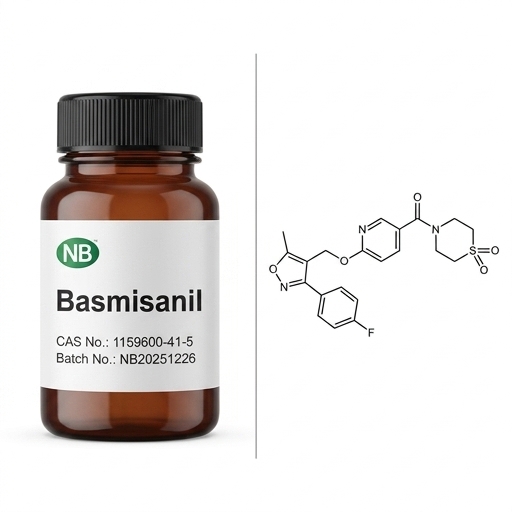
Basmisanil 99% Powder CAS 1159600-41-5
Selective GABAA α5 Negative Allosteric Modulator
Basmisanil (RG1662 / RO5186582) is the most subtype-selective α5-GABAA negative allosteric modulator described to date — approximately 5 nM binding affinity at the human α5 subunit with more than 90-fold selectivity over α1, α2 and α3 containing receptors. By selectively lifting extrasynaptic tonic inhibition in the hippocampus it enhances learning and memory without the sedation, anxiolysis or myorelaxation of broad-spectrum benzodiazepine-site drugs. Advanced by Roche into Phase II for Down syndrome and cognitive impairment associated with schizophrenia.
Molecular Information
CAS: 1159600-41-5
Formula: C21H20FN3O5S
MW: 445.47 g/mol
Purity: ≥99% (HPLC)
SMILES: CC1=C(C(=NO1)
C2=CC=C(C=C2)F)COC3=
NC=C(C=C3)C(=O)N4CC
S(=O)(=O)CC4
InChIKey: VCGRFBXVSFAGGA
-UHFFFAOYSA-N
Appearance: White to off-white powder
Solubility: DMSO (≥32 mg/mL)
Codes: RG1662 / RO5186582
Storage: -20°C, sealed, desiccated
Basmisanil Technical Specifications & QC Parameters
Complete physicochemical data and quality-control profile for research-grade Basmisanil 99% powder (CAS 1159600-41-5)
📋 Physicochemical Properties
- Product NameBasmisanil
- IUPAC Name(1,1-Dioxo-1,4-thiazinan-4-yl)-[6-[[3-(4-fluorophenyl)-5-methyl-1,2-oxazol-4-yl]methoxy]pyridin-3-yl]methanone
- CAS Number1159600-41-5
- Development CodesRG1662 / RO5186582
- Molecular FormulaC21H20FN3O5S
- Molecular Weight445.47 g/mol
- SMILESCC1=C(C(=NO1)C2=CC=C(C=C2)F)COC3=NC=C(C=C3)C(=O)N4CCS(=O)(=O)CC4
- InChIKeyVCGRFBXVSFAGGA-UHFFFAOYSA-N
- AppearanceWhite to off-white powder
- Chemical ClassIsoxazolyl-methoxy-pyridine sulfone amide
- PubChem CID57336276
- UNII788PET5SUA
- KEGG DrugD10863
- ChEMBL IDCHEMBL3681419
🔬 Quality Control & Handling
- Purity (HPLC)≥99%
- FormCrystalline powder
- Receptor Affinity≈5 nM at recombinant human GABAA α5
- Subtype Selectivity>90-fold over α1, α2 and α3 subtypes
- Functional ProfileNegative allosteric modulator / inverse agonist
- SolubilityDMSO ≥32 mg/mL (~72 mM); insoluble in water
- Storage Condition-20°C, sealed, desiccated, dark
- Stock Solution Storage-20°C to -80°C, aliquoted, avoid freeze-thaw
- QC DocumentationCOA / HPLC / NMR / MS / MSDS
- Pack Sizes1g / 5g / 10g / 100g / 1KG
- Stock StatusIn Stock
- Use StatementResearch use only; not for human or clinical use
Receptor Target Profile & Subtype Selectivity
Basmisanil engages the benzodiazepine-site pocket only when the α5 subunit is present, leaving the α1, α2 and α3 subtypes that drive sedation, anxiolysis and muscle relaxation essentially untouched
Basmisanil Mechanism of Action: Selective α5 Disinhibition
How a subtype-selective negative allosteric modulator converts reduced hippocampal tonic inhibition into measurable cognitive gain — without sedation
α5-Restricted Binding
Basmisanil occupies the benzodiazepine allosteric site at the α/γ2 interface, but its binding energy depends on α5-specific residues. Affinity is ≈5 nM at α5β3γ2 pentamers and more than 90-fold weaker at α1, α2 and α3 assemblies.
Negative Allosteric Modulation
Unlike a channel blocker, it does not occlude the pore. Instead it shifts the GABA concentration-response curve to the right, reducing the chloride current evoked by a given GABA concentration only at α5-containing receptors.
Reduced Hippocampal Tonic Inhibition
α5-GABAA receptors sit extrasynaptically on CA1 and CA3 pyramidal neurons, where they generate a persistent tonic conductance driven by ambient GABA. Damping this leak current depolarises the effective resting state of the network.
Lowered LTP Threshold
With less tonic shunting, NMDA-receptor-dependent long-term potentiation is induced by weaker stimulation. Signal-to-noise across hippocampal circuits improves, which is the electrophysiological correlate of enhanced encoding.
Cognition Without Sedation
Because α1-mediated sedation, α2/α3-mediated anxiolysis and myorelaxation are untouched, and because inhibition is only partially reduced rather than abolished, the proconvulsant and anxiogenic liabilities of non-selective inverse agonists are avoided.
Translational Target Engagement
Receptor occupancy can be tracked non-invasively with the α5-preferring PET ligand [11C]Ro15-4513, and pharmaco-EEG signatures confirm central engagement — enabling a clean plasma-exposure to occupancy relationship from rodent to human.
Research Applications of the α5-GABAA NAM Basmisanil
A best-in-class chemical probe for dissecting GABAA receptor subtype pharmacology and the neurobiology of cognition
Cognitive Impairment in Down Syndrome
Trisomy 21 models such as Ts65Dn show excessive GABAergic inhibition that suppresses hippocampal plasticity. α5-selective negative allosteric modulators restore LTP and rescue spatial learning in these mice, and Basmisanil was the clinical embodiment of that hypothesis in the Phase II CLEMATIS programme.
Down SyndromeCognitive Impairment Associated with Schizophrenia
Post-mortem and imaging studies implicate altered hippocampal GABAergic tone in the working-memory and episodic-memory deficits of schizophrenia. Basmisanil was tested in patients on stable antipsychotics as a pro-cognitive add-on, and remains a reference tool for CIAS mechanism studies.
CIAS ResearchLearning, Memory & Cognition Enhancement
Used to probe hippocampus-dependent tasks — Morris water maze, novel object recognition, delayed matching-to-sample and trace conditioning — and to reverse pharmacologically induced amnesia such as diazepam-induced spatial learning impairment.
Nootropic PharmacologyGABAA Receptor Subtype Pharmacology
An essential selectivity benchmark in recombinant α1/α2/α3/α5 β3γ2 electrophysiology panels and radioligand binding assays. Its exceptionally wide selectivity window makes it the cleanest available pharmacological substitute for α5 genetic deletion.
Receptor PharmacologyBenzodiazepine-Site Mechanism Studies
Because it binds the same allosteric pocket as diazepam but with opposite efficacy and strict subtype restriction, Basmisanil is used to deconstruct which behavioural components of benzodiazepine pharmacology arise from which receptor subtype.
Allosteric ModulationHippocampal Tonic Inhibition & LTP
A standard reagent in slice electrophysiology for isolating the α5-dependent component of tonic GABA current, quantifying its contribution to the LTP induction threshold, and testing excitation-inhibition balance hypotheses.
ElectrophysiologyPET Imaging & Target Occupancy
Paired with [11C]Ro15-4513 or related α5-preferring radiotracers to build plasma-concentration versus receptor-occupancy curves, validate CNS penetration and set translational dose ranges for α5-directed compounds.
Translational ImagingPost-Anaesthetic & Post-Ischaemic Memory Deficit
Excess α5-mediated tonic inhibition has been implicated in memory impairment after general anaesthesia, inflammation and stroke. α5-NAMs are used to test whether normalising tonic inhibition restores memory performance in these models.
Recovery NeuroscienceAgeing, Alzheimer's & Neurodevelopmental Disorders
Applied in models of age-related cognitive decline, amyloid-associated hippocampal hyperinhibition, autism spectrum and intellectual disability, where excitation-inhibition imbalance is a leading mechanistic hypothesis.
CNS Disease ModelsKey Publications on Basmisanil & α5-GABAA Negative Allosteric Modulation
Preclinical characterisation, translational target engagement and the α5 cognition hypothesis
Basmisanil 99% Powder — Pack Sizes & Ordering
Research-grade Basmisanil (CAS 1159600-41-5) supplied with full QC documentation — available in 1g / 5g / 10g / 100g / 1KG
| Tier | Pack Size | Stock Status | Typical Use Case | Shipping Notes |
|---|---|---|---|---|
| Standard | 1 g | In Stock | Radioligand binding, recombinant receptor electrophysiology, selectivity panels | Same/next-day dispatch; amber vial with desiccant |
| Medium | 5 g | In Stock | Rodent behavioural cohorts, dose-ranging cognition studies | Same/next-day dispatch; ambient shipping, sealed foil pouch |
| Large | 10 g | In Stock | Chronic dosing studies, PET occupancy work, multi-site collaborations | 1-2 business days; double-sealed, light-protected |
| Bulk | 100 g | In Stock | Formulation and PK/PD development, large preclinical programmes | Quote to confirm; HDPE container, cool-chain option available |
| Industrial | 1 KG | Made to order | Pilot-scale synthesis, CRO/CMO supply contracts, repeat-supply agreements | Batch delivery on campaign schedule; per-lot COA and export documents |
💡 Reference pack sizes shown above; for current pricing, lot availability and bulk Basmisanil 99% quotations please contact us for a quote. Tiered discounts apply to 100 g and 1 KG orders.
Basmisanil Frequently Asked Questions (FAQ)
What is Basmisanil (CAS 1159600-41-5)?
How is an α5-NAM different from a benzodiazepine?
Why does reducing α5 GABAA tone improve cognition instead of causing seizures?
What was the clinical development status of Basmisanil?
Which α5-GABAA assays is Basmisanil suitable for?
How should Basmisanil be dissolved and stored?
Does Basmisanil cross the blood-brain barrier?
How does Basmisanil compare with α5IA, L-655,708, MRK-016 and RO4938581?
What concentrations and controls are recommended?
What QC documentation is supplied with 99% Basmisanil, and are bulk quantities available?
Need Basmisanil 99% Powder for Your Cognition Research?
Research-grade Basmisanil (CAS 1159600-41-5, RG1662 / RO5186582) — purity ≥99% HPLC, COA included, 1g to 1KG
The most selective GABAA α5 negative allosteric modulator available — request your quote today


