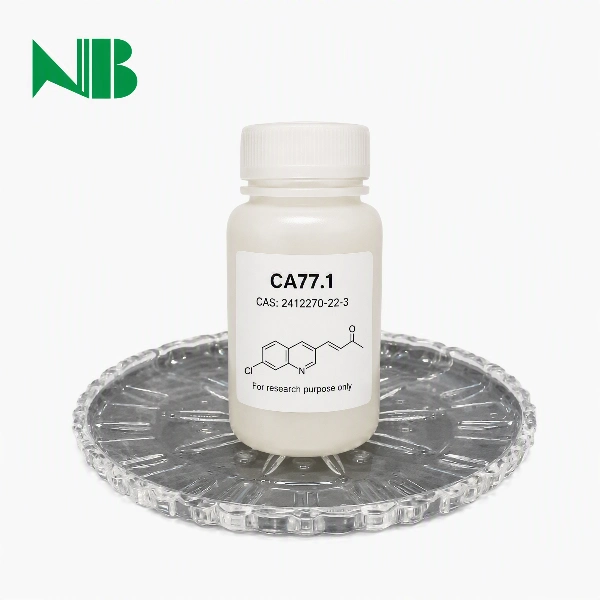
CA77.1 CAS 2412270-22-3
Chaperone-Mediated Autophagy Activator
An orally available, brain-penetrant small molecule that selectively activates chaperone-mediated autophagy (CMA) without affecting macroautophagy. First-in-class CMA activator demonstrating in vivo activity and improved pathology in Alzheimer's disease mouse models. A breakthrough tool compound for neurodegeneration, proteostasis, and aging research.
Molecular Information
CAS: 2412270-22-3
Formula: C16H12ClN3O
MW: 297.74 g/mol
SMILES: Clc1cc2ncc(nc2cc1)
c3ccc(cc3)NC(=O)C
InChIKey: ZQXMPDVGBWOTBY
-UHFFFAOYSA-N
LogP: 2.7
tPSA: 54.9
Appearance: White to off-white powder
Synonyms: CA / N-[4-(6-Chloro-2-
quinoxalinyl)phenyl]acetamide
Storage: -20°C (powder), 2-8°C short term
Product Technical Specifications
Complete physicochemical properties and QC parameters for CA77.1 (CAS 2412270-22-3)
📋 Physicochemical Properties
- Product NameCA77.1
- IUPAC NameN-(4-(6-Chloroquinoxalin-2-yl)phenyl)acetamide
- CAS Number2412270-22-3
- SynonymsCA; N-[4-(6-Chloro-2-quinoxalinyl)phenyl]acetamide
- Molecular FormulaC16H12ClN3O
- Molecular Weight297.74 g/mol
- SMILESClc1cc2ncc(nc2cc1)c3ccc(cc3)NC(=O)C
- InChIKeyZQXMPDVGBWOTBY-UHFFFAOYSA-N
- LogP2.7
- tPSA54.9
- HBD / HBA1 / 3
- Rotatable Bonds2
- HS Code2934.99.9001
🔬 Quality Control & Handling
- Purity (HPLC)≥98%
- AppearanceWhite to off-white powder
- SolubilityDMSO (~5 mg/mL); Ethanol (~1 mg/mL)
- Storage Condition-20°C (powder); 2-8°C short term
- Storage ClassCold storage required
- HandlingHandle in fume hood; use appropriate PPE
- QC DocumentationCOA / HPLC / NMR / MS / MSDS
- Pack Sizes1g / 5g / 10g / 100g / 1KG
- Stock StatusIn Stock
- Use StatementResearch use only; not for human/clinical use
Key Molecular Targets & Pathway Profile
CA77.1 acts selectively on the chaperone-mediated autophagy (CMA) machinery, distinguishing it from macroautophagy modulators
How CA77.1 Works: Selective CMA Activation
CA77.1 activates the chaperone-mediated autophagy pathway without triggering macroautophagy, enabling precise study of selective protein degradation
CMA Pathway Upregulation
CA77.1 enhances the activity of the CMA machinery, increasing the rate at which cytosolic proteins bearing KFERQ-like motifs are recognized and targeted for lysosomal degradation via the LAMP2A receptor complex.
Selective Substrate Clearance
Hsc70 chaperone recognizes KFERQ-motif substrates and delivers them to the lysosomal membrane, where they are translocated through LAMP2A multimers for degradation. CA77.1 boosts this selective clearance of pathogenic and damaged proteins.
No Macroautophagy Activation
Unlike rapamycin or other autophagy inducers, CA77.1 does not affect macroautophagy (autophagosome-mediated bulk degradation). This selectivity allows researchers to isolate CMA-specific contributions to proteostasis and disease pathology.
Research Applications & Disease Models
CA77.1's selective CMA activation makes it a versatile tool across neurodegeneration, aging, and drug discovery research
Alzheimer's Disease
Improves pathology in Alzheimer's disease mouse models. CMA activation enhances clearance of pathogenic proteins via the LAMP2A/Hsc70 pathway, reducing toxic protein accumulation and neuronal damage associated with neurodegeneration.
AD Mouse ModelsNeurodegeneration (PD / HD)
Parkinson's and Huntington's disease research benefits from CMA-mediated clearance of misfolded protein aggregates (α-synuclein, mutant huntingtin). CA77.1 enables selective upregulation of this degradation pathway in neuronal models.
Protein AggregatesAutophagy Research
A first-in-class tool for selectively activating CMA without macroautophagy interference. Enables dissection of CMA-specific vs. macroautophagy contributions to cellular proteostasis, a longstanding challenge in autophagy biology.
CMA-SelectiveAging & Longevity
CMA activity declines with age, contributing to proteostasis failure. CA77.1 enables investigation of whether restoring CMA function can counteract age-related protein aggregation and extend healthspan in aging models.
ProteostasisCancer Biology
CMA plays a dual role in cancer — tumor-suppressive in some contexts and tumor-promoting in others. CA77.1 allows researchers to probe CMA's context-dependent functions in tumor cell metabolism, survival, and resistance mechanisms.
OncologyDrug Discovery Pipeline
As a first-in-class, orally available, brain-penetrant CMA activator, CA77.1 serves as a lead compound and chemical probe for neurodegenerative disease drug discovery programs targeting the autophagy-lysosome pathway.
First-in-ClassKey Literature & Landmark Publications
Seminal papers on CA77.1, chaperone-mediated autophagy activation, and neurodegenerative disease applications
Available Sizes & Ordering
Research-grade CA77.1 (CAS 2412270-22-3) with full QC documentation; research packs and bulk custom quantities supported
| Tier | Pack Size | Stock Status | Suitable For | Lead Time |
|---|---|---|---|---|
| Standard | 1 g | In Stock | Biochemical / cell-based assays | Same/next-day ship |
| Medium | 5 g | In Stock | In vivo pharmacology, long-term studies | Same/next-day ship |
| Large | 10 g | In Stock | Multi-lab collaborations, HTS | Same/next-day ship |
| Bulk | 100 g | In Stock | Process development, scale-up | Quote to confirm |
| Industrial | 1 KG | Made to order | Pilot/production scale, CMO supply | Batch delivery |
For exact pricing and availability please contact us for a quote. Bulk orders qualify for tiered discounts.
Frequently Asked Questions (FAQ)
What is CA77.1 (CAS 2412270-22-3), and what makes it unique?
How does CA77.1 differ from macroautophagy activators like rapamycin?
Does CA77.1 cross the blood-brain barrier?
How does CA77.1 improve Alzheimer's disease pathology?
What in vivo dosing is recommended for CA77.1?
How should CA77.1 be dissolved for biological assays?
What is the LAMP2A pathway and why is it important?
Is QC documentation provided? Can I request a sample?
Need CA77.1 for Your Research?
Research-grade CA77.1 (CAS 2412270-22-3) — purity ≥98%, COA included
A first-in-class, brain-penetrant CMA activator — request a quote today