GS967 CAS 1262618-39-2
Selective Late Sodium Current (Persistent I_Na) Inhibitor
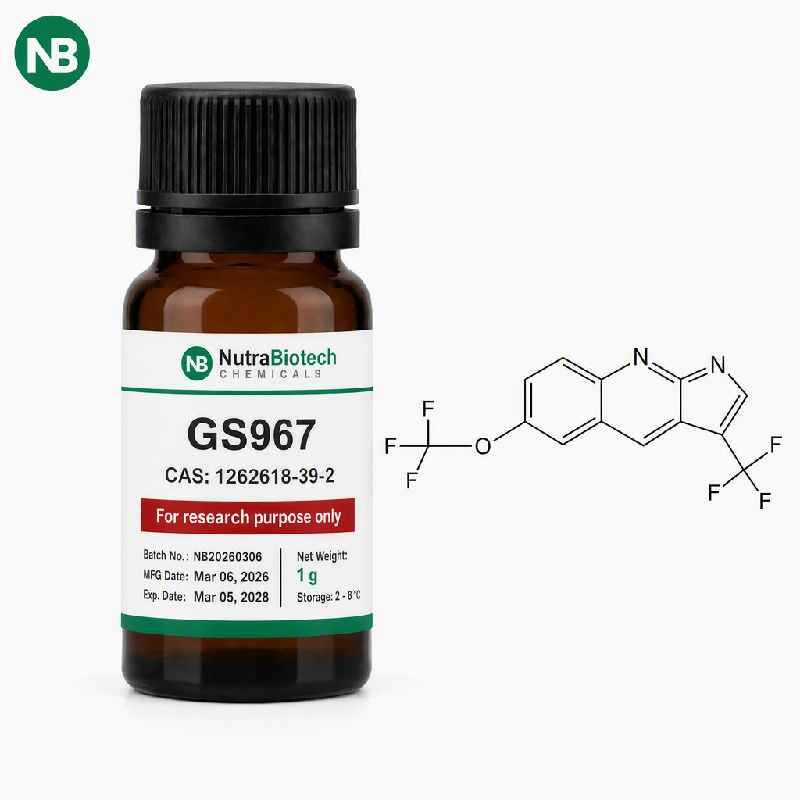
GS967 (CAS 1262618-39-2), also GS-458967, is a potent and selective inhibitor of the late (persistent) sodium current (late I_Na) with IC50 values of 0.13 and 0.21 uM in ventricular myocytes and isolated hearts. It shows ~42-fold preference for persistent over peak current and exerts anti-arrhythmic and anti-epileptic effects without broadly blocking other cardiac ion channels. Molecular formula C14H7F6N3O, MW 347.22. Research-grade with COA.
Molecular Information
CAS: 1262618-39-2
Formula: C14H7F6N3O
MW: 347.22 g/mol
Class: Triazolopyridine
Core: 6-[4-(trifluoromethoxy)phenyl]-3-(trifluoromethyl)-[1,2,4]triazolo[4,3-a]pyridine
Target: Late/persistent I_Na (Nav1.5)
IC50: 0.13 uM (myocytes)
Selectivity: ~42x persistent vs peak
Appearance: White solid powder
Synonyms: GS-458967
Storage: -20 C
Product Technical Specifications
Complete physicochemical properties and QC parameters for GS967 (CAS 1262618-39-2)
📋 Physicochemical Properties
- Product NameGS967 (GS-458967)
- IUPAC Core6-[4-(trifluoromethoxy)phenyl]-3-(trifluoromethyl)-[1,2,4]triazolo[4,3-a]pyridine
- CAS Number1262618-39-2
- SynonymsGS-458967; GS 458967; GS-967
- Molecular FormulaC14H7F6N3O
- Molecular Weight347.22 g/mol
- SourceSynthetic small molecule
- AppearanceWhite solid powder
- Melting PointNot reported
- Water SolubilityInsoluble
- Organic SolubilityDMSO ~45 mg/mL; ethanol ~46 mg/mL
- Compound ClassTriazolopyridine / late-Na blocker
- HS Code2934.99
🔬 Quality Control & Handling
- Purity (HPLC)≥98%
- FormSolid powder
- Primary TargetLate / persistent sodium current (I_Na,L)
- Pathway ReadoutReduced late I_Na; shortened action-potential duration
- Selectivity~42x persistent vs peak I_Na; spares Ca2+/K+ channels
- Storage Condition-20 C, sealed, protect from light
- Solution StabilityAliquot DMSO stocks; avoid freeze-thaw
- ShippingRoom-temp stable (per testing) / blue ice optional
- QC DocumentationCOA / HPLC / NMR / MS / MSDS
- Pack Sizes1g / 5g / 10g / 100g / 1KG
- Stock StatusIn Stock
- Use StatementResearch use only; not for human/clinical use
Key Molecular Targets & Pathway Nodes
GS967's therapeutic interest centers on the late (persistent) component of the cardiac and neuronal sodium current, which becomes pathological in disease.
How GS967 Works: Silencing the Pathological Late Sodium Leak
By preferentially blocking persistent sodium current, GS967 curbs the late inward Na+ load that destabilizes hearts and neurons
Persistent vs Peak Sodium Current
Voltage-gated sodium channels (notably Nav1.5 in heart) open transiently (peak current) but a small fraction fail to fully inactivate, producing a tiny 'late' (persistent) inward Na+ current (I_Na,L). In disease (ischemia, hypoxia, mutations) this late current is amplified, prolonging the action potential and promoting arrhythmias and excitability disorders.
Selective Late-Current Blockade
GS967 binds to inhibit the late/persistent I_Na with IC50 ~0.13 uM in myocytes and ~0.21 uM in isolated hearts, showing ~42-fold preference for persistent over peak current. This spares normal rapid depolarization while removing the pathological leak.
Electrical Stabilization & Anti-Seizure Effect
Reducing late I_Na lowers intracellular Na+ (and secondary Ca2+ via NCX), shortens pathologically prolonged action potentials, and reduces early- (EAD) and delayed- (DAD) afterdepolarizations that seed arrhythmias. In neurons the same mechanism raises seizure threshold, underpinning anti-epileptic activity — without broad sedation.
⚖️ GS967 vs Ranolazine vs Flecainide
- GS967 (this)Selective persistent I_Na; ~42x vs peak; anti-arrhythmic & anti-epileptic
- RanolazineLate I_Na inhibitor; anti-anginal (same mechanism)
- FlecainideBroad use-dependent Na+ blocker; pro-arrhythmic risk
- Selectivity EdgeGS967 spares peak & most other channels
- Research UseLate-current pathology models
- DistinctionPreferential persistent-current targeting
♻️ Downstream Biological Consequences
- Na+ LoadReduced late inward Na+
- Ca2+ HandlingLower Na+/Ca2+ exchanger load
- APDShortened pathologically prolonged AP
- ArrhythmiaFewer EAD/DAD triggers
- NeuronElevated seizure threshold
- SafetyMinimal effect on peak/L-type/Ca-K channels
Research Applications & Models
Late sodium current is a validated but under-exploited drug target in cardiology and neurology.
Anti-Arrhythmic Research
Studied for suppressing EAD- and DAD-mediated extrasystoles in atrial and ventricular preparations, including ischemia and catecholamine models — a clean late-I_Na mechanism.
EAD / DADAnti-Epileptic Models
Demonstrates anticonvulsant activity and protection against premature lethality in Scn2a epilepsy models, raising seizure threshold without sedation.
Seizure ThresholdCardiac Ischemia / Reperfusion
Reduces ischemia-induced repolarization alternans and ECG heterogeneity in porcine/canine models, protecting against arrhythmogenesis.
IschemiaIon-Channel Selectivity
A precision tool to isolate persistent-Na vs peak-Na pharmacology; benchmarked against ranolazine and flecainide in cardiac myocyte assays.
Ion ChannelsSCN Mutant Models
Used in Nav1.5/SCN5A and SCN2A mutant contexts to probe gain-of-function sodium-channel pathologies.
SCN MutantsAction-Potential Research
Quantifies APD shortening and late-current contribution in guinea-pig and rabbit myocytes — establishing basal late I_Na as an APD determinant.
APDLong-QT / Repolarization
Explored where late Na+ blockade corrects acquired long-QT and drug-induced repolarization prolongation.
Long-QTAnti-Anginal Context
Shares the late-I_Na mechanism of ranolazine, supporting studies of myocardial oxygen-demand reduction in ischemic heart disease.
Anti-AnginalKey Literature & Landmark Publications
Key references on late sodium current and GS967 pharmacology.
Available Sizes & Ordering
Research-grade GS967 (CAS 1262618-39-2) with full QC documentation; standard packs and bulk custom quantities supported.
| Tier | Pack Size | Stock Status | Suitable For | Lead Time |
|---|---|---|---|---|
| Standard | 1g | In Stock | Late-I_Na / cardiac ion-channel assays | Same/next-day ship |
| Medium | 5g | In Stock | Ischemia & arrhythmia models | Same/next-day ship |
| Large | 10g | In Stock | Epilepsy & neuronal excitability studies | Same/next-day ship |
| Bulk | 100g | In Stock | Electrophysiology & formulation | Quote to confirm |
| Industrial | 1KG | Made to order | Pilot/production scale, CMO supply | Batch delivery |
💡 Reference sizes shown above; for exact pricing and availability please contact us for a quote. Bulk orders qualify for tiered discounts.
Frequently Asked Questions (FAQ)
What is GS967?
What is 'late' sodium current and why target it?
How does GS967 differ from ranolazine or flecainide?
What readouts confirm activity?
In which models is it studied?
How soluble is GS967 and how should it be prepared?
Is QC documentation provided?
Need GS967 (Late Sodium Current Inhibitor) for Your Research?
Research-grade GS967 (CAS 1262618-39-2) — purity ≥98% HPLC, COA included
GS-458967 — selective persistent I_Na blocker for anti-arrhythmic and anti-epileptic research — request a quote today