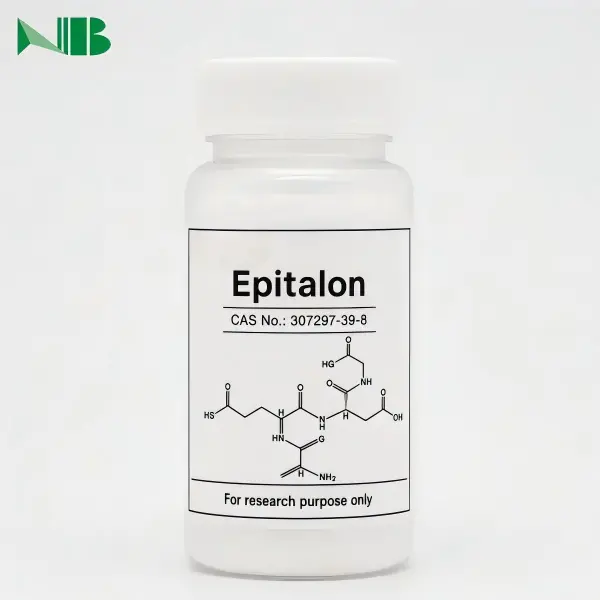
Epitalon CAS 307297-39-8
Telomerase Activator & Geroprotective Peptide
Ala-Glu-Asp-Gly (AEDG) tetrapeptide that upregulates telomerase activity, elongates telomeres, and regulates melatonin/cortisol circadian rhythms. Demonstrated 12.3% lifespan increase in mice, 6-fold leukemia reduction, and geroprotective effects across aging, neuroprotection, and retinal health models. A landmark peptide in longevity and telomere biology research.
Molecular Information
CAS: 307297-39-8
Formula: C14H22N4O9
MW: 390.35 g/mol
Sequence: Ala-Glu-Asp-Gly (AEDG)
Length: Tetrapeptide (4 aa)
Source: Synthetic (SPPS)
Appearance: White to off-white
lyophilized powder
Synonyms: Epithalon / Epithalone /
AEDG tetrapeptide
Storage: -20°C, protect from
light and moisture
Product Technical Specifications
Complete physicochemical properties and QC parameters for Epitalon (CAS 307297-39-8)
📋 Physicochemical Properties
- Product NameEpitalon
- SequenceAla-Glu-Asp-Gly (AEDG)
- CAS Number307297-39-8
- SynonymsEpithalon; Epithalone; AEDG tetrapeptide
- Molecular FormulaC14H22N4O9
- Molecular Weight390.35 g/mol
- Peptide Length4 amino acids (tetrapeptide)
- SourceSynthetic (SPPS)
- Synthesis MethodSolid-phase peptide synthesis (SPPS)
- OriginPineal gland peptide (Khavinson)
- PubChem CIDPending assignment
🔬 Quality Control & Handling
- Purity (HPLC)≥98%
- AppearanceWhite to off-white lyophilized powder
- SolubilityDMSO (250 mg/mL); Water
- Storage Condition-20°C, protect from light & moisture
- FormLyophilized powder
- ReconstitutionReconstitute in sterile water or DMSO
- HandlingUse aseptic technique; avoid freeze-thaw cycles
- QC DocumentationCOA / HPLC / MS / MSDS
- Pack Sizes1g / 5g / 10g / 100g / 1KG
- Stock StatusIn Stock
- Use StatementResearch use only; not for human/clinical use
Key Molecular Targets & Biological Pathways
Epitalon modulates telomerase, pineal gland function, and circadian hormone regulation — the core axes of aging biology
How Epitalon Works: Telomerase, Circadian & Geroprotective Action
Epitalon exerts its anti-aging effects through three interconnected mechanisms targeting the fundamental biology of cellular aging
Telomerase Activation
Epitalon upregulates telomerase reverse transcriptase (TERT) expression and activity in somatic cells. This reactivates the enzyme that elongates telomeres — the protective chromosome caps that shorten with each cell division — counteracting replicative senescence and extending cellular proliferative lifespan.
Circadian Rhythm Regulation
As a pineal gland-derived peptide, Epitalon modulates melatonin and cortisol secretion patterns, restoring age-disrupted circadian rhythms. In elderly primates, it normalized melatonin and cortisol profiles, improving sleep-wake cycles and neuroendocrine balance critical for healthy aging.
Geroprotective & Antioxidant Action
Epitalon reduces reactive oxygen species (ROS), supports mitochondrial function, and decreases chromosome aberrations. These combined effects — telomere maintenance, hormonal balance, and oxidative stress reduction — produce measurable lifespan extension (12.3% in mice) and tumor suppression.
Research Applications & Disease Models
Epitalon's multi-pathway geroprotective action spans longevity, telomere biology, neuroscience, oncology, and reproductive health
Anti-Aging & Longevity
Demonstrated 12.3% lifespan increase in mice with reduced chromosome aberrations. Epitalon counteracts replicative senescence through telomerase activation, making it a cornerstone tool for geroscience and lifespan-extension research.
+12.3% LifespanTelomere Biology
Activates telomerase in somatic cells and induces measurable telomere elongation (Khavinson et al., 2003). A key chemical tool for studying telomere dynamics, cellular senescence, and the relationship between telomere length and aging phenotypes.
Telomere ElongationCancer Prevention
Produced a 6-fold reduction in leukemia incidence and suppressed spontaneous tumor development in mice. Epitalon's tumor-suppressive effects make it relevant for chemoprevention research and studying the telomerase-cancer nexus.
Tumor SuppressionCircadian Rhythm
Regulates melatonin and cortisol circadian rhythms in elderly primates, restoring age-disrupted neuroendocrine cycles. Relevant for sleep disorders, jet lag, shift-work adaptation, and age-related circadian decline research.
Melatonin / CortisolRetinitis Pigmentosa
Preserves visual function and retinal integrity in retinitis pigmentosa models. Epitalon's neuroprotective and antioxidant properties support photoreceptor survival, making it a candidate for inherited retinal degeneration research.
Retinal DegenerationNeuroprotection
Promotes neuronal differentiation and upregulates neurogenesis markers. Epitalon's neurotrophic effects are relevant for cognitive aging, neurodegenerative disease models, and neural repair research.
NeurogenesisReproductive Health
Improves oocyte quality and reduces spindle defects in reproductive aging models. Relevant for studying age-related fertility decline, oocyte competence, and reproductive senescence mechanisms.
Oocyte QualityOxidative Stress & Mitochondria
Reduces reactive oxygen species (ROS) and supports mitochondrial function. Epitalon's antioxidant action complements its telomerase activity, addressing multiple hallmarks of aging simultaneously.
ROS ReductionKey Literature & Landmark Publications
Seminal papers on Epitalon's discovery, telomerase activation, and geroprotective applications
Available Sizes & Ordering
Research-grade Epitalon (CAS 307297-39-8) with full QC documentation; research packs and bulk custom quantities supported
| Tier | Pack Size | Stock Status | Suitable For | Lead Time |
|---|---|---|---|---|
| Standard | 1 g | In Stock | Biochemical / cell-based assays | Same/next-day ship |
| Medium | 5 g | In Stock | In vivo pharmacology, long-term studies | Same/next-day ship |
| Large | 10 g | In Stock | Multi-lab collaborations, HTS | Same/next-day ship |
| Bulk | 100 g | In Stock | Process development, scale-up | Quote to confirm |
| Industrial | 1 KG | Made to order | Pilot/production scale, CMO supply | Batch delivery |
For exact pricing and availability please contact us for a quote. Bulk orders qualify for tiered discounts.
Frequently Asked Questions (FAQ)
What is Epitalon (CAS 307297-39-8)?
How does Epitalon activate telomerase?
Is there human evidence for Epitalon's effects?
What dosing protocols are used in Epitalon research?
Is Epitalon safe? What are the known side effects?
What is the relationship between Epitalon and the pineal gland?
How does Epitalon's cancer prevention data compare to other geroprotectors?
Is QC documentation provided? Can I request a sample?
Need Epitalon for Your Research?
Research-grade Epitalon (CAS 307297-39-8) — purity ≥98%, COA included
A telomerase-activating, geroprotective AEDG tetrapeptide — request a quote today