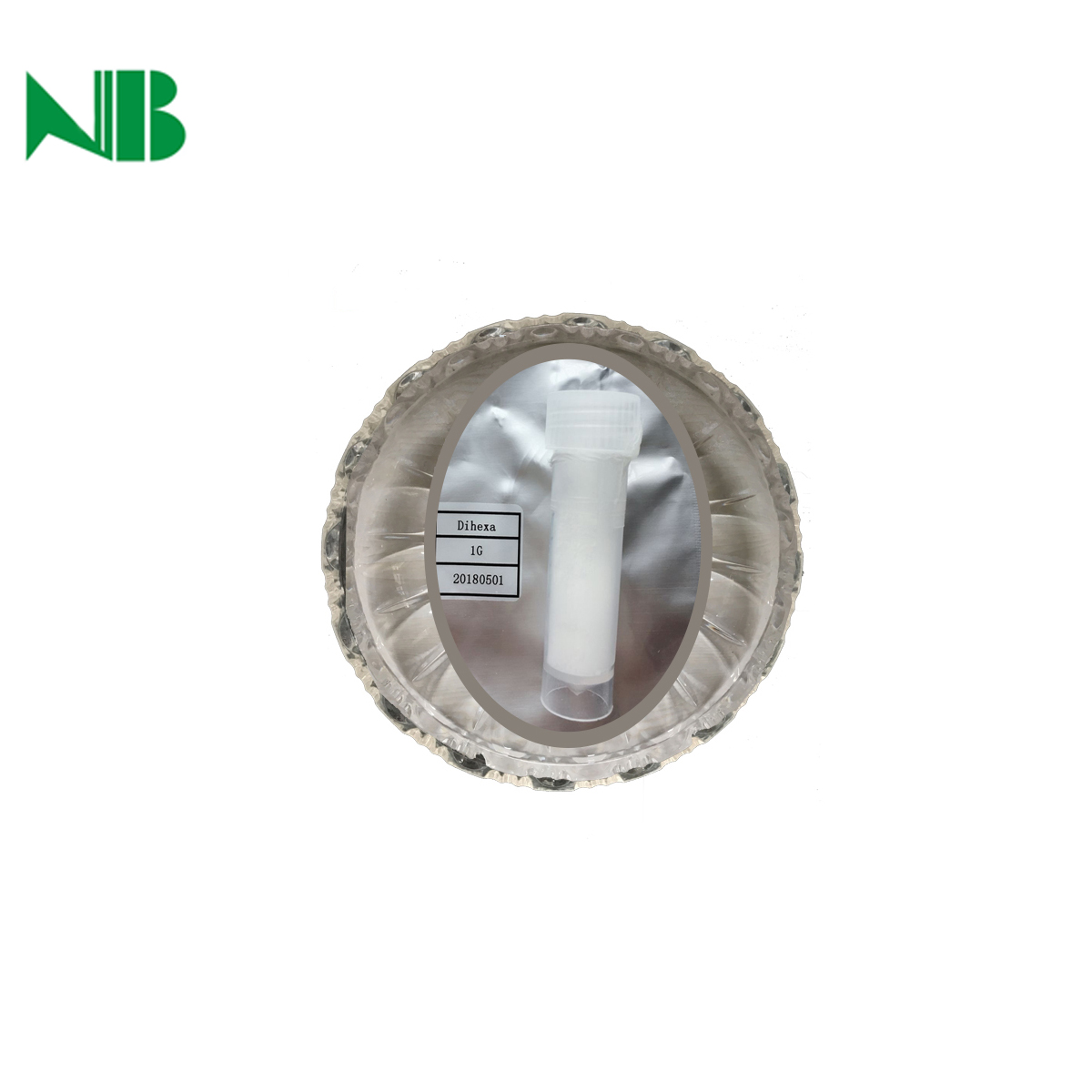
Dihexa CAS 1401708-83-5
Angiotensin IV Analog & HGF/c-Met Potentiator (Cognitive Enhancer)
Dihexa (CAS 1401708-83-5) is an orally active, blood-brain-barrier-permeable angiotensin IV analog (N-hexanoic-Tyr-Ile-(6)-aminohexanoic amide) that binds hepatocyte growth factor (HGF) with high affinity (Kd 65 pM) and potently potentiates HGF/c-Met signaling. It promotes hippocampal spinogenesis and synaptogenesis and is studied for cognitive enhancement and Alzheimer's disease. Molecular formula C27H44N4O5, MW 504.66. Research-grade with COA.
Molecular Information
CAS: 1401708-83-5
Formula: C27H44N4O5
MW: 504.66 g/mol
Class: Angiotensin IV peptidomimetic
Sequence: Hexanoyl-Tyr-Ile-Ahx-NH2
Target: HGF / c-Met (potentiation)
Kd: 65 pM (HGF)
Route: Oral; BBB-permeable
Appearance: White to off-white powder
Synonyms: N-hexanoic-Tyr-Ile-(6)-aminohexanoic amide
Storage: -20 C
Product Technical Specifications
Complete physicochemical properties and QC parameters for Dihexa (CAS 1401708-83-5)
📋 Physicochemical Properties
- Product NameDihexa
- Sequence / IUPACN-hexanoic-Tyr-Ile-(6)-aminohexanoic amide (Hexanoyl-Tyr-Ile-Ahx-NH2)
- CAS Number1401708-83-5
- SynonymsPN-271; N-hexanoic-Tyr-Ile-(6)-aminohexanoic amide
- Molecular FormulaC27H44N4O5
- Molecular Weight504.66 g/mol
- SourceSynthetic peptidomimetic (angiotensin IV analog)
- AppearanceWhite to off-white powder
- Melting PointNot reported
- Water SolubilityLow (amphipathic); formulate in solvent/DMSO
- Organic SolubilityDMSO ~100 mg/mL
- Compound ClassAngiotensin IV analog / HGF-c-Met potentiator
- HS Code2934.99
🔬 Quality Control & Handling
- Purity (HPLC)≥98%
- FormPowder / lyophilized
- Primary TargetHGF (hepatocyte growth factor) / c-Met potentiator
- Pathway Readoutc-Met phosphorylation; spinogenesis / synaptogenesis
- SelectivityHigh-affinity HGF binding (Kd 65 pM)
- Storage-20 C, sealed, protect from light (desiccated)
- Solution StabilityAliquot DMSO stocks; avoid freeze-thaw
- ShippingBlue ice / cold chain recommended
- QC DocumentationCOA / HPLC / MS / MSDS
- Pack Sizes1g / 5g / 10g / 100g / 1KG
- Stock StatusIn Stock
- Use StatementResearch use only; not for human/clinical use
Key Molecular Targets & Pathway Nodes
Dihexa's signature is potentiation of the HGF/c-Met trophic axis — a synaptogenic pathway distinct from conventional neurotransmitter-targeted nootropics.
How Dihexa Works: Amplifying the HGF/c-Met Trophic Signal
Rather than hijacking a receptor, Dihexa makes endogenous HGF a far better activator of c-Met
High-Affinity HGF Binding
Dihexa is a small-molecule angiotensin IV analog that binds hepatocyte growth factor (HGF) with very high affinity (Kd ~65 pM) — remarkably tighter than HGF's own receptor. This binding is the molecular anchor of its activity.
Potentiation of c-Met Signaling
By binding HGF, dihexa potentiates HGF's ability to activate its receptor tyrosine kinase c-Met (measured as increased p-Met Tyr1234/1235). In effect it is an allosteric co-agonist: at subthreshold HGF it augments c-Met phosphorylation and the HGF-dependent cell-scattering/migration response.
Spinogenesis, Synaptogenesis & Cognition
HGF/c-Met signaling drives dendritic spine and synapse formation. Dihexa replicates HGF's ability to induce hippocampal spinogenesis and synaptogenesis, and in vivo it improves spatial learning (reversing scopolamine deficits and aging-related impairment) — the basis of its procognitive profile and Alzheimer's research interest.
⚖️ Dihexa vs Other Cognitive Research Agents
- Dihexa (this)HGF/c-Met potentiator; synaptogenic; BBB-permeable
- Semax / SelankMelanocortin/BDNF & GABAergic peptides
- Traditional nootropicsCholinergic / glutamatergic targets
- Unique MechanismAmplifies endogenous HGF (not a receptor agonist)
- Research UseSynaptogenesis & dementia models
- DeliveryOrally active (metabolically stabilized analog)
♻️ Downstream Biological Consequences
- c-MetIncreased p-Met (Tyr1234/1235)
- NeuronalDendritic spine & synapse formation
- PlasticityEnhanced long-term potentiation (LTP)
- CognitionImproved spatial learning/memory
- AngiogenesisHGF-driven (context-dependent)
- DiseaseProcognitive in Alzheimer's models
Research Applications & Models
Dihexa occupies a unique niche: a synaptogenic, HGF/c-Met-targeted cognitive enhancer with oral activity and brain penetration.
Cognitive & Memory Research
Studied for procognitive effects — reversing scopolamine-induced and aging-related spatial-learning deficits, and enhancing memory in rodent models via synaptic plasticity.
Memory / LTPAlzheimer's Disease Models
Investigated as an antidementia agent leveraging synaptogenesis to counter synapse loss, a core pathological feature of Alzheimer's disease.
Synapse LossSynaptogenesis / Spinogenesis
A reference tool to induce hippocampal dendritic spines and synapses in culture and in vivo, isolating HGF/c-Met-dependent plasticity.
Spine FormationHGF / c-Met Pharmacology
Used to study HGF-c-Met potentiation, receptor phosphorylation and the distinction between receptor agonists and allosteric co-activators.
c-Met SignalingNeuroplasticity & Repair
Explored for neural repair and plasticity after injury, where HGF/c-Met trophic signaling supports neuronal connectivity.
NeurorepairAngiotensin IV System
Probes the lesser-known AngIV/AT4 receptor axis and its cognitive and cerebrovascular roles, distinct from classical ACE/AT1 pathways.
AngIV / AT4Peptidomimetic Stability
As a metabolically stabilized AngIV analog (capped termini), it exemplifies orally active peptidomimetic design resistant to aminopeptidases.
PeptidomimeticNeurogenesis Models
HGF/c-Met signaling also influences neurogenesis and migration; dihexa is used to probe these trophic programs in vitro.
NeurogenesisKey Literature & Landmark Publications
Key references on angiotensin IV analogs and HGF/c-Met procognitive effects.
Available Sizes & Ordering
Research-grade Dihexa (CAS 1401708-83-5) with full QC documentation; standard packs and bulk custom quantities supported.
| Tier | Pack Size | Stock Status | Suitable For | Lead Time |
|---|---|---|---|---|
| Standard | 1g | In Stock | HGF/c-Met & synaptogenesis assays | Same/next-day ship |
| Medium | 5g | In Stock | Cognitive & Alzheimer's models | Same/next-day ship |
| Large | 10g | In Stock | In vivo behavioral & plasticity studies | Same/next-day ship |
| Bulk | 100g | In Stock | Formulation & process development | Quote to confirm |
| Industrial | 1KG | Made to order | Pilot/production scale, CMO supply | Batch delivery |
💡 Reference sizes shown above; for exact pricing and availability please contact us for a quote. Bulk orders qualify for tiered discounts.
Frequently Asked Questions (FAQ)
What is Dihexa?
How does Dihexa enhance cognition?
Is Dihexa a c-Met agonist?
How is it different from Semax or Selank?
What readouts confirm activity?
How soluble is Dihexa and how should it be prepared?
Is QC documentation provided?
Need Dihexa (HGF/c-Met Potentiator) for Your Research?
Research-grade Dihexa (CAS 1401708-83-5) — purity ≥98% HPLC, COA included
The synaptogenic angiotensin IV analog that amplifies the HGF/c-Met cognitive axis — request a quote today