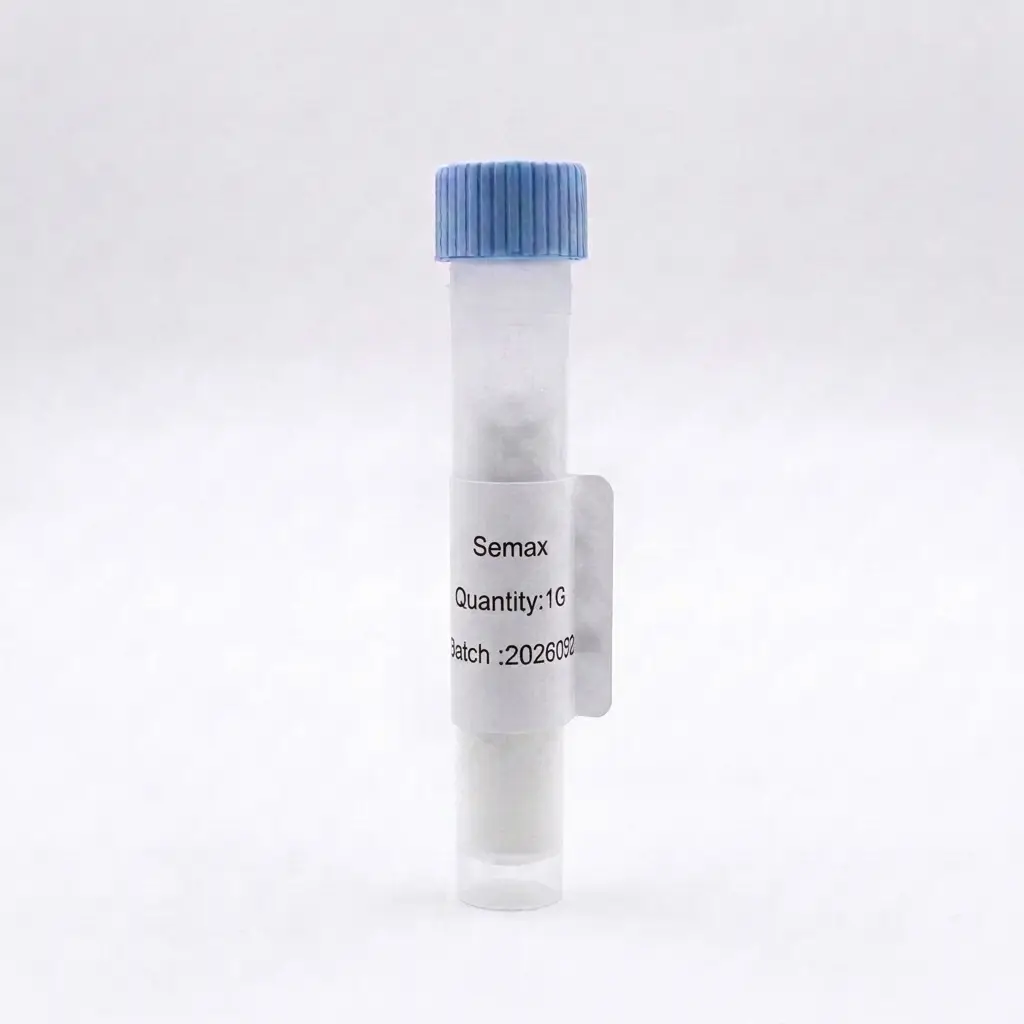
Semax Acetate CAS 80714-61-0
Nootropic & Neuroprotective Peptide
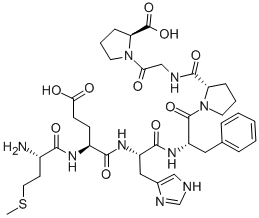
A synthetic ACTH(4-10) analog heptapeptide (Met-Glu-His-Phe-Pro-Gly-Pro) with potent neuroprotective and cognitive-enhancing activity. Upregulates BDNF (1.4-fold) and trkB phosphorylation (1.6-fold), inhibits enkephalinase (IC50 ~10 μM), and acts as a partial MC4R/MC5R antagonist — without cortisol stimulation. Extended 20-24 hour half-life. Clinically used in Russia for stroke recovery and cognitive impairment.
Molecular Information
CAS (free base): 80714-61-0
CAS (acetate): 2828433-33-4
Formula: C37H51N9O10S
MW: 813.92 (free base)
MW (acetate): 873.98
Sequence: Met-Glu-His-Phe-Pro-
Gly-Pro (MEHFPGP)
Length: Heptapeptide (7 aa)
Appearance: White to tan powder
Synonyms: ACTH(4-7) Pro-Gly-Pro /
ACTH(4-10) analog
Storage: -20°C
Product Technical Specifications
Complete physicochemical properties and QC parameters for Semax Acetate (CAS 80714-61-0)
📋 Physicochemical Properties
- Product NameSemax Acetate
- SequenceMet-Glu-His-Phe-Pro-Gly-Pro
- CAS Number (free base)80714-61-0
- CAS Number (acetate)2828433-33-4
- SynonymsACTH(4-7) Pro-Gly-Pro; ACTH(4-10) analog
- Molecular FormulaC37H51N9O10S
- MW (free base)813.92 g/mol
- MW (acetate salt)873.98 g/mol
- Peptide Length7 amino acids (heptapeptide)
- Parent SequenceACTH(4-10) + Pro-Gly-Pro extension
- OriginSynthetic; Russian clinical peptide
🔬 Quality Control & Handling
- Purity (HPLC)≥98%
- AppearanceWhite to tan powder
- SolubilityDMSO (250 mg/mL); H2O (>2 mg/mL)
- Storage Condition-20°C
- FormAcetate salt powder
- ReconstitutionDissolve in sterile water or DMSO
- HandlingUse aseptic technique; avoid freeze-thaw
- QC DocumentationCOA / HPLC / MS / MSDS
- Pack Sizes1g / 5g / 10g / 100g / 1KG
- Stock StatusIn Stock
- Use StatementResearch use only; not for human/clinical use
Key Molecular Targets & Receptor Profile
Semax's multi-target neuropharmacology spans neurotrophin signaling, neuropeptide regulation, and melanocortin modulation — without HPA-axis activation
How Semax Works: Multi-Target Neuroprotection & Cognition
Semax's unique ACTH(4-10) analog structure with Pro-Gly-Pro extension enables three convergent neuroprotective mechanisms — without the cortisol release of native ACTH
BDNF / trkB Upregulation
Semax upregulates brain-derived neurotrophic factor (BDNF) expression by 1.4-fold and increases trkB receptor phosphorylation by 1.6-fold in the hippocampus. This neurotrophin signaling enhances neuronal survival, synaptic plasticity, and memory consolidation — the molecular basis of its nootropic effects.
Enkephalinase Inhibition
Semax inhibits enkephalinase (neutral endopeptidase, NEP) with an IC50 of ~10 μM. By blocking enkephalin degradation, it prolongs the action of endogenous opioid peptides (enkephalins), contributing to anxiolytic and neuroprotective effects without sedation or addiction liability.
Melanocortin Modulation (No Cortisol)
Semax acts as a partial antagonist at MC4R and MC5R melanocortin receptors. Critically, unlike native ACTH, it does not stimulate cortisol secretion — the Pro-Gly-Pro extension eliminates HPA-axis activation while preserving cognitive and neuroprotective benefits. Half-life is extended to 20-24 hours.
Research Applications & Disease Models
Semax's multi-target neuropharmacology makes it relevant across stroke recovery, cognitive enhancement, ophthalmology, and CNS drug delivery research
Stroke & Ischemia
Neuroprotective in acute ischemic stroke models; improves motor and functional recovery post-stroke. Clinically used in Russia for stroke rehabilitation. BDNF upregulation and anti-excitotoxic mechanisms support neuronal survival during ischemic injury.
Stroke RecoveryCognitive Enhancement
Enhances memory consolidation, learning, and attention without stimulant side effects. BDNF/trkB upregulation and cholinergic modulation underlie its nootropic action. Relevant for age-related cognitive decline, post-surgical cognitive dysfunction, and healthy cognition research.
NootropicADHD Research
Non-stimulant cognitive enhancer with attention-improving properties. Unlike amphetamine-based ADHD medications, Semax does not cause agitation, tolerance, or cortisol elevation — making it a novel mechanistic probe for non-stimulant ADHD therapeutic approaches.
Non-StimulantOptic Nerve Disease
Clinically approved in Russia for treatment of optic nerve atrophy. Semax's neurotrophin-upregulating properties support retinal ganglion cell survival and axonal integrity, making it relevant for glaucoma, optic neuropathy, and neuro-ophthalmology research.
Optic NeuropathyNeurotrophin Biology
A valuable research tool for studying the BDNF/trkB signaling pathway. Semax's ability to selectively upregulate hippocampal BDNF (1.4-fold) and trkB phosphorylation (1.6-fold) makes it useful for dissecting neurotrophin contributions to plasticity, learning, and neuroprotection.
BDNF / trkB ToolMood & Anxiety
Anxiolytic properties without sedation, mediated through enkephalinase inhibition and melanocortin modulation. Unlike benzodiazepines, Semax reduces anxiety while maintaining alertness and cognitive function — a unique profile for anxiety research.
AnxiolyticHypoxia & Ischemia Research
Neuroprotective in brain hypoxia models. Semax supports neuronal survival under oxygen deprivation through BDNF-mediated anti-apoptotic signaling and excitotoxicity reduction. Relevant for traumatic brain injury, cardiac arrest, and altitude hypoxia studies.
Hypoxia ModelPeptide Drug Delivery
A model compound for intranasal CNS drug delivery research. Semax achieves direct nose-to-brain transport bypassing the blood-brain barrier. Its extended half-life (20-24h vs. minutes for native ACTH) demonstrates how structural modification enables practical peptide therapeutics.
Intranasal DeliveryKey Literature & Landmark Publications
Seminal papers on Semax's neuropharmacology, BDNF mechanisms, and clinical applications
Available Sizes & Ordering
Research-grade Semax Acetate (CAS 80714-61-0) with full QC documentation; research packs and bulk custom quantities supported
| Tier | Pack Size | Stock Status | Suitable For | Lead Time |
|---|---|---|---|---|
| Standard | 1 g | In Stock | Biochemical / cell-based assays | Same/next-day ship |
| Medium | 5 g | In Stock | In vivo pharmacology, long-term studies | Same/next-day ship |
| Large | 10 g | In Stock | Multi-lab collaborations, HTS | Same/next-day ship |
| Bulk | 100 g | In Stock | Process development, scale-up | Quote to confirm |
| Industrial | 1 KG | Made to order | Pilot/production scale, CMO supply | Batch delivery |
For exact pricing and availability please contact us for a quote. Bulk orders qualify for tiered discounts.
Frequently Asked Questions (FAQ)
What is Semax Acetate (CAS 80714-61-0)?
How does Semax compare to Selank?
What is the bioavailability of intranasal Semax?
Is Semax classified as a nootropic?
What is Semax's clinical use in Russia?
Why doesn't Semax stimulate cortisol like ACTH?
How should Semax be dissolved and stored?
Is QC documentation provided? Can I request a sample?
Need Semax Acetate for Your Research?
Research-grade Semax Acetate (CAS 80714-61-0) — purity ≥98%, COA included
A BDNF-upregulating nootropic & neuroprotective peptide — request a quote today