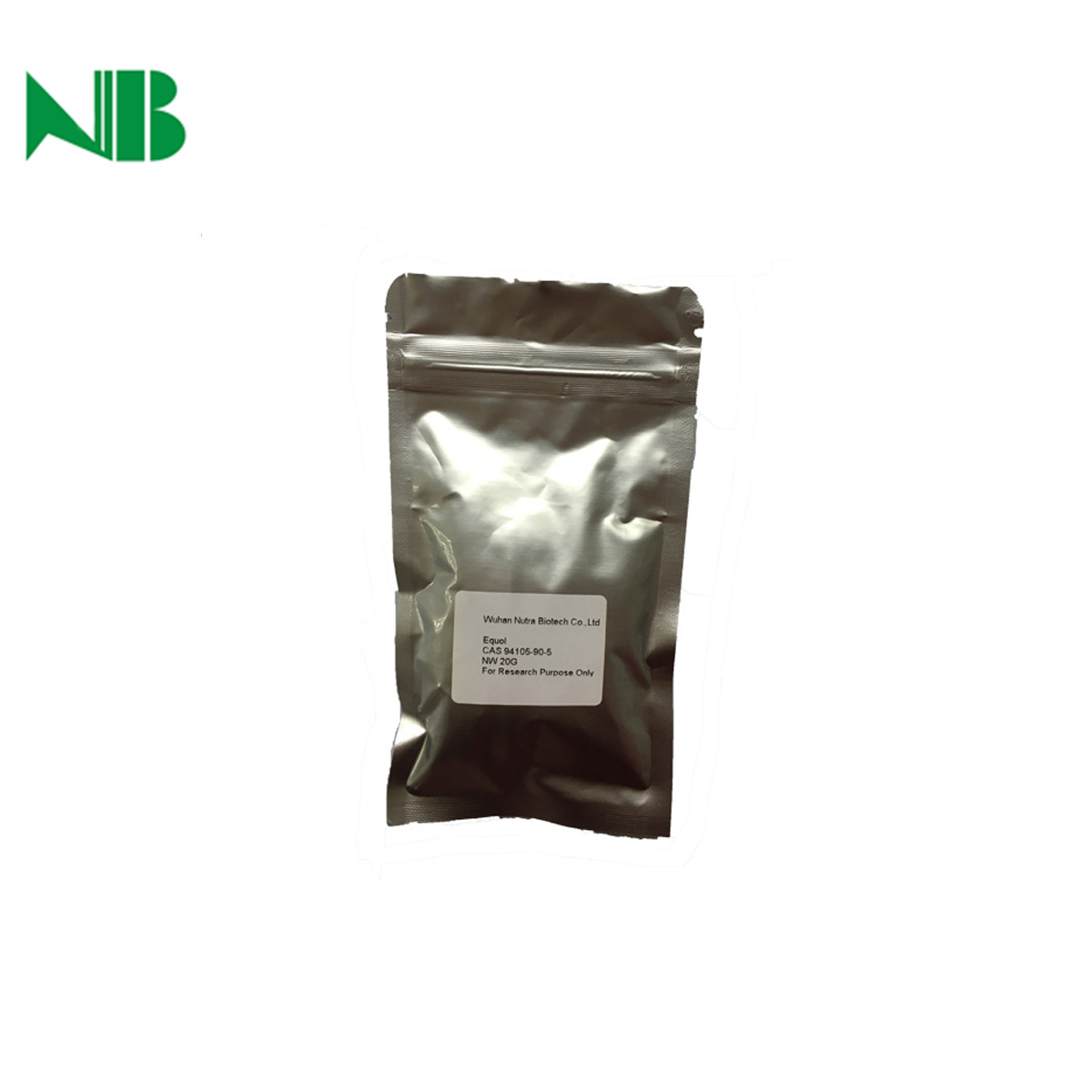
R,S-Equol CAS 94105-90-5
Racemic Equol — ERβ-Selective Daidzein Metabolite
R,S-Equol is the racemic (50:50) form of equol, an isoflavandiol produced in the large intestine when specific gut bacteria reduce the soy isoflavone daidzein. It behaves as a non-steroidal selective estrogen receptor modulator (SERM) with preference for estrogen receptor beta (ERβ), shows anti-androgenic activity through high-affinity binding of 5α-dihydrotestosterone (DHT), and is a potent antioxidant with greater biological activity than its parent compound daidzein. Supplied as 99% HPLC powder.
Molecular Information
CAS: 94105-90-5
Formula: C15H14O3
MW: 242.27 g/mol
Purity: ≥99% (HPLC)
SMILES: C1Cc2ccc(O)cc2O
C(c3ccc(O)cc3)C1
InChIKey: ADFCQWZHKCXPAJ
-UHFFFAOYSA-N
MP: 172-176°C
Appearance: White to off-white powder
Solubility: DMSO, methanol, ethanol
Synonyms: (+/-)-Equol / rac-Equol
Storage: -20°C, cool, dry, dark
R,S-Equol Technical Specifications & QC Data
Complete physicochemical properties and quality control parameters for research-grade R,S-Equol / racemic equol powder (CAS 94105-90-5)
📋 Physicochemical Properties
- Product NameR,S-Equol (Racemic Equol)
- IUPAC Name3-(4-Hydroxyphenyl)-3,4-dihydro-2H-chromen-7-ol
- CAS Number94105-90-5
- Synonyms(+/-)-Equol / rac-Equol / 4',7-Isoflavandiol
- Molecular FormulaC15H14O3
- Molecular Weight242.27 g/mol
- Exact Mass242.094 Da
- StereochemistryRacemate (50:50 R / S) at C3
- SMILESC1Cc2ccc(O)cc2OC(c3ccc(O)cc3)C1
- InChIKeyADFCQWZHKCXPAJ-UHFFFAOYSA-N
- AppearanceWhite to off-white crystalline powder
- Melting Point172-176°C
- OriginIntestinal metabolite of daidzein
- MDL NumberMFCD00016662
- PubChem CID382975
🔬 Quality Control & Handling
- Purity (HPLC)≥99%
- Enantiomeric RatioR:S ≈ 1:1 (racemic)
- FormCrystalline powder
- ColorWhite to off-white
- Storage Condition-20°C, cool, dry, protected from light
- HygroscopicityHygroscopic; keep tightly sealed with desiccant
- ShippingAmbient or cold pack; light-protected vial
- SolubilityDMSO, methanol, ethanol; insoluble in water
- QC DocumentationCOA / HPLC / NMR / MS / heavy metals
- Pack Sizes1g / 5g / 10g / 100g / 1KG
- Stock StatusIn Stock
- Use StatementResearch use only; not for human/clinical use
Molecular Targets & Signaling Partners
Equol's biology spans estrogen receptor subtypes, androgen-pathway modulation via DHT sequestration, and direct phenolic antioxidant activity
How R,S-Equol Works: From Daidzein to Tissue-Selective Estrogenicity
A stepwise view of bacterial metabolism, estrogen-receptor engagement, anti-androgenic sequestration and antioxidant action
Dietary Daidzein Intake
Soy foods and supplements deliver the isoflavone daidzein. Unlike equol, daidzein is planar, less estrogenic and is not directly produced as a mammalian metabolite — it requires colonic bacterial activation.
Gut Bacterial Reduction
Specific intestinal anaerobes reduce the C2-C3 double bond of the isoflavone C-ring, converting daidzein into equol — a non-planar isoflavan with a chiral centre at C3. Only "equol producers" harbour the necessary microbiota.
ERβ-Preferential Binding
Equol binds both estrogen receptors but with clear preference for ERβ (ESR2) over ERα (ESR1). Reported EC50 values are ~200 nM at ERα versus ~74 nM at ERβ; the S-enantiomer is ~9-fold ERβ-selective.
Coactivator Recruitment & Transcription
ERβ:equol complexes dimerize, recruit coactivators and engage estrogen-response elements (EREs), modulating genes in bone, brain, vasculature, prostate and colon — the basis of its tissue-selective SERM-like profile.
Anti-Androgenic DHT Sequestration
Equol binds 5α-dihydrotestosterone (DHT) directly with high affinity, sequestering the hormone and preventing androgen-receptor engagement — a distinct mechanism from classical androgen-receptor antagonists (Lund et al., Biol Reprod 2004).
Potent Phenolic Antioxidant
As an isoflavandiol with two phenolic hydroxyls, equol scavenges ROS and peroxyl radicals more effectively than daidzein, inhibits lipid peroxidation and chelates redox-active metal ions, contributing to vascular and cellular protection.
Research Applications of R,S-Equol
From phytoestrogen and SERM pharmacology to menopause, bone, hair-loss and gut-microbiota metabolism research
Phytoestrogen & SERM Signaling
A reference non-steroidal estrogen receptor modulator used to compare ERα vs ERβ signaling, coactivator recruitment, ERE-reporter assays and tissue-selective estrogenic profiling alongside genistein, daidzein and tamoxifen.
ER PharmacologyMenopause & Vasomotor Symptoms
Studied for hot flushes and night sweats via ERβ in the hypothalamic thermoregulatory centre. A key comparator in trials of direct equol supplementation for equol non-producers (e.g. Aso et al., Menopause 2012).
Women's HealthBone Health & Osteoporosis
ERβ predominates in bone; equol is investigated for osteoblast/osteoclast balance, bone mineral density, menopausal bone loss and as an estrogen-depleted-model supplement to mitigate skeletal resorption.
Skeletal BiologyAndrogenetic Alopecia & Hair Follicle Research
Through high-affinity DHT sequestration, equol is a natural probe for androgen-driven follicular miniaturization. Used in dermal papilla, hair-follicle organoid and 5α-reductase/DHT-binding assays.
DermatologyProstate & BPH Biology
Equol's anti-androgenic and ERβ activity make it a tool in benign prostatic hyperplasia and prostate epithelial models, where DHT-driven hyperplasia and ERβ-mediated epithelial effects are studied (Lund et al., Biol Reprod 2004).
AndrologyCardiovascular & Endothelial Function
Investigated for vascular endothelial function, arterial stiffness, lipid peroxidation inhibition and improved flow-mediated dilation — endpoints central to soy and phytoestrogen cardiovascular epidemiology.
Vascular MedicineGut Microbiota & Equol-Producer Metabolism
A focal metabolite for studying inter-individual variability in soy responsiveness. Used to phenotype equol producers vs non-producers, annotate daidzein-metabolizing taxa and model microbial biotransformation of isoflavones.
MicrobiomeSkin Health & Photoprotection
ERβ in skin and equol's ROS-scavenging activity support studies of UV-induced oxidative stress, collagen integrity, photoaging and dermal antioxidant defense in keratinocyte and fibroblast models.
DermatoscienceAntioxidant & Redox Research
A convenient phenolic antioxidant standard for ORAC/TEAC radical-scavenging assays, lipid peroxidation inhibition, metal-chelation studies and comparison against daidzein, genistein and vitamin E analogues.
Redox BiologyKey Publications on R,S-Equol & Equol
From the identification of dietary non-steroidal estrogens to anti-androgen and menopause clinical research
R,S-Equol Pack Sizes & Ordering Information
Research-grade R,S-Equol / racemic equol powder (CAS 94105-90-5) available in 1g / 5g / 10g / 100g / 1KG with full QC documentation and light-protected logistics
| Tier | Pack Size | Stock Status | Suitable For | Lead Time & Shipping |
|---|---|---|---|---|
| Standard | 1 g | In Stock | ER binding/ERE-reporter assays, DHT-binding and antioxidant screening | Same/next-day ship; amber vial, desiccant |
| Medium | 5 g | In Stock | Cell-culture studies, hair-follicle and dermal papilla assays | Same/next-day ship; light-protected packaging |
| Large | 10 g | In Stock | Multi-arm in vivo programs, bone and cardiovascular models | Same/next-day ship; DHL/FedEx |
| Bulk | 100 g | In Stock | Formulation screening, microbiome-metabolite scale-up | Quote to confirm; sealed drum, desiccant |
| Industrial | 1 KG | Made to order | Pilot/production scale, CMO supply, long-term supply agreements | Scheduled batch delivery; validated freight |
💡 Reference sizes shown above; R,S-Equol is hygroscopic and light-sensitive — store cool, dry and dark. For exact bulk pricing please contact us for a quote. Bulk orders qualify for tiered discounts.
R,S-Equol FAQ — Frequently Asked Questions
What is R,S-Equol (CAS 94105-90-5)?
How does equol differ from daidzein and genistein?
What is an equol producer and why does it matter?
Why is equol described as ERβ-selective?
How is equol anti-androgenic and relevant to hair-loss research?
What is the difference between R,S-equol and S-equol?
How should R,S-Equol powder be dissolved and stored?
Why is equol studied for menopause and bone health?
What purity, documentation and pack sizes are available?
Need R,S-Equol (CAS 94105-90-5) for Your Research?
Research-grade R,S-Equol / racemic equol powder — 99% HPLC purity, COA included, 1g to 1KG
The ERβ-selective daidzein metabolite for phytoestrogen, anti-androgen (DHT) and antioxidant research — request a quote today