Tideglusib CAS 865854-05-3
Irreversible, Non-ATP-Competitive GSK-3β Inhibitor (NP-031112 / NP-12)
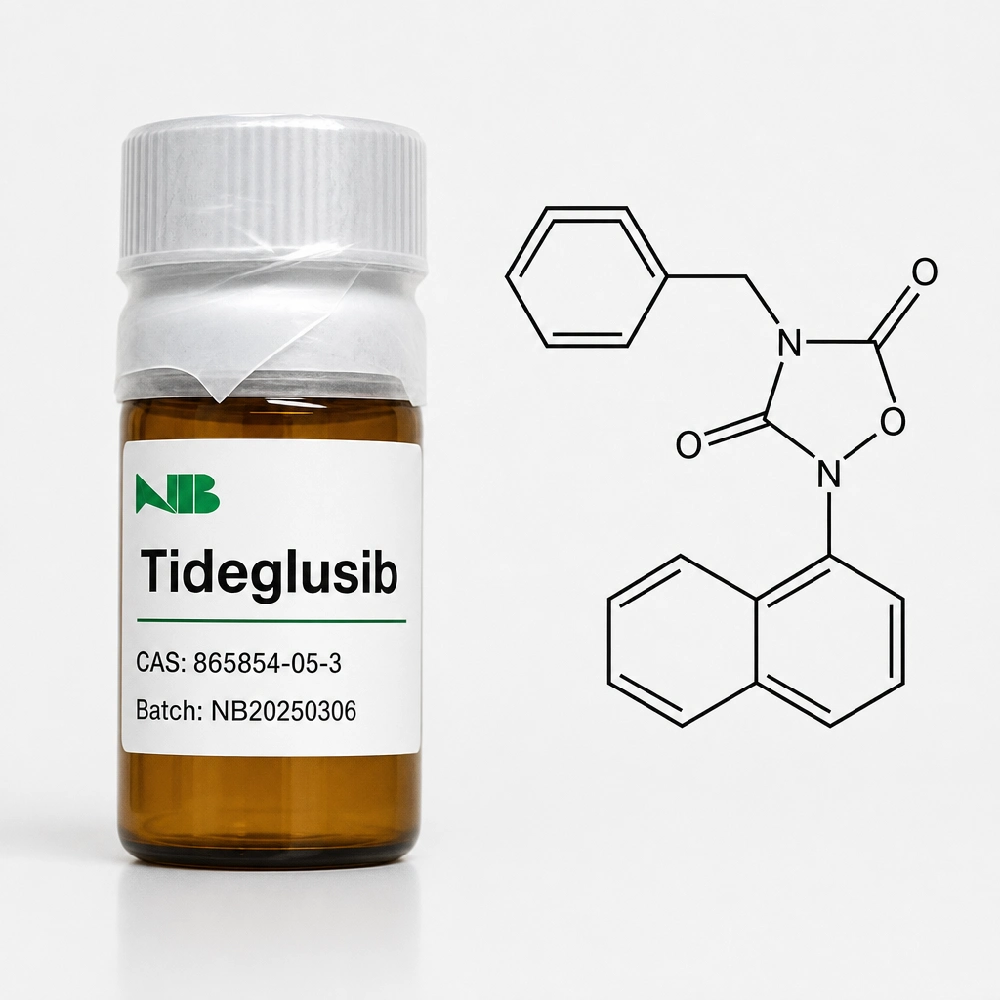
Tideglusib (CAS 865854-05-3), also NP-031112 / NP-12, is an irreversible, non-ATP-competitive inhibitor of glycogen synthase kinase-3 beta (GSK-3β) with an IC50 of ~5 nM (WT) that covalently targets Cys199. It reduces tau phosphorylation and activates Wnt/β-catenin. Molecular formula C19H14N2O2S, MW 334.4. Research-grade with COA.
Molecular Information
CAS: 865854-05-3
Formula: C19H14N2O2S
MW: 334.4 g/mol
Class: Thiadiazolidinedione (TDZD)
Core: 4-benzyl-2-(naphthalen-1-yl)-1,2,4-thiadiazolidine-3,5-dione
Target: GSK-3β
IC50: ~5 nM (WT)
MP: 148-150 C
Appearance: White to off-white solid
Synonyms: NP-031112 / NP-12
Storage: -20 C
Product Technical Specifications
Complete physicochemical properties and QC parameters for Tideglusib (CAS 865854-05-3)
📋 Physicochemical Properties
- Product NameTideglusib
- IUPAC Core4-benzyl-2-(naphthalen-1-yl)-1,2,4-thiadiazolidine-3,5-dione
- CAS Number865854-05-3
- SynonymsNP-031112; NP-12; NP031112
- Molecular FormulaC19H14N2O2S
- Molecular Weight334.4 g/mol
- SourceSynthetic small molecule (Zeltia / Noscira)
- AppearanceWhite to off-white solid
- Melting Point148-150 C
- Water SolubilityLow (sparingly soluble)
- Organic SolubilityDMSO; DMSO/organic vehicle
- Compound ClassThiadiazolidinedione / irreversible GSK-3β inhibitor
- HS Code2934.99
🔬 Quality Control & Handling
- Purity (HPLC)≥98%
- FormSolid powder
- Primary TargetGSK-3β (glycogen synthase kinase 3 beta)
- Pathway ReadoutReduced p-GSK-3 substrates (tau); ↑ β-catenin / AXIN2; Wnt activation
- SelectivityNon-ATP-competitive; irreversible (Cys199 covalent)
- Storage Condition-20 C, sealed, protect from light
- Solution StabilityAliquot DMSO stocks; avoid freeze-thaw
- ShippingBlue ice / cold chain recommended
- QC DocumentationCOA / HPLC / NMR / MS / MSDS
- Pack Sizes1g / 5g / 10g / 100g / 1KG
- Stock StatusIn Stock
- Use StatementResearch use only; not for human/clinical use
Key Molecular Targets & Pathway Nodes
Tideglusib's primary node is GSK-3β, a serine/threonine kinase positioned at the intersection of tau pathology, Wnt signaling and apoptosis — but its non-ATP, covalent mechanism is unusual.
How Tideglusib Works: Covalent, Non-ATP GSK-3β Blockade
Tideglusib locks GSK-3β irreversibly by covalently modifying Cys199, so target engagement outlasts plasma exposure
Non-ATP-Competitive, Covalent Binding
Unlike typical kinase inhibitors that compete for ATP, tideglusib enters the GSK-3β active site and forms a covalent bond with Cys199. The dissociation rate (koff) is near zero, so inhibition is irreversible and sustained even after plasma clearance.
Reduced Tau Phosphorylation & Neuroprotection
GSK-3β is the major tau kinase; its blockade lowers pathologic tau hyperphosphorylation and reduces apoptotic death in neurons and neuroblastoma models. This underpins tideglusib's interest in Alzheimer's and tauopathy research.
Wnt/β-Catenin Activation
By inhibiting GSK-3β within the destruction complex, tideglusib stabilizes β-catenin and drives Wnt target-gene transcription (e.g., AXIN2). This makes it a potent Wnt activator — used in regenerative, odontogenic and osteogenic studies, and a contrast to ATP-competitive inhibitors like CHIR99021.
⚖️ Tideglusib vs CHIR99021 vs Lithium
- Tideglusib (this product)GSK-3β IC50 ~5 nM; irreversible, non-ATP (Cys199)
- CHIR99021ATP-competitive GSK-3 inhibitor; reversible
- LithiumWeak, non-selective GSK-3 inhibitor; high mM
- Shared TargetAll inhibit GSK-3β / β-catenin pathway
- Key DistinctionTideglusib is covalent & sustained
- Wnt ActivationTideglusib ~7.5x stronger AXIN2 induction than CHIR99021 in hDPSCs
♻️ Downstream Biological Consequences
- KinaseGSK-3β activity abolished (covalent)
- CytoskeletonReduced tau hyperphosphorylation
- TranscriptionStabilized β-catenin; ↑ AXIN2
- Wnt OutputEnhanced Wnt/β-catenin signaling
- Cell FateNeuroprotection; osteo-/odontogenic differentiation
- InflammationAttenuated glial TNF-α / COX-2
Research Applications & Models
From tau-pathology research to a standout Wnt activator, tideglusib bridges neurodegeneration and regenerative biology.
Alzheimer's & Tauopathy Models
A leading irreversible GSK-3β inhibitor for reducing tau phosphorylation and probing tau-pathology mechanisms in neuronal and transgenic models.
GSK-3β / TauWnt/β-Catenin & Regeneration
Potent Wnt activator used in bone, dental-pulp (hDPSCs) and tissue-regeneration studies where β-catenin stabilization drives differentiation.
Wnt / β-cateninNeuroprotection
Studied for glutamate-excitotoxicity and apoptotic protection in cortical neurons, astrocytes and microglia.
NeuroprotectionInflammation & Glia
Investigated for suppression of glial activation (TNF-α, COX-2) in neuroinflammatory models.
Glia / InflammationGSK-3 Biology
A fiducial covalent GSK-3β probe distinguishing ATP-competitive vs non-ATP, irreversible mechanisms.
Kinase mechanismOsteogenesis & Development
Used to dissect GSK-3/ Wnt roles in developmental and skeletal biology.
DevelopmentKey Literature & Landmark Publications
The enzymology, irreversibility and clinical translation of tideglusib.
Available Sizes & Ordering
Research-grade Tideglusib (CAS 865854-05-3) with full QC documentation; standard packs and bulk custom quantities supported.
| Tier | Pack Size | Stock Status | Suitable For | Lead Time |
|---|---|---|---|---|
| Standard | 1g | In Stock | GSK-3β / tau & Wnt assays | Cold chain |
| Medium | 5g | In Stock | Neurodegeneration & regeneration models | Cold chain |
| Large | 10g | In Stock | Long-term in vivo & formulation studies | Cold chain |
| Bulk | 100g | In Stock | Formulation & process development | Quote to confirm |
| Industrial | 1KG | Made to order | Pilot/production scale, CMO supply | Batch delivery |
💡 Reference sizes shown above; for exact pricing and availability please contact us for a quote. Bulk orders qualify for tiered discounts.
Frequently Asked Questions (FAQ)
What is tideglusib and what does it do?
How is tideglusib different from CHIR99021 or lithium?
What is the mechanism in Alzheimer's / tau research?
What are the key experimental readouts?
How soluble is tideglusib and how should it be prepared?
Is QC documentation provided?
Need Tideglusib (GSK-3β Inhibitor) for Your Research?
Research-grade Tideglusib (CAS 865854-05-3) — purity ≥98% HPLC, COA included
The irreversible, non-ATP-competitive GSK-3β inhibitor for tau, Wnt/β-catenin and neurodegeneration research — request a quote today