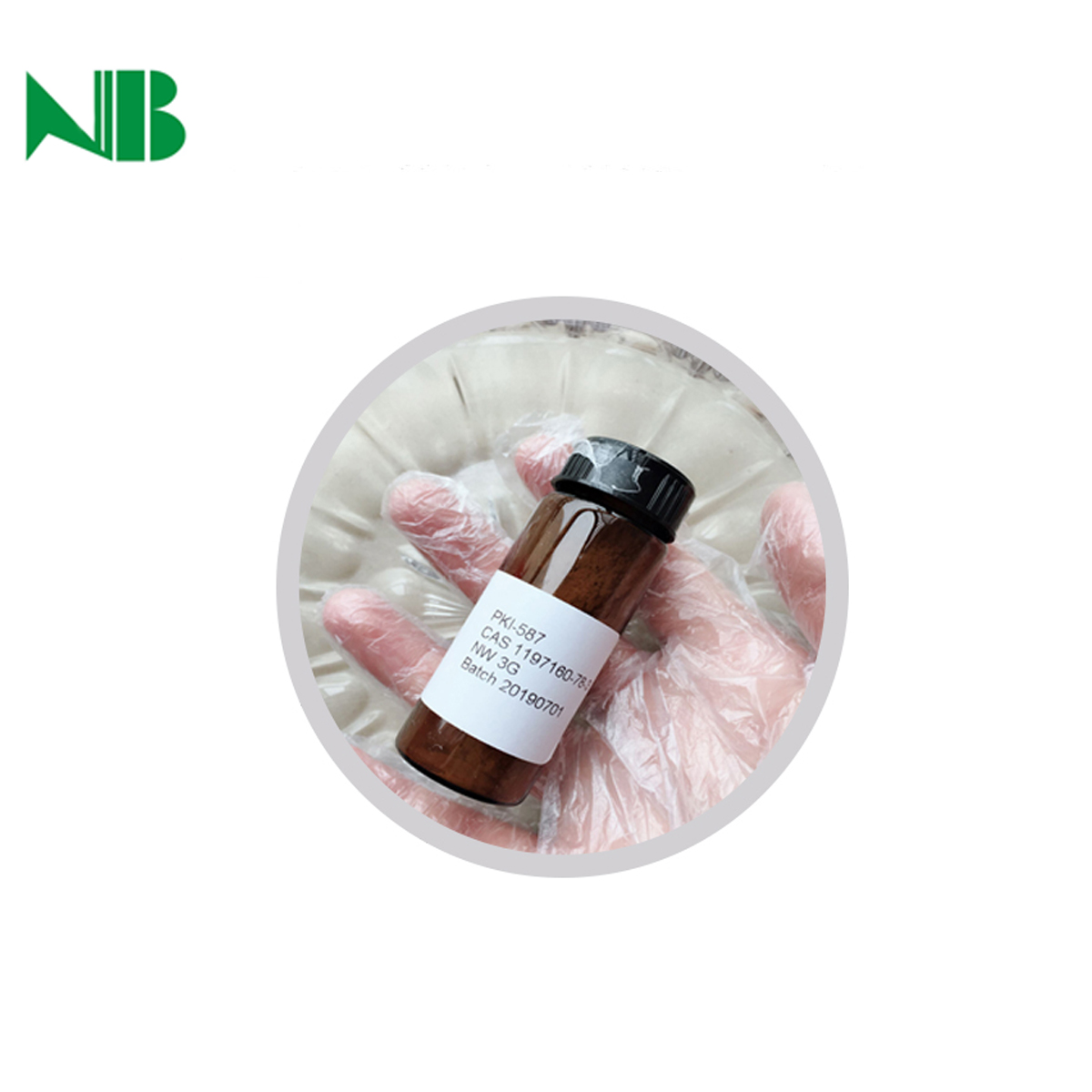
Gedatolisib CAS 1197160-78-3
Dual PI3K / mTOR Kinase Inhibitor (PF-05212384, PKI-587)
Gedatolisib (CAS 1197160-78-3), also PF-05212384 / PKI-587, is a potent, balanced dual inhibitor of class I PI3K isoforms and mTOR kinase with cellular IC50s of ~0.4 nM (PI3Kalpha), 5.4 nM (PI3Kgamma) and 1.6 nM (mTOR). It simultaneously shuts down both arms of the PI3K/Akt/mTOR oncogenic axis. Molecular formula C32H41N9O4, MW 615.73. Research-grade with COA.
Molecular Information
CAS: 1197160-78-3
Formula: C32H41N9O4
MW: 615.73 g/mol
Class: Morpholino-triazine bis-urea
Core: Dimorpholino-triazinyl bis-aryl urea
Target: PI3K (class I) + mTOR
IC50: PI3Ka 0.4 / mTOR 1.6 nM
Appearance: White solid powder
Synonyms: PF-05212384 / PKI-587
Storage: -20 C
Product Technical Specifications
Complete physicochemical properties and QC parameters for Gedatolisib (CAS 1197160-78-3)
📋 Physicochemical Properties
- Product NameGedatolisib
- IUPAC Core1-[4-[[4-(dimethylamino)-1-piperidinyl]carbonyl]phenyl]-3-[4-(4,6-dimorpholin-4-yl-1,3,5-triazin-2-yl)phenyl]urea
- CAS Number1197160-78-3
- SynonymsPF-05212384; PKI-587; PKI587
- Molecular FormulaC32H41N9O4
- Molecular Weight615.73 g/mol
- SourceSynthetic small molecule (Wyeth/Pfizer, now Celcuity)
- AppearanceWhite to off-white solid
- Melting PointNot reported (amorphous)
- Water SolubilityLow (formulate in DMSO/organic)
- Organic SolubilityDMSO
- Compound ClassMorpholino-triazine bis-aryl urea / dual PI3K-mTOR inhibitor
- HS Code2934.99
🔬 Quality Control & Handling
- Purity (HPLC)≥98%
- FormSolid powder
- Primary TargetClass I PI3K (alpha/gamma/delta) + mTOR kinase
- Pathway Readoutp-AKT, p-S6K, p-4E-BP1, p-PRAS40 down; p-ERK may rise (feedback)
- SelectivityBalanced PI3K + mTOR; distinct from rapalogs (mTORC1-only)
- Storage Condition-20 C, sealed, protect from light
- Solution StabilityAliquot DMSO stocks; avoid freeze-thaw
- ShippingBlue ice / cold chain recommended
- QC DocumentationCOA / HPLC / NMR / MS / MSDS
- Pack Sizes1g / 5g / 10g / 100g / 1KG
- Stock StatusIn Stock
- Use StatementResearch use only; not for human/clinical use
Key Molecular Targets & Pathway Nodes
Gedatolisib hits both limbs of the PI3K/Akt/mTOR axis at the kinase level — a broader blockade than rapalogs, which only allosterically inhibit mTORC1.
How Gedatolisib Works: Simultaneous PI3K and mTOR Kinase Blockade
Gedatolisib attacks both catalytic nodes of the oncogenic PI3K/Akt/mTOR network
PI3K Catalytic Inhibition
Gedatolisib binds the ATP sites of class I PI3K catalytic subunits (most potently p110alpha, also gamma/delta), blocking conversion of PIP2 to PIP3 at the membrane. This starves downstream AKT of its membrane-docking lipid, blunting AKT Thr308 and Ser473 phosphorylation even before mTORC2 is engaged.
mTOR Kinase Inhibition
Distinct from rapalogs, gedatolisib directly inhibits the mTOR kinase domain, suppressing both mTORC1 (S6K/4E-BP1) and mTORC2 (AKT Ser473) outputs. This dual coverage avoids the classic rapalog loophole where mTORC2-driven AKT feedback limits efficacy.
Collapse of Growth & Survival Signaling
With PI3K and mTOR both suppressed, downstream p70S6K, 4E-BP1 and PRAS40 phosphorylation fall, cap-dependent translation and cell-growth programs stall, and apoptosis/autophagy ensue in PIK3CA- or PTEN-altered cells. Notably, relief of mTORC1 feedback can transiently raise p-ERK, a marker studied in combination strategies.
⚖️ Gedatolisib vs Rapalogs vs Pan-PI3K
- Gedatolisib (this product)Dual PI3K + mTOR kinase; PI3Ka 0.4 / mTOR 1.6 nM
- Rapalogs (everolimus)Allosteric mTORC1 only; mTORC2/AKT feedback spared
- Pan-PI3K (BKM120)PI3K-only; leaves mTOR arm active (feedback)
- PI3K/mTOR (BEZ235)Dual but less balanced / tolerability-different
- Net CoverageBroadest single-agent PI3K/Akt/mTOR blockade
- Research UsePI3K-addicted & resistant solid tumors, combo studies
♻️ Downstream Biological Consequences
- AKTReduced p-AKT (T308 & S473)
- Translationp-S6K & p-4E-BP1 suppression
- Cell CycleG1 arrest; reduced cyclin D1
- SurvivalApoptosis / autophagy in PIK3CA/PTEN models
- FeedbackPossible p-ERK rise (combination rationale)
- AngiogenesisReduced HIF-1alpha / VEGF output
Research Applications & Models
Dual PI3K/mTOR blockade is a flagship strategy in PIK3CA-mutant and PTEN-loss oncology — and a window into resistance and combination science.
PI3K-Addicted Cancers
Studied in breast, endometrial, ovarian and prostate models bearing PIK3CA mutations or PTEN loss, where gedatolisib's dual blockade collapses the dominant survival axis. A reference dual inhibitor for pathway-addicted lines.
PIK3CA / PTENBreast Cancer Research
Investigated alone and with endocrine therapy, CDK4/6 inhibitors and HER2 blockers in hormone-receptor-positive and HER2+ contexts, probing synthetic-lethal and feedback combinations.
HR+ / HER2Resistance & Feedback Studies
Used to dissect mTORC1-release of AKT/ERK feedback that limits rapalogs and pan-PI3K drugs, informing rational combinations with MEK or CDK inhibitors.
Feedback LoopsAnti-Angiogenic Models
mTOR output controls HIF-1alpha and VEGF; gedatolisib is studied for tumor-vascular normalization and anti-angiogenic effects in xenografts.
HIF-1alpha / VEGFPI3K/Akt/mTOR Pathway Tool
A fiducial dual kinase inhibitor for Western panels (p-AKT, p-S6K, p-4E-BP1, p-PRAS40) and for discriminating PI3K-dependent from mTOR-dependent phenotypes.
Pathway ReadoutIn Vivo Efficacy Models
Evaluated in subcutaneous and orthotopic xenografts for tumor-growth inhibition, pharmacokinetic/pharmacodynamic (p-S6) correlation and tolerability.
Xenograft PDCombination Screening
Deployed in drug-combination matrices with taxanes, anti-HER2, CDK4/6 and MEK inhibitors to identify synergy and mitigate adaptive resistance.
Combo MatrixBiomarker Discovery
Paired with genomic/proteomic profiling to find predictors of response (PIK3CA mutation, PTEN loss, AKT activation) for patient-selection research.
BiomarkersKey Literature & Landmark Publications
Key references on dual PI3K/mTOR inhibition and the gedatolisib clinical program.
Available Sizes & Ordering
Research-grade Gedatolisib (CAS 1197160-78-3) with full QC documentation; standard packs and bulk custom quantities supported.
| Tier | Pack Size | Stock Status | Suitable For | Lead Time |
|---|---|---|---|---|
| Standard | 1g | In Stock | PI3K/mTOR cell signaling assays | Same/next-day ship |
| Medium | 5g | In Stock | In vivo tumor & pathway models | Same/next-day ship |
| Large | 10g | In Stock | Combination & resistance studies | Same/next-day ship |
| Bulk | 100g | In Stock | Formulation & process development | Quote to confirm |
| Industrial | 1KG | Made to order | Pilot/production scale, CMO supply | Batch delivery |
💡 Reference sizes shown above; for exact pricing and availability please contact us for a quote. Bulk orders qualify for tiered discounts.
Frequently Asked Questions (FAQ)
What is gedatolisib and what pathways does it hit?
How is gedatolisib different from everolimus (a rapalog)?
Why block PI3K and mTOR at the same time?
What readouts confirm gedatolisib activity?
In which tumor models is gedatolisib studied?
How soluble is gedatolisib and how should it be prepared?
Is QC documentation provided?
Need Gedatolisib (Dual PI3K/mTOR) for Your Research?
Research-grade Gedatolisib (CAS 1197160-78-3) — purity ≥98% HPLC, COA included
PF-05212384 / PKI-587 — simultaneous PI3K + mTOR kinase blockade for PI3K-addicted oncology — request a quote today