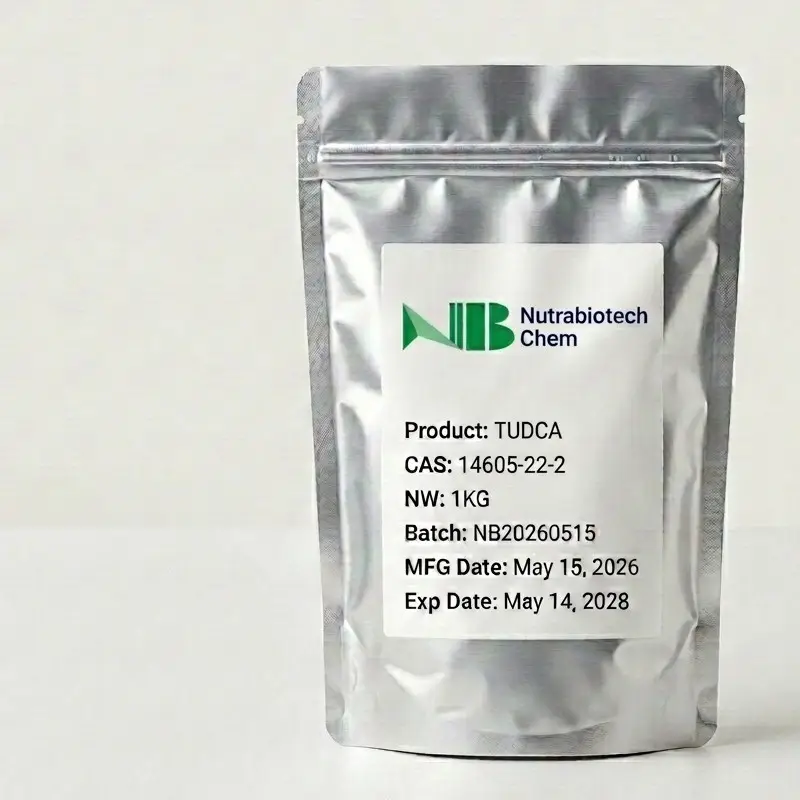
Tauroursodeoxycholic Acid / TUDCA CAS 14605-22-2
Endogenous Bile Acid & Chemical Chaperone — ER-Stress Inhibitor for Cholestasis & Neurodegeneration Research
Tauroursodeoxycholic acid (TUDCA; CAS 14605-22-2), the taurine conjugate of ursodeoxycholic acid (UDCA), is an endogenous hydrophilic tertiary bile acid that acts as a chemical chaperone and ER-stress inhibitor — reducing activation of GRP78, PERK, eIF2α, ATF4, IRE1α, JNK, p38, and CHOP, stabilizing mitochondria, and suppressing apoptosis. Effective in cholestatic liver disease, neurodegeneration (AD/PD/HD), diabetes and airway disease. Molecular formula C26H45NO6S, MW 499.70. Research-grade with COA.
Molecular Information
CAS: 14605-22-2
Formula: C26H45NO6S
MW: 499.70 g/mol
Class: Bile acid / Chemical chaperone
Core: Taurine conjugate of ursodeoxycholic acid (UDCA)
Target: ER-stress / UPR pathway
Activity: Chemical chaperone; mitochondrial stabilizer
Appearance: White to off-white powder
Solubility: DMSO, water, ethanol (50-100 mg/mL)
Clinical: Phase 3 (ALS), Phase 2 (cholestasis)
Synonyms: TUDCA / Taurursodiol
Storage: -20 C powder / -80 C solvent
Product Technical Specifications
Complete physicochemical properties and QC parameters for Tauroursodeoxycholic Acid (CAS 14605-22-2)
📋 Physicochemical Properties
- Product NameTauroursodeoxycholic Acid (TUDCA)
- IUPAC Core2-[[(4R)-4-[(3R,5S,7S,8R,9S,10S,13R,14S,17R)-3,7-dihydroxy-10,13-dimethyl-2,3,4,5,6,7,8,9,11,12,14,15,16,17-tetradecahydro-1H-cyclopenta[a]phenanthren-17-yl]pentanoyl]amino]ethanesulfonic acid
- CAS Number14605-22-2
- SynonymsTUDCA; Taurursodiol; Taurine conjugate of ursodeoxycholic acid
- Molecular FormulaC26H45NO6S
- Molecular Weight499.70 g/mol
- SourceEndogenous hydrophilic tertiary bile acid (low-level in humans); ursodeoxycholic acid taurine conjugate
- AppearanceWhite to off-white powder
- SMILESCC(CCC(=O)NCCS(=O)(=O)O)C1CCC2C1(CCC3C2C(CC4C3(CCC(C4)O)C)O)C
- Compound ClassBile acid / Chemical chaperone
- StereochemistryMultiple defined stereocenters (ursodeoxycholic backbone)
- NatureEndogenous ambiphilic hydrophilic tertiary bile acid
- HS Code2935.99
🔬 Quality Control & Handling
- Purity (HPLC)≥98%
- FormPowder
- Primary TargetEndoplasmic reticulum stress / Unfolded protein response (UPR)
- Pathway Readout↓ p-PERK, p-eIF2α, ATF4, p-IRE1α, p-JNK, p-p38, CHOP; ↑ BCL-2 / ↓ Bax, cl-casp3, cl-PARP-1
- Key BindingPrevents GRP78-PERK dissociation
- Other Readouts↑ PrPC expression; mitochondrial membrane stabilization
- Typical Cell Conc.100 uM (MSC pretreat 30 min; 50-500 uM range)
- Typical In Vivo0.5-5 mg/kg (airway); 100-500 mg/kg oral (liver)
- SolubilityDMSO 100 mg/mL; water 100 mg/mL; ethanol 50 mg/mL
- Storage Condition-20 C powder (3 yrs); -80 C solvent (1 yr); -20 C solvent (1 mo)
- Solution StabilityAliquot to avoid freeze-thaw
- ShippingRoom temperature (stable in transit)
- QC DocumentationCOA / HPLC / NMR / MS / MSDS
- Pack Sizes10G / 100G / 1KG / 10KG / 25KG / 1Ton
- Stock StatusIn Stock
- Use StatementResearch use only; not for human/clinical use
Key Molecular Targets & Pathway Nodes
TUDCA's reach spans the ER-stress sensors (PERK / IRE1α / ATF6 arms of the UPR), the downstream apoptotic machinery, and mitochondrial stability — covering hepatocyte, neuronal, beta-cell and airway biology.
How TUDCA Works: Chaperoning ER Protein Folding to Suppress the Pro-Apoptotic UPR
TUDCA stabilizes protein folding in the ER, prevents GRP78-PERK dissociation, and shuts down the PERK / IRE1α / CHOP apoptotic arm — while stabilizing mitochondria and shifting BCL-2/Bax toward survival.
ER Stress & the Unfolded Protein Response
When misfolded proteins accumulate in the ER, the chaperone GRP78/BiP dissociates from the three UPR sensors (PERK, IRE1α, ATF6). Their activation triggers downstream eIF2α phosphorylation, ATF4 induction, JNK/p38 signaling, and CHOP expression — the pro-apoptotic arm of the UPR. This pathway drives cell death in cholestasis, neurodegeneration (AD/PD/HD), diabetes, and airway inflammation.
Chemical-Chaperone Stabilization of Folding
TUDCA acts as a chemical chaperone that stabilizes protein folding in the ER, reducing the burden of misfolded proteins and preventing the GRP78-PERK dissociation that initiates the UPR. Downstream activation of eIF2α, ATF4, IRE1α, JNK, p38, and CHOP is significantly attenuated, removing the pro-apoptotic drive while preserving productive folding.
Mitochondrial & Apoptotic Protection
Beyond the ER, TUDCA stabilizes mitochondrial membranes and shifts the BCL-2/Bax ratio toward survival — increasing BCL-2 and decreasing Bax, cleaved caspase-3, and cleaved PARP-1. It also increases PrPC expression and regulates stem-cell differentiation into adipogenic/osteogenic lineages — translating to in vivo efficacy in MSC transplantation, cholestasis, neurodegeneration and Phase 3 ALS trials.
⚖️ TUDCA vs UDCA vs 4-PBA
- TUDCA (this product)Taurine conjugate; more hydrophilic; stronger per-mole chaperone
- UDCA (ursodiol)Free bile acid; approved drug for PBC & gallstones
- 4-PBASynthetic chemical chaperone; HDAC inhibitor; parallel ER-stress tool
- Shared MechanismAll three reduce ER stress & UPR markers
- Key DistinctionTUDCA combines ER-chaperone + mitochondrial stabilization
- Clinical StageTUDCA Phase 3 (ALS); UDCA approved; 4-PBA clinical use
♻️ Downstream Biological Consequences
- ER-Stress Sensors↓ PERK / IRE1α / ATF6 activation
- UPR Downstream↓ p-eIF2α, ATF4, p-JNK, p-p38, CHOP
- Apoptosis↑ BCL-2; ↓ Bax, cl-casp3, cl-PARP-1
- MitochondriaStabilized membrane potential
- PrPC↑ Cellular prion protein expression
- Tissue EffectsLiver, brain, beta-cell, airway, MSC protection
Research Applications & Models
From cholestatic liver disease to ALS clinical trials and ER-stress mechanistic probes, TUDCA spans hepatology, neurology, endocrinology and stem-cell biology.
Cholestatic Liver Disease
The clinically validated indication — TUDCA improves intrahepatic cholestasis by protecting hepatocytes from bile-acid-induced ER stress and apoptosis (Phase 2 clinical trial).
Cholestasis / liverNeurodegeneration (AD / PD / HD)
Mitochondrial stabilizer and anti-apoptotic agent in models of Alzheimer's, Parkinson's, and Huntington's disease — protects neurons from protein-misfolding and ER-stress toxicity.
AD / PD / HDAmyotrophic Lateral Sclerosis (ALS)
TUDCA is in Phase 3 clinical development for ALS (NCT05753852) — combining ER-stress protection with mitochondrial stabilization in motor-neuron degeneration.
Phase 3 / ALSMesenchymal Stem-Cell Transplant
Pretreatment of MSCs with TUDCA (100 μM, 30 min) augments survival, vessel formation, and blood perfusion after transplantation in hindlimb ischemia — via PrPC upregulation.
MSCs / PrPCAirway Disease & Asthma
Attenuates HDM-induced ER stress, airway inflammation, mucus metaplasia, airway remodeling, and methacholine-induced airway hyper-responsiveness (0.5-5 mg/kg).
Airway / asthmaDiabetes & Metabolic Disease
ER-stress protection in pancreatic beta-cells; improves glucose homeostasis by preventing UPR dysfunction — central to metabolic disease ER-stress research.
Beta-cell / diabetesKey Literature & Landmark Publications
The pharmacology and clinical validation of TUDCA as a chemical chaperone and ER-stress inhibitor.
Available Sizes & Ordering
Research-grade Tauroursodeoxycholic Acid (CAS 14605-22-2) with full QC documentation; standard packs and bulk custom quantities supported.
| Tier | Pack Size | Stock Status | Suitable For | Lead Time |
|---|---|---|---|---|
| Standard | 10G | In Stock | UPR / ER-stress cell assays | Same/next-day ship |
| Medium | 100G | In Stock | Mitochondrial & apoptosis studies | Same/next-day ship |
| Large | 1KG | In Stock | In vivo dosing & formulation work | Same/next-day ship |
| Bulk | 10KG | Made to order | Pilot / process scale, CMO supply | Quote to confirm |
| Industrial | 25KG | Made to order | Production-scale supply | Batch delivery |
| Industrial | 1Ton | Made to order | Production-scale synthesis | Batch delivery |
💡 Reference sizes shown above; for exact pricing and availability please contact us for a quote. Bulk orders qualify for tiered discounts.
Frequently Asked Questions (FAQ)
What is TUDCA and what does it do?
How is TUDCA different from ursodeoxycholic acid (UDCA)?
What is the mechanism of ER-stress inhibition?
What are the key experimental readouts for TUDCA?
How soluble is TUDCA and how should it be prepared?
Is QC documentation provided? Can I request a sample?
Need Tauroursodeoxycholic Acid (TUDCA) for Your Research?
Research-grade Tauroursodeoxycholic Acid (CAS 14605-22-2) — purity ≥98% HPLC, COA included
The endogenous bile-acid chemical chaperone — ER-stress inhibitor and mitochondrial stabilizer for cholestasis, neurodegeneration, and stem-cell research — request a quote today