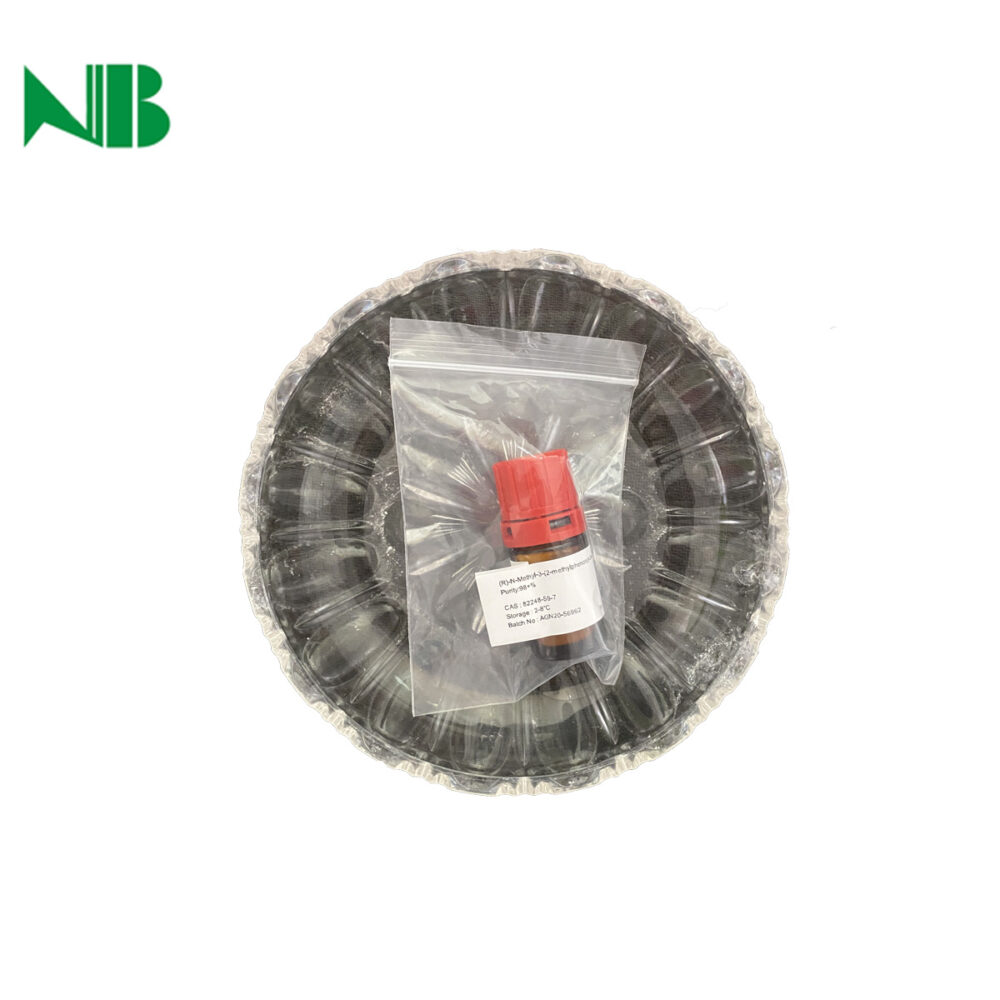
Atomoxetine HCl CAS 82248-59-7
Selective Norepinephrine Reuptake Inhibitor
A highly selective norepinephrine transporter (NET/SLC6A2) inhibitor and the first non-stimulant approved by the FDA for ADHD (2002). Atomoxetine produces a region-selective elevation of norepinephrine and dopamine in the prefrontal cortex without increasing dopamine in the nucleus accumbens or striatum — the pharmacological basis of its low abuse liability. A CYP2D6 substrate with a well-characterized poor-metabolizer phenotype, it is a cornerstone reference compound for noradrenergic, attention, and pharmacogenetics research.
Molecular Information
CAS (HCl): 82248-59-7
CAS (free base): 83015-26-3
Formula: C17H21NO·HCl
MW: 291.82 (salt) / 255.36 (base)
SMILES: CC1=C(C=CC=C1)O[C@H]
(CCNC)C2=CC=CC=C2
InChIKey: LUCXVPAZUDVVBT
-UNTBIKODSA-N
Chirality: R(-) isomer
Appearance: White to practically white solid
Synonyms: Atomoxetine HCl /
Strattera (Eli Lilly)
Storage: Room temperature, dry
Product Technical Specifications
Complete physicochemical, pharmacokinetic and QC parameters for Atomoxetine Hydrochloride (CAS 82248-59-7)
📋 Physicochemical Properties
- Product NameAtomoxetine Hydrochloride
- IUPAC Name(-)-N-Methyl-3-phenyl-3-(o-tolyloxy)-propylamine hydrochloride
- CAS (HCl salt)82248-59-7
- CAS (free base)83015-26-3
- SynonymsAtomoxetine HCl; Tomoxetine HCl; LY139603; Strattera
- Molecular FormulaC17H21NO·HCl
- Molecular Weight291.82 (salt) / 255.36 (base)
- SMILES (free base)CC1=C(C=CC=C1)O[C@H](CCNC)C2=CC=CC=C2
- InChIKey (HCl)LUCXVPAZUDVVBT-UNTBIKODSA-N
- Optical RotationR(-) isomer, levorotatory
- AppearanceWhite to practically white solid
- SolubilityWater 27.8 mg/mL; DMSO; Ethanol
- Drug ClassSelective norepinephrine reuptake inhibitor (sNRI)
- HS Code2922.19
🔬 Quality Control, PK & Handling
- Purity (HPLC)≥98%
- FormCrystalline solid / powder
- Oral Bioavailability63–94%
- Elimination Half-life~5 h (CYP2D6 EM) / ~24 h (CYP2D6 PM)
- Plasma Protein Binding98% (mainly albumin)
- Primary MetabolismCYP2D6 → 4-hydroxyatomoxetine
- Storage ConditionRoom temperature, dry, sealed
- ShippingAmbient; desiccated packaging
- QC DocumentationCOA / HPLC / NMR / MS / MSDS
- Pack Sizes1g / 5g / 10g / 100g / 1KG
- Stock StatusIn Stock
- Use StatementResearch use only; not for human/clinical use
Key Molecular Targets & Transporter Selectivity Profile
Atomoxetine's defining feature is its high selectivity for the norepinephrine transporter over dopamine and serotonin transporters and over monoamine receptors
How Atomoxetine Works: Selective Noradrenergic Modulation of the Prefrontal Cortex
Atomoxetine's therapeutic profile emerges from three linked pharmacological principles — transporter selectivity, regional dopamine specificity, and sustained tonic modulation
Selective NET Blockade
Atomoxetine binds the presynaptic norepinephrine transporter (NET, SLC6A2) with high affinity, blocking reuptake of norepinephrine into the presynaptic terminal and raising synaptic NE. Affinity for SERT is substantially lower and for DAT lower still, giving a clean noradrenergic signature.
Region-Selective Dopamine Increase
In the prefrontal cortex, dopamine is cleared predominantly by NET rather than DAT because DAT expression is sparse. NET blockade therefore raises both NE and DA in the PFC — while leaving dopamine in the nucleus accumbens and striatum unchanged (Bymaster et al., 2002), which explains its low abuse liability.
Sustained Tonic Modulation
Rather than producing acute phasic monoamine surges like stimulants, atomoxetine delivers continuous tonic enhancement of catecholamine signaling. Clinical benefit accumulates over 2–4 weeks, consistent with adaptive changes in α2A/α1 receptor signaling and prefrontal network efficiency.
🧠 Secondary Pharmacology
- SERT BindingMeasurable but lower affinity; may contribute to mood effects
- NMDA ReceptorNon-competitive blockade reported at higher concentrations
- Receptor PanelNo meaningful affinity for muscarinic, histaminic, or adrenergic receptors
- Monoamine ReleaseNot a releasing agent (unlike amphetamine)
- Reward CircuitNo accumbal DA elevation → non-controlled substance
🧫 CYP2D6 Pharmacogenetic Profile
- Primary EnzymeCYP2D6
- Main Metabolite4-Hydroxyatomoxetine (equipotent, low exposure)
- Poor Metabolizers (PM)~7% of Caucasians; 1–2% East Asian
- PM Exposure~10× higher AUC vs extensive metabolizers
- Half-life EM vs PM~5 h vs ~24 h
- Interaction RiskPotent CYP2D6 inhibitors (paroxetine, fluoxetine, quinidine)
Research Applications & Disease Models
Atomoxetine is used across neuropsychopharmacology, cognitive neuroscience, pediatric research and pharmacogenetics as a selective noradrenergic probe
ADHD — First-Line Non-Stimulant
The first non-stimulant approved by the FDA for ADHD (2002), indicated in children aged ≥6 years, adolescents and adults. Used as the benchmark comparator in non-stimulant efficacy studies, in patients with comorbid tics, anxiety, or substance use history, and where stimulant diversion is a concern.
FDA Approved 2002Norepinephrine Transporter Biology
A gold-standard selective NET (SLC6A2) inhibitor for transporter binding assays, uptake inhibition studies, occupancy PET imaging, and knockout/knock-in mouse validation. Widely used to dissect noradrenergic contributions to arousal, attention and stress physiology.
NET / SLC6A2Prefrontal Cortex Dopamine Research
Microdialysis studies (Bymaster et al., Neuropsychopharmacology 2002) established that atomoxetine elevates prefrontal DA and NE while leaving nucleus accumbens and striatal DA unchanged — a defining model for studying region-specific catecholamine regulation and abuse liability.
Region-Selective DACYP2D6 Pharmacogenetics
A canonical CYP2D6 probe substrate. Poor metabolizers show ~10-fold higher AUC and prolonged half-life, making atomoxetine a model compound for genotype-guided dosing, phenotype–genotype correlation studies, DDI modeling, and PBPK simulation work.
PharmacogenomicsPediatric Psychopharmacology
Extensive pediatric evidence base including Kratochvil et al. (JAACAP 2002). Used in studies of growth, cardiovascular safety, long-term tolerability and dose-response in children and adolescents, and as a reference agent in pediatric clinical trial design.
Age ≥6 YearsCombination & Adjunct Therapy
Investigated as an adjunct to psychostimulants in partial responders, and in combination with α2A agonists (guanfacine, clonidine). Research explores complementary tonic (atomoxetine) versus phasic (stimulant) catecholamine modulation.
Adjunct ResearchDepression & Augmentation
Investigational use as a noradrenergic augmentation strategy in treatment-resistant depression and in ADHD with comorbid mood symptoms. Its SERT affinity and NE-mediated effects make it a useful probe of noradrenergic contributions to affective regulation.
InvestigationalCognitive Neuroscience
Widely used in human and animal studies of sustained attention, response inhibition, stop-signal reaction time, working memory and executive function. A key pharmacological tool for probing the noradrenergic locus coeruleus–prefrontal axis.
Executive FunctionAnalytical & Reference Standard Use
Used as an analytical reference standard for HPLC/UPLC-MS method development, chiral purity determination of the R(-) enantiomer, impurity profiling, dissolution testing, and bioanalytical assay validation in plasma and urine matrices.
Reference StandardKey Literature & Landmark Publications
Seminal papers on atomoxetine's mechanism, clinical efficacy, and pharmacogenetics
Available Sizes & Ordering
Research-grade Atomoxetine Hydrochloride (CAS 82248-59-7) with full QC documentation; research packs and bulk custom quantities supported
| Tier | Pack Size | Stock Status | Suitable For | Lead Time |
|---|---|---|---|---|
| Standard | 1 g | In Stock | Receptor binding & uptake assays | Same/next-day ship |
| Medium | 5 g | In Stock | In vivo behavioral pharmacology, microdialysis | Same/next-day ship |
| Large | 10 g | In Stock | Multi-lab collaborations, chronic dosing studies | Same/next-day ship |
| Bulk | 100 g | In Stock | Formulation and process development | Quote to confirm |
| Industrial | 1 KG | Made to order | Pilot/production scale, CMO supply | Batch delivery |
💡 Reference sizes shown above; for exact pricing and availability please contact us for a quote. Bulk orders qualify for tiered discounts.
Frequently Asked Questions (FAQ)
What is Atomoxetine Hydrochloride (CAS 82248-59-7)?
How does Atomoxetine differ from stimulants like methylphenidate or amphetamine?
Why is CYP2D6 genotype so important for Atomoxetine?
Does Atomoxetine have abuse potential?
How quickly does Atomoxetine take effect?
Is Atomoxetine appropriate for pediatric research?
What are Atomoxetine's key pharmacokinetic parameters?
How should Atomoxetine HCl be dissolved and stored for laboratory use?
What is the significance of the R(-) enantiomer?
Is QC documentation provided? Can I request a sample?
Need Atomoxetine Hydrochloride for Your Research?
Research-grade Atomoxetine HCl (CAS 82248-59-7) — purity ≥98% HPLC, COA included
A selective NET inhibitor and non-stimulant ADHD reference compound — request a quote today