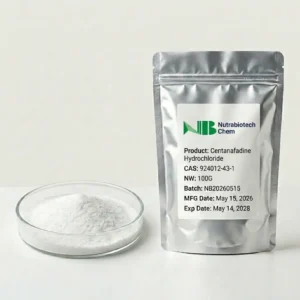
β-Estradiol CAS 50-28-2
17β-Estradiol (E2) — ERα / ERβ Agonist
The primary and most potent endogenous estrogen in humans, and the reference agonist for the nuclear estrogen receptors ERα (ESR1) and ERβ (ESR2) as well as the membrane receptor GPER (GPR30). 17β-Estradiol drives both classical genomic transcription through estrogen response elements and rapid non-genomic kinase signalling, making it indispensable in estrogen receptor biology, menopause and HRT research, bone health, neuroprotection, ER-positive breast and endometrial cancer models, cardiovascular biology and reproductive endocrinology.
Molecular Information
CAS: 50-28-2
Formula: C18H24O2
MW: 272.38 g/mol
Purity: ≥98% (HPLC)
Solubility: DMSO; ethanol (~50 mg/mL);
poorly water soluble
SMILES: C[C@]12CC[C@H]3[C@@H]
(CCc4cc(O)ccc34)[C@@H]1CC[C@@H]2O
InChIKey: VOXZDWNPVJITMN
-ZBRFXRBCSA-N
MP: 176-180°C
Appearance: White to off-white crystalline powder
Synonyms: E2 / Estradiol /
1,3,5(10)-Estratriene-3,17β-diol
Storage: Sealed, dry, protect from light
17β-Estradiol Technical Specifications & Quality Control Data
Complete physicochemical properties, structural identifiers and QC release parameters for research-grade β-Estradiol (CAS 50-28-2)
📋 Physicochemical Properties
- Product Nameβ-Estradiol (17β-Estradiol)
- IUPAC Name(8R,9S,13S,14S,17S)-13-Methyl-6,7,8,9,11,12,13,14,15,16,17-dodecahydro-cyclopenta[a]phenanthrene-3,17-diol
- CAS Number50-28-2
- Common AbbreviationE2
- SynonymsEstradiol / Dihydrofolliculin / 1,3,5(10)-Estratriene-3,17β-diol
- Molecular FormulaC18H24O2
- Molecular Weight272.38 g/mol
- Exact Mass272.1776 Da
- SMILESC[C@]12CC[C@H]3[C@@H](CCc4cc(O)ccc34)[C@@H]1CC[C@@H]2O
- InChIKeyVOXZDWNPVJITMN-ZBRFXRBCSA-N
- Stereocentres5 defined (8R, 9S, 13S, 14S, 17S)
- AppearanceWhite to off-white crystalline powder
- Melting Point176-180°C
- MDL NumberMFCD00003693
- PubChem CID5757
- EC Number200-023-8
🔬 Quality Control & Handling
- Purity (HPLC)≥98%
- Identity1H-NMR / 13C-NMR / LC-MS conform
- FormCrystalline powder
- ColorWhite to off-white
- Loss on Drying≤0.5%
- Residue on Ignition≤0.1%
- Heavy Metals≤20 ppm
- Storage ConditionRoom temp or 2-8°C, sealed, protect from light
- SolubilityEthanol ~50 mg/mL (clear, colorless); DMSO; poorly soluble in water
- GHS ClassificationDanger; H351 Carc. 2; H360FD Repr. 1A; H362 Lact.; H410 Aquatic Chronic 1
- Cell Culture SuitabilitySuitable (mammalian)
- QC DocumentationCOA / HPLC / NMR / MS / MSDS
- Pack Sizes1g / 5g / 10g / 100g / 1KG
- Stock StatusIn Stock
- Use StatementResearch use only; not for human or clinical use
Estrogen Receptor Targets & Downstream Signalling Nodes
17β-Estradiol engages nuclear and membrane estrogen receptors, then propagates through a broad transcriptional and kinase network across virtually every organ system
How 17β-Estradiol Works: Genomic and Non-Genomic Mechanism of Action
Estradiol signalling operates on two timescales — a slow transcriptional programme measured in hours and a rapid membrane-initiated kinase response measured in seconds
Membrane Diffusion & Receptor Binding
As a small lipophilic steroid, 17β-estradiol crosses the plasma membrane freely and binds the ligand-binding domain (LBD) of ERα or ERβ with sub-nanomolar affinity. The phenolic A-ring 3-OH and the 17β-OH form the critical hydrogen-bond anchor points with Glu353/Arg394 and His524.
Helix 12 Repositioning
Agonist binding folds helix 12 of the LBD across the ligand pocket, creating the AF-2 coactivator groove. This is the conformational switch first visualised in the Brzozowski et al. Nature 1997 crystal structures that distinguishes agonists from SERMs such as raloxifene.
Chaperone Release & Dimerisation
Heat shock protein chaperones (HSP90, HSP70) dissociate, the receptor is phosphorylated, and two liganded receptors form ERα/ERα, ERβ/ERβ homodimers or ERα/ERβ heterodimers, each with distinct transcriptional output.
ERE Binding & Transcription
The dimer engages estrogen response elements in target gene promoters via its zinc-finger DNA-binding domain and recruits SRC-1, CBP/p300 and the mediator complex, activating transcription of cyclin D1, c-Myc, PGR, TFF1/pS2 and hundreds of other estrogen-responsive genes.
Rapid Non-Genomic Signalling
A palmitoylated membrane pool of ER and the GPCR GPER (GPR30) trigger second-messenger responses within seconds to minutes: cAMP generation, intracellular calcium flux, PI3K/AKT activation, MAPK/ERK phosphorylation and eNOS-derived nitric oxide release causing vasodilation.
Tissue-Specific Physiological Output
The integrated response is tissue dependent: proliferation and differentiation in mammary and endometrial epithelium, suppression of osteoclastogenesis via the RANKL/OPG axis in bone, neurotrophic and anti-apoptotic effects in CNS neurons, and endothelial protection in the vasculature.
17β-Estradiol Research Applications & Experimental Models
E2 is one of the most widely deployed reference hormones in biomedical research, spanning nuclear receptor pharmacology, oncology, skeletal biology, neuroscience and reproductive endocrinology
Estrogen Receptor Biology & Nuclear Receptor Pharmacology
The gold-standard full agonist for ERα and ERβ in competitive radioligand binding, fluorescence polarisation, ERE-luciferase reporter, coactivator recruitment and ChIP-seq experiments. Serves as the positive control against which SERMs (tamoxifen, raloxifene) and SERDs (fulvestrant) are benchmarked.
Reference AgonistMenopause & Hormone Replacement Therapy Research
Estradiol decline at menopause drives vasomotor symptoms, urogenital atrophy, accelerated bone loss and altered cardiometabolic risk. E2 is used in ovariectomised rodent models to reconstruct the postmenopausal state and to test HRT regimens, tissue-selective estrogen complexes and phytoestrogen alternatives.
HRT & MenopauseBone Health & Osteoporosis
Estradiol suppresses osteoclastogenesis by shifting the RANKL/OPG ratio and promoting osteoclast apoptosis while supporting osteoblast survival. Central to ovariectomy-induced osteoporosis models, micro-CT bone density studies and osteoblast/osteoclast co-culture assays.
Skeletal BiologyNeuroprotection & Neuroendocrinology
E2 upregulates BDNF, enhances hippocampal spine density and synaptic plasticity, and reduces excitotoxic and oxidative neuronal injury. Applied in stroke, Alzheimer's disease, traumatic brain injury and cognitive ageing models, and in hypothalamic-pituitary-gonadal axis feedback studies.
CNS ResearchER-Positive Breast & Endometrial Cancer
Roughly 70-80% of breast cancers are ER-positive. Estradiol is the canonical proliferative stimulus in MCF-7, T47D, ZR-75-1 and Ishikawa cell models, in endocrine-resistance studies (ESR1 mutations, CDK4/6 inhibitor combinations) and in estrogen-dependent xenograft experiments.
OncologyCardiovascular & Vascular Biology
Rapid non-genomic activation of eNOS produces nitric oxide-dependent vasodilation; E2 also modulates lipid profiles, endothelial repair and vascular inflammation. Used in endothelial cell culture, aortic ring myography and atherosclerosis models to probe the female cardiovascular protection hypothesis.
VascularReproductive Endocrinology & Fertility
Essential for follicular development, endometrial receptivity, oocyte maturation and the LH surge. Routinely supplemented in in vitro maturation (IVM) media for bovine and porcine cumulus-oocyte complexes and in embryo implantation and uterotrophic assay protocols.
Reproductive BiologyEndocrine Disruption & Environmental Toxicology
17β-Estradiol is the mandated reference estrogen in OECD-aligned screening assays including the uterotrophic bioassay, E-SCREEN, ER transactivation (ERTA) and yeast estrogen screen (YES). It anchors the potency scale used to characterise bisphenols, parabens and other suspected endocrine disruptors.
Regulatory StandardAnalytical Chemistry & Immunoassay Calibration
Used as a certified-quality reference standard for LC-MS/MS and GC-MS quantification of steroid panels, for ELISA and chemiluminescence immunoassay calibration curves, and for method validation in clinical endocrinology and anti-doping laboratories.
Reference StandardKey Publications on Estradiol & Estrogen Receptor Biology
Foundational literature spanning receptor discovery, structural biology and clinical endocrinology
β-Estradiol Pack Sizes & Ordering Information
Research-grade 17β-Estradiol (CAS 50-28-2) supplied in 1g / 5g / 10g / 100g / 1KG with full QC documentation; custom bulk quantities supported
| Tier | Pack Size | Stock Status | Suitable For | Shipping & Lead Time |
|---|---|---|---|---|
| Standard | 1 g | In Stock | ERE-reporter assays, MCF-7 proliferation, receptor binding studies | Ambient shipping in amber container; same/next-day dispatch |
| Medium | 5 g | In Stock | Ovariectomised rodent models, pellet implantation, uterotrophic assays | Ambient shipping; same/next-day dispatch |
| Large | 10 g | In Stock | Long-term in vivo studies, multi-lab consortia, screening campaigns | Ambient shipping; same/next-day dispatch |
| Bulk | 100 g | In Stock | Formulation development, transdermal and implant research, standard production | Carton or drum, light-protected; quote to confirm dispatch |
| Industrial | 1 KG | Made to order | Pilot and production scale, CMO/CDMO supply, process validation batches | Drum shipment with batch COA; scheduled batch delivery |
💡 Reference pack sizes shown above; for exact pricing, lot availability and bulk 17β-estradiol supply please contact us for a quote. Tiered discounts apply to bulk orders.
β-Estradiol FAQ — Frequently Asked Questions
Common technical and scientific questions about 17β-estradiol pharmacology, handling and sourcing
What is β-Estradiol (CAS 50-28-2) and why is it called E2?
17β-Estradiol vs 17α-estradiol — which one do I need?
What is the difference between ERα and ERβ, and does estradiol prefer one?
How does estradiol produce effects within seconds if it works through transcription?
Why is estradiol associated with breast and endometrial cancer risk?
How should I dissolve and store 17β-estradiol for cell culture?
What concentration of estradiol should I use in vitro?
Is 17β-estradiol used as a regulatory reference standard?
What safety precautions apply when handling estradiol powder?
What purity, documentation and pack sizes are available?
Need 17β-Estradiol for Your Endocrinology Research?
Research-grade β-Estradiol (CAS 50-28-2) — C18H24O2, MW 272.38, purity ≥98% HPLC, COA included
The reference ERα/ERβ agonist for estrogen receptor biology — available 1g to 1KG