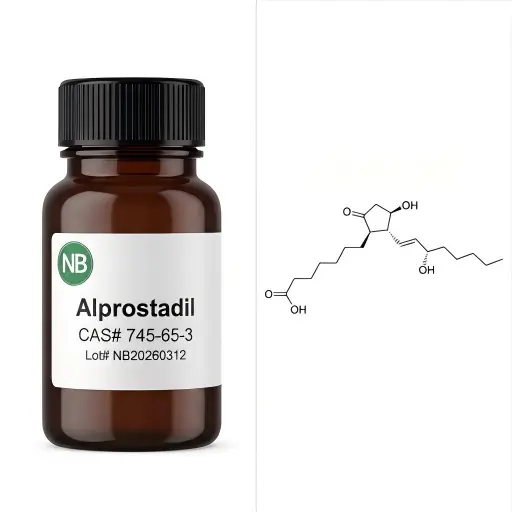
Alprostadil CAS 745-65-3
Prostaglandin E1 (PGE1) — EP Receptor Agonist
A naturally occurring 20-carbon eicosanoid derived from dihomo-γ-linolenic acid, alprostadil is a broad-spectrum agonist at the EP1, EP2, EP3 and EP4 prostanoid receptors. Gs-coupled EP2/EP4 activation raises intracellular cAMP, producing potent vasodilation, vascular and cavernosal smooth muscle relaxation and inhibition of platelet aggregation. The reference prostaglandin for erectile dysfunction, patent ductus arteriosus (PDA), peripheral arterial disease and critical limb ischemia research.
Molecular Information
CAS: 745-65-3
Formula: C20H34O5
MW: 354.48 g/mol
Purity: ≥98% (HPLC)
SMILES: CCCCC[C@H](O)/C=C/
[C@H]1[C@@H](O)CC(=O)
[C@@H]1CCCCCCC(=O)O
InChIKey: GMVPRGQOIOIIMI
-DWKJAMRDSA-N
MP: ~115-116°C
Appearance: White to off-white powder
Solubility: Ethanol, DMSO, methanol
Synonyms: Prostaglandin E1 / PGE1
Storage: -20°C, protect from light & heat
Alprostadil (PGE1) Technical Specifications & QC Data
Complete physicochemical properties and quality control parameters for research-grade Alprostadil / Prostaglandin E1 powder (CAS 745-65-3)
📋 Physicochemical Properties
- Product NameAlprostadil (Prostaglandin E1)
- IUPAC Name7-[(1R,2R,3R)-3-Hydroxy-2-[(1E,3S)-3-hydroxyoct-1-en-1-yl]-5-oxocyclopentyl]heptanoic acid
- CAS Number745-65-3
- SynonymsPGE1 / Prostaglandin E1 / Alprostadilum
- Molecular FormulaC20H34O5
- Molecular Weight354.48 g/mol
- Exact Mass354.241 Da
- Stereochemistry9-oxo, 11α-OH, 15S-OH, 13E
- SMILESCCCCC[C@H](O)/C=C/[C@H]1[C@@H](O)CC(=O)[C@@H]1CCCCCCC(=O)O
- InChIKeyGMVPRGQOIOIIMI-DWKJAMRDSA-N
- AppearanceWhite to off-white crystalline powder
- Melting Point~115-116°C
- Biosynthetic PrecursorDihomo-γ-linolenic acid (DGLA)
- MDL NumberMFCD00078661
- PubChem CID5280723
🔬 Quality Control & Handling
- Purity (HPLC)≥98%
- Related SubstancesPGA1 / PGB1 / 15-keto-PGE1 controlled
- FormCrystalline powder / lyophilized solid
- ColorWhite to off-white
- Storage Condition-20°C, sealed, dry, protect from light
- Stability NoteHeat/acid/base labile — dehydrates to PGA1 then isomerizes to PGB1
- ShippingCold chain with gel/dry ice recommended
- SolubilityEthanol, methanol, DMSO, DMF; sparingly soluble in water
- QC DocumentationCOA / HPLC / NMR / MS / optical rotation / MSDS
- Pack Sizes1g / 5g / 10g / 100g / 1KG
- Stock StatusIn Stock
- Use StatementResearch use only; not for human/clinical use
Prostanoid Receptor Targets & Signaling Partners
Alprostadil is a broad-spectrum E-prostanoid agonist — its tissue-specific effects are dictated by which EP subtype and G-protein predominate in a given cell type
How Alprostadil Works: From EP Receptor Binding to Vasodilation
A stepwise view of the cAMP-dependent signaling cascade that underpins PGE1's vasodilator, antiplatelet and smooth muscle relaxant activity
Biosynthesis from DGLA
Endogenous PGE1 is generated from dihomo-γ-linolenic acid via cyclooxygenase (COX-1/COX-2) and PGE synthase, forming the 1-series prostaglandin with a single omega-chain double bond.
EP Receptor Engagement
Alprostadil binds the four E-prostanoid GPCR subtypes. Vasodilator effects are driven mainly by Gs-coupled EP2 and EP4; EP1 (Gq) raises Ca²⁺ and EP3 (Gi) lowers cAMP, giving tissue-dependent pharmacology.
Adenylyl Cyclase → cAMP Rise
Gs activation stimulates adenylyl cyclase, sharply increasing intracellular cyclic AMP in vascular smooth muscle, corpus cavernosum smooth muscle, ductal myocytes and platelets.
PKA Activation & Ca²⁺ Fall
cAMP activates protein kinase A, which phosphorylates myosin light chain kinase, promotes sarcoplasmic Ca²⁺ sequestration and opens K channels — lowering cytosolic calcium and relaxing the contractile apparatus.
Vasodilation & Platelet Inhibition
Arterial and arteriolar smooth muscle relaxes, increasing regional blood flow; in platelets the same cAMP/PKA rise suppresses GPIIb/IIIa activation, granule release and aggregation, and improves microcirculatory rheology.
Rapid Enzymatic Inactivation
PGE1 undergoes extensive first-pass metabolism in the lung (up to ~70-80% in a single circulation) via 15-hydroxyprostaglandin dehydrogenase, giving a plasma half-life of minutes — the basis for local/regional delivery strategies.
Research Applications of Alprostadil (Prostaglandin E1)
From urology and neonatal cardiology to vascular biology and prostanoid receptor pharmacology
Prostaglandin & Prostanoid Receptor Signaling
A cornerstone reference agonist for EP1-EP4 pharmacology. Used in cAMP accumulation assays, radioligand binding, β-arrestin recruitment, GloSensor reporter systems and receptor-deconvolution studies alongside selective tools such as butaprost (EP2), sulprostone (EP1/EP3) and L-902688 (EP4).
GPCR PharmacologyErectile Dysfunction & Cavernosal Smooth Muscle
Raises cAMP in corpus cavernosum smooth muscle through a pathway independent of the NO/cGMP/PDE5 axis, making it a key probe when PDE5-dependent signaling is impaired. Used in organ bath studies of human and rabbit cavernosal strips and intracavernosal pressure models. Clinically formulated for intracavernosal injection and intraurethral (MUSE) delivery.
Urology / MUSEPatent Ductus Arteriosus (PDA) & Neonatal Cardiology
PGE1 reactivates EP4 signaling in ductal smooth muscle to maintain ductus arteriosus patency in ductal-dependent congenital heart disease — a landmark application established by Freed et al. (Circulation 1981). Central to studies of oxygen-mediated ductal constriction and prostaglandin-dependent ductal tone.
Ductal PatencyPeripheral Arterial Disease & Critical Limb Ischemia
Studied for arteriolar vasodilation, enhanced microcirculatory perfusion, reduced leukocyte-endothelial adhesion and improved erythrocyte deformability. Typical endpoints include transcutaneous oxygen tension (TcPO₂), laser Doppler flux, ischemic ulcer healing and rest pain resolution.
Vascular MedicinePlatelet Biology & Antithrombotic Research
A classic cAMP-elevating platelet inhibitor used as a positive control in aggregometry, VASP phosphorylation assays, flow-chamber thrombus formation studies and platelet-rich plasma preparation protocols where reversible aggregation blockade is required.
HemostasisPulmonary Hypertension & Cardiac Research
Investigated as an inhaled and intravenous pulmonary vasodilator, for right ventricular afterload reduction, in ischemia-reperfusion injury protection and in vasoreactivity testing protocols in preclinical pulmonary hypertension models.
CardiopulmonaryEndothelial Function & Microcirculation
Used to probe endothelium-independent vasodilation, capillary recruitment, nitric oxide crosstalk, VEGF-associated angiogenic signaling and cAMP-dependent barrier stabilization in cultured endothelial monolayers and intravital microscopy models.
Microvascular BiologyInflammation & Immune Modulation
EP2/EP4-mediated cAMP elevation suppresses TNF-α production, modulates macrophage polarization, dampens T-cell proliferation and shapes dendritic cell maturation — making PGE1 a useful tool in immunopharmacology and cytokine regulation studies.
ImmunopharmacologyAnalytical Reference & Formulation Science
Supplied as a reference standard for LC-MS/MS eicosanoid profiling, prostaglandin impurity and degradation studies (PGA1/PGB1), lipid emulsion and cyclodextrin inclusion complex development, and stability-indicating method validation.
Reference StandardKey Publications on Alprostadil & Prostaglandin E1
From the Nobel Prize-winning isolation of prostaglandins to landmark clinical applications in urology and neonatal cardiology
Alprostadil Pack Sizes & Ordering Information
Research-grade Alprostadil / Prostaglandin E1 powder (CAS 745-65-3) available in 1g / 5g / 10g / 100g / 1KG with full QC documentation and cold-chain logistics
| Tier | Pack Size | Stock Status | Suitable For | Lead Time & Shipping |
|---|---|---|---|---|
| Standard | 1 g | In Stock | EP receptor cAMP assays, organ bath and platelet aggregation studies | Same/next-day ship; cold pack, amber vial |
| Medium | 5 g | In Stock | In vivo vascular pharmacology, ischemia and ductal patency models | Same/next-day ship; insulated cold chain |
| Large | 10 g | In Stock | Multi-arm preclinical programs, extended dosing studies | Same/next-day ship; DHL/FedEx cold chain |
| Bulk | 100 g | In Stock | Lipid emulsion and cyclodextrin formulation development, scale-up | Quote to confirm; light-protected drum, dry ice |
| Industrial | 1 KG | Made to order | Pilot/production scale, CMO supply, long-term supply agreements | Scheduled batch delivery; validated cold-chain freight |
💡 Reference sizes shown above; alprostadil is light- and heat-sensitive and ships under temperature-controlled conditions. For exact bulk pricing please contact us for a quote. Bulk orders qualify for tiered discounts.
Alprostadil (PGE1) FAQ — Frequently Asked Questions
What is Alprostadil (CAS 745-65-3) and how does it relate to prostaglandin E1?
What is the difference between PGE1 and PGE2?
Which EP receptors mediate alprostadil's vasodilator effect?
How is alprostadil used in erectile dysfunction (ED) research and what is MUSE?
How does alprostadil keep the ductus arteriosus open in neonates?
Why is alprostadil so unstable, and how should it be stored?
What solvents should be used to dissolve alprostadil?
Why does alprostadil have such a short half-life in vivo?
Can alprostadil be used as a platelet aggregation inhibitor control?
What documentation and pack sizes do you supply for alprostadil?
Need Alprostadil (Prostaglandin E1, CAS 745-65-3) for Your Research?
Research-grade Alprostadil / PGE1 powder — purity ≥98% HPLC, COA included, cold-chain shipping, 1g to 1KG
The reference EP receptor agonist for vasodilation, erectile dysfunction, PDA and prostanoid signaling research — request a quote today