Elamipretide CAS 736992-21-5
SS-31 Cardiolipin-Binding Mitochondrial Peptide
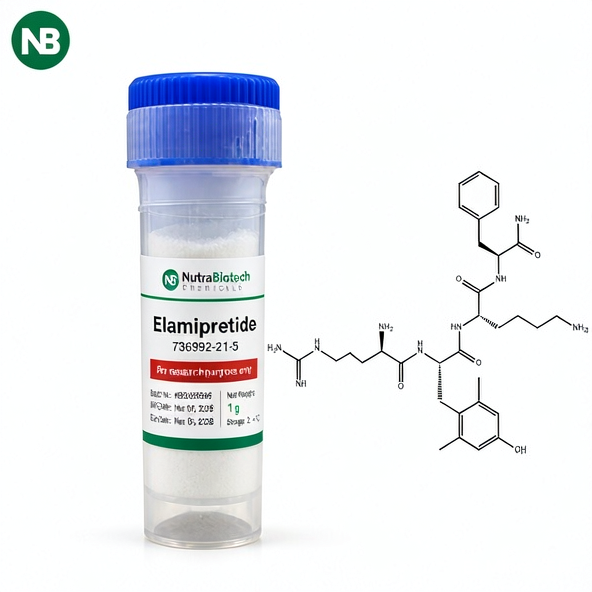
Elamipretide (SS-31, MTP-131; CAS 736992-21-5) is a synthetic aromatic-cationic tetrapeptide, H-D-Arg-Dmt-Lys-Phe-NH2, that concentrates at the inner mitochondrial membrane and binds cardiolipin, supporting cristae architecture and electron-transport function. In September 2025 the same molecule became the first therapy granted accelerated approval by the US FDA for Barth syndrome, marketed there as FORZINITY following the TAZPOWER trial. It is also widely used as a research probe in primary mitochondrial myopathy, geographic atrophy, cardiology and senescence models. Formula C32H49N9O5, MW 639.78. Research grade, ≥98% HPLC, shipped with COA.
Molecular Information
CAS: 736992-21-5
Sequence: H-D-Arg-Dmt-Lys-Phe-NH2
Formula: C32H49N9O5
MW: 639.78 g/mol (free peptide)
[M+H]+: 640.393 (calculated)
Class: Aromatic-cationic tetrapeptide amide
Family: Szeto-Schiller (SS) peptide
Net charge: Positive at neutral pH
Target: Inner mitochondrial membrane cardiolipin
Appearance: White lyophilised powder
Storage: -20 °C, dry, protect from light
Product Technical Specifications
Peptide identity, counter-ion handling and QC parameters for Elamipretide (CAS 736992-21-5)
📋 Peptide Identity
- Product NameElamipretide
- Peptide SequenceH-D-Arg-Dmt-Lys-Phe-NH2 (4 residues)
- Systematic ResiduesD-arginyl-2′,6′-dimethyl-L-tyrosyl-L-lysyl-L-phenylalaninamide
- CAS Number736992-21-5
- SynonymsElamipretide; SS-31; MTP-131; Bendavia; D-Arg-Dmt-Lys-Phe-NH2
- US Brand (finished drug)FORZINITY
- Non-standard ResidueDmt = 2′,6′-dimethyl-L-tyrosine
- Terminal ModificationsN-terminal D-arginine; C-terminal amide
- Molecular FormulaC32H49N9O5
- Molecular Weight639.78 g/mol (free peptide basis)
- Calculated [M+H]+640.393
- PubChem CID11764719
- FDA UNII87GWG91S09
- AppearanceWhite lyophilised powder
- SolubilityWater up to 100 mg/mL; DMSO ≥29 mg/mL
- HS Code2937.19 (peptide classification; confirm per destination)
🔬 Quality Control & Handling
- Purity (HPLC)≥98%
- FormLyophilised powder in sealed vial
- Identity ConfirmationMS to m/z 640.393 (formula level)
- Stereochemistry CheckChiral amino-acid analysis (not resolvable by MS)
- Binding PartnerCardiolipin, inner mitochondrial membrane
- Typical ReadoutsOCR; ATP; cardiolipin content; ROS; mPTP; cytochrome c peroxidase
- ReconstitutionSterile water, saline or bacteriostatic water; DMSO for organic stock
- Counter-ionAcetate or TFA; net peptide content stated per lot
- Storage (powder)-20 °C; -80 °C for longest term
- Storage (in solution)Aliquot at -80 °C up to 6 months; avoid repeated freeze-thaw
- ShippingCold chain recommended; ambient on request
- QC DocumentationCOA / HPLC / MS / chiral analysis / MSDS
- Pack Sizes100 mg / 1 g / 10 g / 100 g / 1 kg / 10 kg
- Stock StatusIn Stock
- Use StatementResearch use only; not a finished drug product
Key Molecular Targets & Pathway Nodes
Elamipretide engages the inner mitochondrial membrane lipid environment rather than a single enzyme.
How Elamipretide Works: Repairing the Inner Mitochondrial Membrane
A three-stage process: selective accumulation, cardiolipin association, restoration of oxidative phosphorylation.
Accumulation at the Inner Membrane
The alternating aromatic and cationic residues plus the D-arginine and amidated C-terminus give the peptide a net positive charge and resistance to exopeptidases. Published work reports enrichment at the inner mitochondrial membrane several thousand-fold over cytosol, largely independent of membrane potential.
Association with Cardiolipin
Cardiolipin is the signature phospholipid of the inner mitochondrial membrane and the anchor for electron-transport supercomplexes. Elamipretide associates with cardiolipin and helps preserve cristae architecture and complex organisation under stress.
Restored Bioenergetics, Less Oxidative Leak
With membrane organisation preserved, electron flux and ATP synthesis recover, electron leak and reactive oxygen species fall, cardiolipin peroxidation is limited, cytochrome c peroxidase activity is suppressed and opening of the permeability transition pore is delayed.
⚖️ Elamipretide vs Comparator Tools
- Elamipretide (this product)Cardiolipin-binding SS peptide
- EpitalonTetrapeptide used in senescence research
- Coenzyme Q10 / MitoQQuinone electron and redox carriers
- IdebenoneSynthetic quinone redox agent
- TUDCAMitochondrial and ER stress modulator
- Selective EdgeTargets the membrane lipid rather than one redox step
- Research NicheMitochondrial disease, cardiology, retinal models
♻️ Downstream Biological Consequences
- CristaeArchitecture and curvature preserved
- Electron transportSupercomplex organisation supported
- ATPOxidative phosphorylation output supported
- ROSMitochondrial emission reduced
- CardiolipinPeroxidation limited
- Cytochrome cPeroxidase activity suppressed
- Cell deathPermeability transition pore opening delayed
- InflammationNLRP3 inflammasome signalling dampened
Research & Formulation Applications
Elamipretide is used wherever mitochondrial bioenergetics, cardiolipin content or cristae integrity are the experimental endpoint.
Barth Syndrome & TAZ Models
Cardiolipin remodelling deficiency linked to TAZ variants; the setting behind the 2025 accelerated approval.
Barth / TAZPrimary Mitochondrial Myopathy
Muscle strength, endurance and oxygen consumption endpoints in PMM trial-derived models.
PMMRetinal & Photoreceptor Models
Photoreceptor ellipsoid-zone preservation in geographic atrophy models and retinal ganglion cell work.
OphthalmologyCardiac Ischaemia & Failure
Reperfusion injury, infarct size and left ventricular function endpoints in ischaemia-reperfusion models.
CardiologyRenal Injury Models
Ischaemic acute kidney injury; mitochondrial depolarisation, ATP recovery and tubular repair endpoints.
AKIBioenergetic Assay Development
Seahorse OCR panels, cardiolipin quantification, mPTP opening, mitochondrial ROS and membrane-potential assays.
AssaysKey Literature & Clinical Evidence
Mechanistic and clinical references covering the Szeto-Schiller peptide family and its translational track record.
Supply, IP & Compliance Notes
Regulatory position of the molecule and how this research material differs from the finished prescription product.
⚠️ Regulatory Position
- First ApprovalUS FDA, 19 September 2025
- Approval RouteAccelerated approval
- Approved IndicationMuscle strength in Barth syndrome ≥30 kg
- US Trade NameFORZINITY (elamipretide) injection
- Approvals Outside USNone declared in trial documentation
- This ListingBulk research material, not the drug product
📦 Post-Approval Commitments
- Accelerated BasisKnee extensor strength (TAZPOWER)
- Confirmatory Trial4TAZPower Phase 3b/4 (NCT07531251)
- Trial StartFirst patient dosed mid-2026
- DesignationsOrphan Drug; Fast Track; Priority Review; Rare Pediatric Disease
- Pipeline AreasYounger Barth patients; nPMD; dry AMD
- IP ConsiderationComposition and method patents held by originator
Available Sizes & Ordering
Research-grade Elamipretide (CAS 736992-21-5) with full QC documentation; supplied from 100 mg research packs through to 10 kg production batches.
| Tier | Pack Size | Stock Status | Suitable For | Lead Time |
|---|---|---|---|---|
| Research | 100 mg | In Stock | Cellular OCR, ROS and mPTP assays | Same/next-day ship |
| Standard | 1 g | In Stock | Extended in vitro panels | Same/next-day ship |
| Scale-up | 10 g | In Stock | In vivo dose-ranging and formulation screening | 3–5 business days |
| Pilot | 100 g | Made to order | Process development and pilot batches | Quote to confirm |
| Commercial | 1 kg | Made to order | Contract supply and validation runs | Batch delivery |
| Industrial | 10 kg | Made to order | Large-scale production scheduling | Reserved batch slot |
Reference sizes shown above; for exact pricing and availability please contact us for a quote. Bulk orders qualify for tiered discounts.
Frequently Asked Questions (FAQ)
What is elamipretide and what is it researched for?
What does Dmt mean in the sequence?
How does elamipretide affect mitochondrial function?
Is elamipretide an approved medicine?
What supported the 2025 accelerated approval?
How soluble is elamipretide and how are working solutions prepared?
How should lyophilised elamipretide be stored?
Why is chiral amino-acid analysis included in the QC set?
Is the peptide supplied as free base or as a salt?
What QC documentation ships with each lot?
Which pack sizes are available and is bulk supply supported?
Which related research peptides are available?
Need Elamipretide for Your Research?
Research-grade Elamipretide (CAS 736992-21-5) — purity ≥98% HPLC, COA included
SS-31 cardiolipin-binding mitochondrial peptide — request a quote today
Elamipretide (CAS 736992-21-5) listed here is bulk research-grade material supplied for laboratory research use only. It is not the finished prescription product FORZINITY, not a dietary ingredient, and not intended to diagnose, treat, cure or prevent any disease. The finished drug is approved in the United States for Barth syndrome in patients weighing at least 30 kg and is not declared as approved elsewhere. Composition and method patents are held by the originating organisation, and patent status should be confirmed for the intended territory before any commercial activity.