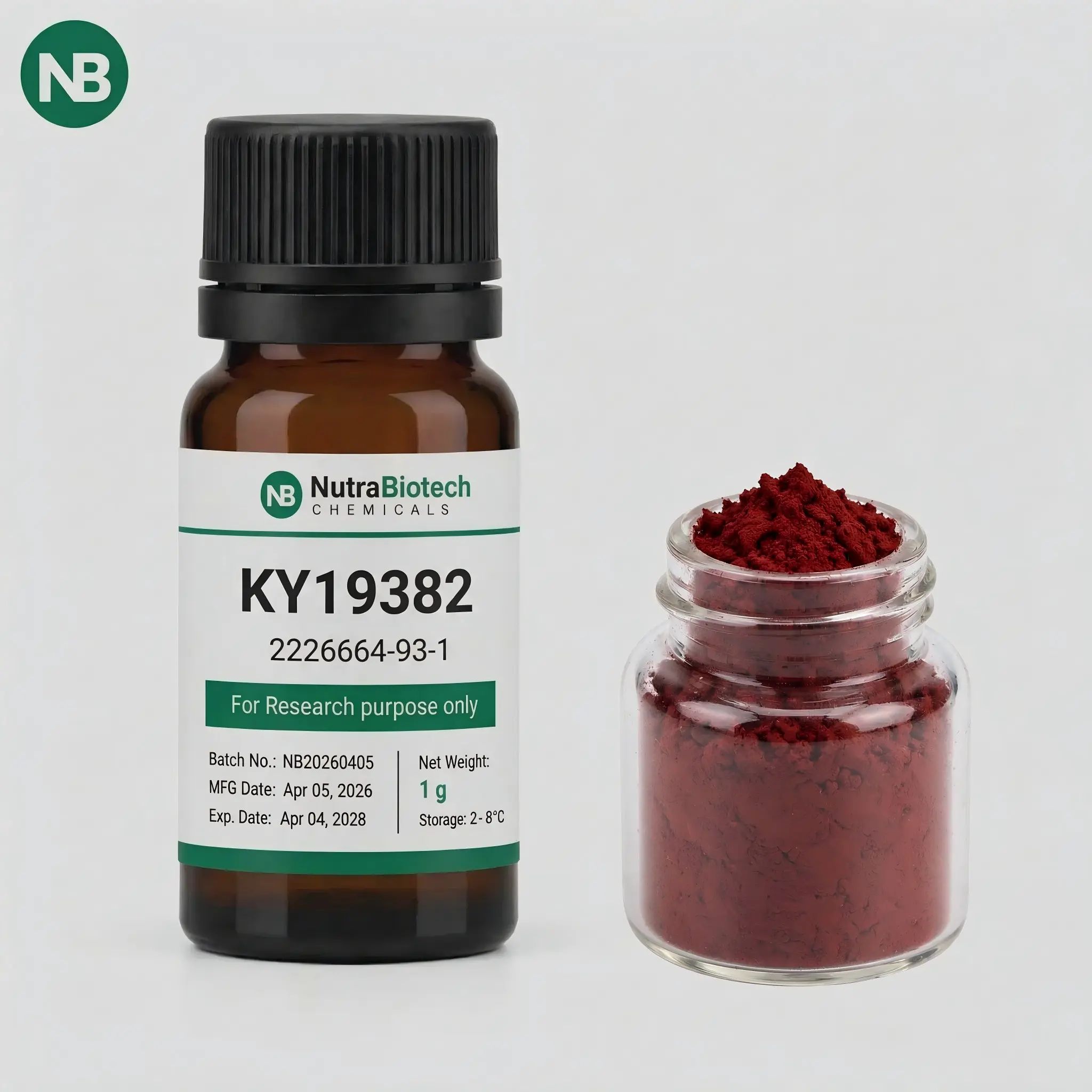
KY19382 CAS 2226664-93-1
Wnt/β-Catenin Activator & Dual CXXC5-Dvl / GSK3β Inhibitor
KY19382 (CAS 2226664-93-1) is a synthetic analogue of indirubin-3′-monoxime that activates Wnt/β-catenin signalling through two complementary nodes: it disrupts the protein-protein interaction between the negative feedback regulator CXXC5 and Dishevelled (IC50 = 19 nM) and directly inhibits glycogen synthase kinase 3β (IC50 = 10 nM). Published preclinical work covers hair regrowth and wound-induced hair follicle neogenesis, growth-plate driven longitudinal bone growth, chondrogenesis and high-fat-diet metabolic models. Formula C17H11Cl2N3O2, MW 360.19. Research grade, ≥98% HPLC, shipped with COA.
Molecular Information
CAS: 2226664-93-1
Formula: C17H11Cl2N3O2
MW: 360.19 g/mol
Exact Mass: 359.0230
Class: Indirubin-3′-monoxime (I3O) analogue
Scaffold: 5,6-dichloro bis-indole oxime
Target 1: CXXC5-Dvl interaction (19 nM)
Target 2: GSK3β (10 nM)
Pathway: Wnt/β-catenin activation
Appearance: Brown to reddish-brown solid
Storage: -20 °C, dry, protect from light
Product Technical Specifications
Complete physicochemical identity and QC parameters for KY19382 (CAS 2226664-93-1)
📋 Physicochemical Identity
- Product NameKY19382
- IUPAC Name5,6-dichloro-3-[1,3-dihydro-3-(methoxyimino)-2H-indol-2-ylidene]-1,3-dihydro-2H-indol-2-one
- CAS Number2226664-93-1
- SynonymsKY 19382; KY-19382; I3O analogue; Wnt/β-catenin signalling activator
- Molecular FormulaC17H11Cl2N3O2
- Molecular Weight360.19 g/mol (exact mass 359.0230)
- Elemental AnalysisC 56.69; H 3.08; Cl 19.68; N 11.67; O 8.88
- Chemical ClassSynthetic bis-indole oxime (indirubin-3′-monoxime analogue)
- SMILESCO\N=C1/C(/Nc2ccccc/12)=C1/C(=O)Nc2cc(Cl)c(Cl)cc12
- InChIKeyPROTUMHDKVZVBW-CLXIBKRSSA-N
- InChIKey (no stereo)PROTUMHDKVZVBW-UHFFFAOYSA-N
- PubChem CID148959784
- AppearanceBrown to reddish-brown solid powder
- SolubilityDMSO ≈4–5 mg/mL (11.6–13.9 mM); warming/sonication advised
- Aqueous SolubilityPractically insoluble in water
- HS Code2934.99 (reference vendor listing; confirm per destination)
🔬 Quality Control & Handling
- Purity (HPLC)≥98%
- FormSolid powder
- Primary TargetsCXXC5-Dvl interaction; GSK3β
- Reported PotencyCXXC5-Dvl IC50 19 nM; GSK3β IC50 10 nM
- Assay ReadoutsTOPFlash reporter; β-catenin; p-GSK3β (S9); PCNA; ALP
- Cell ModelsATDC5; C28/I2; HEK293 reporter; human dermal papilla
- Storage (powder)-20 °C up to 3 years; 4 °C up to 2 years
- Storage (in solvent)-80 °C up to 6 months; -20 °C up to 1 month
- ShippingAmbient, non-hazardous; cold chain on request
- QC DocumentationCOA / HPLC / NMR / MS / MSDS
- Pack Sizes100 mg / 1 g / 10 g / 100 g / 1 kg / 10 kg
- Stock StatusIn Stock
- Development StatusPreclinical (no marketing authorisation)
- Use StatementResearch use only; not for human or veterinary use
Key Molecular Targets & Pathway Nodes
KY19382 acts on the CXXC5 negative-feedback arm and the GSK3β destruction complex, converging on β-catenin driven transcription.
How KY19382 Works: Releasing the Brake on Wnt/β-Catenin Signalling
Two complementary actions in one molecule — upstream block of the CXXC5-Dvl negative feedback loop and direct inhibition of GSK3β.
Block of the CXXC5–Dvl Interaction
CXXC5 is a negative-feedback regulator of the Wnt pathway that binds Dishevelled and dampens signal transduction. KY19382 disrupts this protein-protein interaction (IC50 = 19 nM), removing the brake at the receptor-proximal level.
Direct Inhibition of GSK3β
KY19382 inhibits glycogen synthase kinase 3β (IC50 = 10 nM), lowering destruction-complex activity and raising inhibitory phospho-GSK3β (Ser9) levels, an activity independent of the CXXC5 arm.
β-Catenin Stabilisation & Transcription
Stabilised β-catenin accumulates in cytosol and nucleus; TOPFlash reporter activity rises (0.001–10 μM, 18 h) together with Wnt target genes Axin2 and WISP1, and with ALP and PCNA in human dermal papilla cells.
⚖️ KY19382 vs Comparator Tools
- KY19382 (this product)Dual CXXC5-Dvl + GSK3β block
- PTD-DBMCXXC5-Dvl peptide only
- Valproic acid / LiClGSK3β-level activators only
- WAY-316606sFRP-1 inhibitor, Wnt-pathway hair tool
- Finasteride / dutasteride5α-reductase, androgen axis
- MinoxidilVasodilator, hair-growth comparator
- Selective EdgeUpstream release + kinase block in one molecule
- Research NicheFollicle neogenesis / bone / metabolic models
♻️ Downstream Biological Consequences
- β-cateninStabilised, nuclear translocation up
- TranscriptionAxin2, WISP1 mRNA up
- Dermal papillaALP activity and PCNA up
- Ex vivo follicleVibrissa and human hair shaft elongation
- In vivo hairRegrowth and de novo follicle neogenesis
- BoneGrowth-plate proliferation, tibia length up
- CartilageChondrogenic marker induction (ATDC5, C28/I2)
- MetabolicEvaluated in high-fat-diet models
Research & Formulation Applications
KY19382 is used as a Wnt-pathway tool compound across hair-follicle, skeletal, cartilage and metabolic research programmes.
Hair Loss & Alopecia Models
Human dermal papilla cells, ex vivo vibrissa and human hair follicle culture, depilation-induced hair cycling.
AlopeciaWound-Induced Follicle Neogenesis
WIHN and hair patch assays in C57BL/6 mice; Fgf9 and keratin 17 as neogenesis markers.
NeogenesisFollicle Stem Cell Activation
Keratin 15-positive bulge readouts with β-catenin, Ki67 and PCNA immunostaining.
Stem CellsBone Growth & Growth Plate
Growth-plate senescence and longitudinal bone growth; 0.1 mg/kg per day raised tibia length in adolescent mice.
BoneChondrogenesis & Cartilage
ATDC5 and C28/I2 chondrogenic differentiation markers at 0.01–0.1 μM.
CartilageMetabolic Disease Models
High-fat-diet induced models; the scaffold is the subject of patent WO2020079569 on metabolic disease.
MetabolicKey Literature & Landmark Publications
Peer-reviewed work defining KY19382 pharmacology across hair-follicle, skeletal and metabolic models.
Supply, IP & Compliance Notes
Status of the molecule and documentation that accompanies each shipment.
⚠️ Regulatory Position
- Development StagePreclinical
- Marketing AuthorisationNone in any jurisdiction
- Intended UseLaboratory research only
- Human / Veterinary UseNot permitted
- Originator OrganisationsCK Regeon Inc.; Yonsei University
- Active Indication (pipeline)Alopecia
📦 Documentation & Logistics
- Certificate of AnalysisBatch-specific, HPLC purity
- Structural ConfirmationNMR and MS data
- Safety DocumentationMSDS / SDS on request
- Origin DocumentsCertificate of Origin available
- Transport ClassificationNon-hazardous chemical, ambient
- IP ConsiderationComposition/method patents filed by originators
Available Sizes & Ordering
Research-grade KY19382 (CAS 2226664-93-1) with full QC documentation; supplied from 100 mg research packs through to 10 kg production batches.
| Tier | Pack Size | Stock Status | Suitable For | Lead Time |
|---|---|---|---|---|
| Research | 100 mg | In Stock | TOPFlash, β-catenin and DP-cell assays | Same/next-day ship |
| Standard | 1 g | In Stock | Extended in vitro and ex vivo programmes | Same/next-day ship |
| Scale-up | 10 g | In Stock | In vivo dose-ranging and formulation screening | 3–5 business days |
| Pilot | 100 g | Made to order | Process development and pilot batches | Quote to confirm |
| Commercial | 1 kg | Made to order | Contract supply and validation runs | Batch delivery |
| Industrial | 10 kg | Made to order | Large-scale production scheduling | Reserved batch slot |
Reference sizes shown above; for exact pricing and availability please contact us for a quote. Bulk orders qualify for tiered discounts.
Frequently Asked Questions (FAQ)
What is KY19382 and what is it researched for?
How does KY19382 activate Wnt/β-catenin signalling?
What are the reported IC50 values for KY19382?
Is KY19382 the same compound as PTD-DBM?
Which experimental models has KY19382 been used in?
How soluble is KY19382 and how are stock solutions prepared?
How should KY19382 be stored and shipped?
What QC documentation is provided with each batch?
Which pack sizes are available and is bulk supply supported?
Is KY19382 approved for human or veterinary use?
Which related hair-loss research compounds are available?
Need KY19382 for Your Research?
Research-grade KY19382 (CAS 2226664-93-1) — purity ≥98% HPLC, COA included
CXXC5-Dvl IC50 19 nM / GSK3β IC50 10 nM — request a quote today
KY19382 (CAS 2226664-93-1) is supplied for laboratory research use only. It is not a drug, not a dietary ingredient, and is not for human or veterinary use, diagnosis or treatment. Development status is preclinical, and composition and method patents covering the scaffold have been filed by the originating organisations; patent status should be confirmed for the intended territory before any commercial activity.