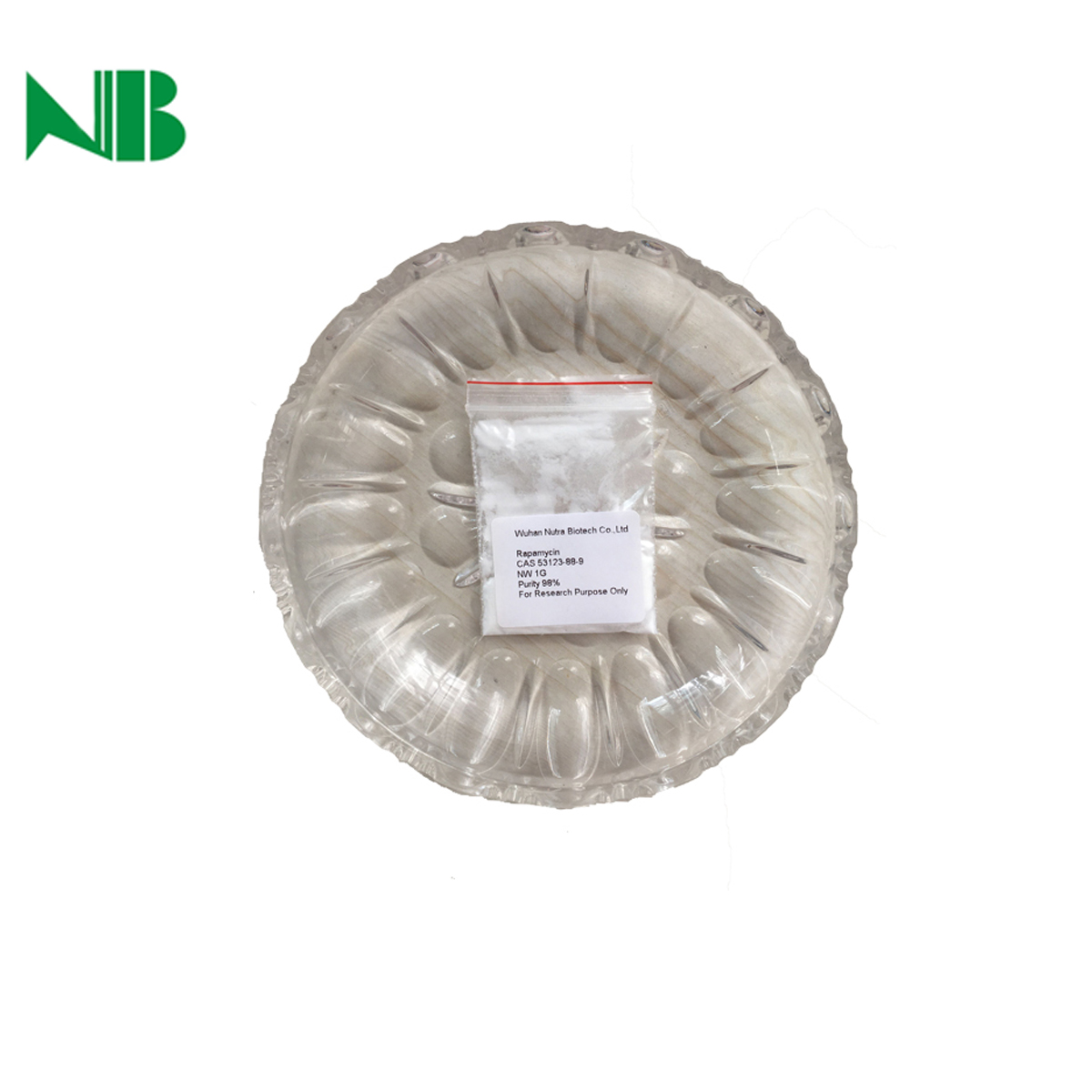
Sirolimus (Rapamycin) CAS 53123-88-9
Allosteric mTORC1 Inhibitor
A macrocyclic lactone produced by Streptomyces hygroscopicus, originally isolated from Easter Island (Rapa Nui) soil. Sirolimus binds FKBP12, and the FKBP12–rapamycin complex engages the FRB domain of mTOR to allosterically inhibit mTORC1 — suppressing protein synthesis, cell growth and proliferation while relieving the brake on autophagy. It does not directly inhibit mTORC2 under acute treatment. Antifungal, immunosuppressive, antiproliferative and the first pharmacological agent shown to extend mouse lifespan when started late in life.
Molecular Information
CAS: 53123-88-9
Formula: C51H79NO13
MW: 914.17 g/mol
Class: Macrocyclic lactone (31-membered)
Core: 23,27-Epoxy-3H-pyrido[2,1-c]
[1,4]oxaazacyclohentriacontine
Source: Streptomyces hygroscopicus
MP: 183–185°C
Appearance: White to off-white powder
Synonyms: Rapamycin / AY 22989 /
Rapamune / Fyarro / Hyftor
Storage: −20°C
Product Technical Specifications
Complete physicochemical properties and QC parameters for Sirolimus / Rapamycin (CAS 53123-88-9)
📋 Physicochemical Properties
- Product NameSirolimus (Rapamycin)
- IUPAC Core23,27-Epoxy-3H-pyrido[2,1-c][1,4]oxaazacyclohentriacontine macrocyclic lactone
- CAS Number53123-88-9
- SynonymsRapamycin; AY 22989; Rapamune; Fyarro; Hyftor
- Molecular FormulaC51H79NO13
- Molecular Weight914.17 g/mol
- SourceStreptomyces hygroscopicus (Rapa Nui soil)
- AppearanceWhite to off-white powder
- Melting Point183–185°C
- Water Solubility0.0026 mg/mL (very poor)
- Organic SolubilityDMSO; ethanol (~2 mM)
- Compound ClassRapalog parent / macrolide immunosuppressant
- HS Code2941.90
🔬 Quality Control & Handling
- Purity (HPLC)≥95%
- FormAmorphous to crystalline powder
- Primary TargetmTORC1 via FKBP12 + FRB domain
- Pathway Readoutp-p70S6K (Thr389), p-4E-BP1, p-S6 (Ser235/236)
- mTORC2 ActivityNot directly inhibited (acute treatment)
- Storage Condition−20°C, sealed, protect from light
- Solution StabilityAliquot DMSO stocks; avoid freeze–thaw
- ShippingBlue ice / cold chain recommended
- QC DocumentationCOA / HPLC / NMR / MS / MSDS
- Pack Sizes1g / 5g / 10g / 100g / 1KG
- Stock StatusIn Stock
- Use StatementResearch use only; not for human/clinical use
Key Molecular Targets & mTOR Pathway Nodes
Sirolimus is inactive as a free molecule; its activity emerges from a ternary complex with FKBP12 and the FRB domain of mTOR, giving it exceptional pathway selectivity
How Sirolimus Works: Allosteric Control of the mTORC1 Growth Program
Rapamycin converts an abundant immunophilin into a precision inhibitor of the master regulator of cell growth
FKBP12 Complex Formation
Sirolimus enters the cell and binds the cytosolic immunophilin FKBP12 with high affinity. As with tacrolimus, the free drug is not the active species — the drug–immunophilin pair forms a composite binding surface, but unlike tacrolimus this surface targets mTOR rather than calcineurin.
FRB Engagement & mTORC1 Inhibition
The FKBP12–rapamycin complex binds the FKBP12–rapamycin binding (FRB) domain of mTOR within the mTOR–Raptor complex (mTORC1), allosterically restricting substrate access. In mTORC2 the Rictor subunit occludes the FRB site, which is why acute treatment spares mTORC2 (Brown et al., Nature 1994; Sabatini et al., Cell 1994).
Translational Arrest & Autophagy Induction
Loss of mTORC1 activity dephosphorylates p70S6K (Thr389) and 4E-BP1, collapsing cap-dependent translation and driving G1 arrest, while de-repression of ULK1 and nuclear entry of TFEB switch on autophagy and lysosomal biogenesis. T and B cells also lose sensitivity to IL-2, producing immunosuppression.
⚖️ Sirolimus vs Tacrolimus vs Everolimus
- Shared ImmunophilinFKBP12 (sirolimus & tacrolimus)
- Sirolimus TargetmTORC1 (growth/translation)
- Tacrolimus TargetCalcineurin (NFAT/IL-2 transcription)
- CompetitionBoth compete for FKBP12 — a classic pharmacological antagonism
- Everolimus40-O-(2-hydroxyethyl) sirolimus; shorter half-life (~30 h vs ~60 h)
- TemsirolimusWater-soluble ester prodrug of sirolimus
♻️ Downstream Biological Consequences
- Protein SynthesisSuppressed (4E-BP1 / eIF4E block)
- Cell CycleG1 arrest; reduced cyclin D1
- AutophagyInduced (ULK1 de-repression)
- Lysosome BiogenesisIncreased via TFEB nuclear entry
- Immune CellsReduced T/B cell responsiveness to IL-2
- AngiogenesisReduced HIF-1α / VEGF output
- Smooth MuscleAntiproliferative — basis of drug-eluting stents
Research Applications & Disease Models
Few small molecules span as many fields as rapamycin — from transplant immunology and interventional cardiology to oncology, autophagy and the biology of aging
Organ Transplantation
Approved for prophylaxis of organ rejection in kidney transplantation. Widely used in calcineurin-inhibitor-sparing and CNI-conversion regimens to reduce chronic nephrotoxicity, and studied for its distinct profile of impaired wound healing, proteinuria and dyslipidemia versus CNIs.
CNI-Sparing RegimensmTOR Signaling Research
The premier chemical tool for the mTOR field — the molecule that led to mTOR's discovery. Standard for distinguishing mTORC1-dependent from mTORC2-dependent phenotypes, with p-p70S6K (Thr389) and p-4E-BP1 as canonical readouts, often benchmarked against torin1 and PP242.
mTORC1 vs mTORC2Aging & Longevity
The first pharmacological agent shown to extend median and maximal lifespan in genetically heterogeneous mice when started late in life (Harrison et al., Nature 2009, NIA Interventions Testing Program). Replicated across doses and validated in the Dog Aging Project; Mannick et al. (Sci Transl Med 2014) showed improved vaccine responses in elderly humans.
ITP ValidatedOncology
mTOR hyperactivation is common in cancers with PI3K/AKT/PTEN lesions. Albumin-bound sirolimus (Fyarro) is approved for malignant PEComa, and sirolimus is used in lymphangioleiomyomatosis (LAM). Also central to research on rapalog resistance and feedback AKT activation.
PEComa / LAMDrug-Eluting Stents
Sirolimus-eluting coronary stents revolutionized interventional cardiology by suppressing neointimal smooth muscle proliferation and in-stent restenosis. Ongoing research covers polymer-free and bioresorbable scaffolds, sirolimus-coated balloons, and peripheral vascular applications.
AntirestenoticAutophagy Research
The reference positive control for pharmacological autophagy induction. mTORC1 inhibition relieves ULK1 Ser757 phosphorylation and drives TFEB-dependent lysosomal gene transcription — used with LC3-II/p62 immunoblotting, tandem mRFP-GFP-LC3 flux assays and bafilomycin clamps.
Autophagy InducerNeurodegeneration
Studied in Alzheimer's, Parkinson's and Huntington's models, where autophagy induction enhances clearance of amyloid-β, tau and α-synuclein aggregates. Also investigated in mTOR-driven epilepsy models and in traumatic brain injury and stroke neuroprotection research.
Proteinopathy ClearanceTuberous Sclerosis Complex
TSC1/TSC2 loss removes the brake on Rheb and produces constitutive mTORC1 activation, making TSC the canonical mTORopathy. Sirolimus and rapalogs are used for subependymal giant cell astrocytoma, renal angiomyolipoma, and topically (Hyftor) for facial angiofibroma.
TSC1 / TSC2 – RhebAntifungal & Antiviral Activity
Rapamycin was originally described in 1975 as an antifungal antibiotic active against Candida albicans. Contemporary research explores mTOR dependence of viral replication and translation, host-directed antiviral strategies, and rapamycin's immunomodulatory effects on memory T-cell differentiation.
Original IndicationKey Literature & Landmark Publications
Seminal papers spanning rapamycin's discovery, target identification, and its emergence as a longevity intervention
Available Sizes & Ordering
Research-grade Sirolimus / Rapamycin (CAS 53123-88-9) with full QC documentation; research packs and bulk custom quantities supported
| Tier | Pack Size | Stock Status | Suitable For | Lead Time |
|---|---|---|---|---|
| Standard | 1 g | In Stock | Cell-based mTOR signaling & autophagy assays | Same/next-day ship |
| Medium | 5 g | In Stock | In vivo tumor, transplant and aging models | Same/next-day ship |
| Large | 10 g | In Stock | Long-term lifespan cohorts, multi-lab studies | Same/next-day ship |
| Bulk | 100 g | In Stock | Formulation, coating and process development | Quote to confirm |
| Industrial | 1 KG | Made to order | Pilot/production scale, CMO supply | Batch delivery |
💡 Reference sizes shown above; for exact pricing and availability please contact us for a quote. Bulk orders qualify for tiered discounts.
Frequently Asked Questions (FAQ)
Are rapamycin and sirolimus the same compound?
Does rapamycin inhibit mTORC2?
What is the evidence for rapamycin's anti-aging effects?
How does sirolimus differ from everolimus and temsirolimus?
Why is rapamycin the standard tool for inducing autophagy?
Where did rapamycin come from?
How should sirolimus be dissolved for laboratory use?
Can sirolimus and tacrolimus be used together?
What signaling readouts confirm mTORC1 inhibition?
Is QC documentation provided? Can I request a sample?
Need Sirolimus (Rapamycin) for Your Research?
Research-grade Sirolimus (CAS 53123-88-9) — purity ≥95% HPLC, COA included
An allosteric mTORC1 inhibitor, autophagy inducer and longevity research standard — request a quote today