Siponimod CAS 1230487-00-9
Selective S1P1/S1P5 Receptor Modulator
An orally active, blood-brain-barrier penetrant second-generation sphingosine-1-phosphate receptor modulator (BAF-312, Mayzent) selective for S1P1 (EC50 0.39 nM) and S1P5 (EC50 0.98 nM), with >1000-fold selectivity over S1P2, S1P3 and S1P4. Siponimod sequesters lymphocytes in lymphoid tissue while engaging CNS-resident S1P receptors — the leading pharmacological tool for secondary progressive multiple sclerosis (SPMS), neuroinflammation and remyelination research.
Molecular Information
CAS: 1230487-00-9
Formula: C29H35F3N2O3
MW: 516.60 g/mol
Purity: ≥98% (HPLC)
SMILES: CCC1=C(C=CC(=C1)
C(=NOCC2=CC(=C(C=C2)
C3CCCCC3)C(F)(F)F)C)
CN4CC(C4)C(=O)O
InChIKey: KIHYPELVXPAIDH
-HNSNBQBZSA-N
MP: 154-157°C
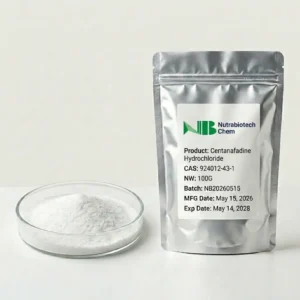
Appearance: White to off-white powder
Solubility: DMSO; methanol (slight)
Synonyms: BAF-312 / Mayzent
Storage: -20°C, sealed, hygroscopic
Siponimod Technical Specifications & QC Data
Complete physicochemical properties and quality control parameters for research-grade Siponimod powder (CAS 1230487-00-9, BAF-312)
📋 Physicochemical Properties
- Product NameSiponimod
- IUPAC Name1-({4-[(1E)-1-({[4-Cyclohexyl-3-(trifluoromethyl)phenyl]methoxy}imino)ethyl]-2-ethylphenyl}methyl)azetidine-3-carboxylic acid
- CAS Number1230487-00-9
- Code NamesBAF-312 / BAF312 / Mayzent
- Molecular FormulaC29H35F3N2O3
- Molecular Weight516.60 g/mol
- Exact Mass516.259 Da
- Geometry(1E)-oxime ether configuration
- InChIKeyKIHYPELVXPAIDH-HNSNBQBZSA-N
- AppearanceWhite to off-white solid powder
- Melting Point154-157°C
- Predicted pKa2.69 ± 0.20 (carboxylic acid)
- Predicted Density1.24 ± 0.1 g/cm³
- PubChem CID44599207
- UNIIRR6P8L282I
🔬 Quality Control & Handling
- Purity (HPLC)≥98%
- Isomeric Purity(E)-oxime ≥98%; (Z)-isomer controlled
- FormFree-flowing crystalline powder
- ColorWhite to off-white
- Storage Condition-20°C, sealed, dry, inert atmosphere
- HygroscopicityHygroscopic — reseal promptly
- SolubilityDMSO (recommended for stocks); methanol (slight); poorly water soluble
- Related FormSiponimod hemifumarate (salt form)
- QC DocumentationCOA / HPLC / NMR / MS / MSDS
- Pack Sizes1g / 5g / 10g / 100g / 1KG
- Stock StatusIn Stock
- Use StatementResearch use only; not for human/clinical use
Receptor Selectivity Profile & Downstream Targets
Siponimod's defining property is receptor subtype discrimination: potent agonism at S1P1 and S1P5 with >1000-fold selectivity over the S1P2, S1P3 and S1P4 subtypes implicated in off-target cardiovascular and fibrotic effects
How Siponimod Works: Dual Peripheral and Central Mode of Action
A stepwise view of functional S1P1 antagonism, lymphocyte sequestration and direct CNS engagement in progressive multiple sclerosis models
High-Affinity S1P1/S1P5 Binding
Siponimod is a directly active modulator — unlike fingolimod it needs no sphingosine kinase 2 phosphorylation. It binds S1P1 and S1P5 with nanomolar potency while sparing S1P2, S1P3 and S1P4.
Receptor Internalization
Sustained agonism drives β-arrestin-mediated S1P1 internalization and degradation on lymphocytes (~91% internalization at 1 μM in 1 h), converting siponimod into a functional antagonist at the receptor.
Loss of S1P Gradient Sensing
Without surface S1P1, lymphocytes can no longer read the low-to-high S1P gradient between lymph node and blood that normally directs their exit — the core chemotactic switch of lymphocyte trafficking.
Lymphocyte Sequestration
Naive and central memory T cells are reversibly retained in secondary lymphoid organs. Peripheral blood lymphocyte counts fall within about six hours of the first dose and recover in most subjects within ~10 days of stopping.
Reduced CNS Immune Infiltration
Fewer autoreactive lymphocytes cross the blood-brain barrier, lowering demyelinating inflammatory activity — the basis for efficacy in experimental autoimmune encephalomyelitis (EAE) and in relapsing MS.
Direct CNS & Remyelination Effects
Because siponimod penetrates the CNS, it also engages astrocyte S1P1 and oligodendrocyte/OPC S1P5. Preclinical work reports reduced demyelination, preserved GABAergic interneurons, protection against synaptic neurodegeneration and enhanced remyelination.
Research Applications of Siponimod (BAF-312)
Where a CNS-penetrant, subtype-selective S1P modulator is the reference tool compound
Secondary Progressive Multiple Sclerosis (SPMS)
The flagship application. Siponimod is the reference agent for studying compartmentalized CNS inflammation, confirmed disability progression, brain volume loss and cortical grey matter atrophy in progressive MS. The phase 3 EXPAND trial established reduced disability progression risk in active SPMS.
EXPAND Phase 3Sphingosine-1-Phosphate Signaling Biology
A benchmark chemical probe for dissecting S1P receptor subtype pharmacology — Gi/o coupling, β-arrestin recruitment, receptor internalization kinetics, GIRK channel activation and functional-antagonism versus agonism paradigms in transfected and primary cell systems.
GPCR Chemical ProbeRemyelination & Oligodendrocyte Biology
Applied in cuprizone-induced demyelination, lysolecithin focal lesion and organotypic cerebellar slice models to evaluate OPC proliferation and differentiation, myelin basic protein expression, g-ratio morphometry and S1P5-dependent oligodendrocyte survival.
Myelin RepairLymphocyte Trafficking & Immunology
Used to map lymphocyte egress, homing and recirculation. Standard readouts include flow-cytometric CD4/CD8 naive and central memory subset counts, lymph node retention imaging, S1P1 surface expression and dose-dependent peripheral lymphopenia kinetics.
Immune TraffickingNeuroinflammation & Glial Activation
Investigated for direct effects on microglial and astrocytic activation states, reactive astrogliosis, pro-inflammatory cytokine release and neurodegeneration-associated synaptic loss — key mechanisms of progression-independent-of-relapse-activity (PIRA) biology.
Glial BiologyEAE & Autoimmune Disease Models
Effective in experimental autoimmune encephalomyelitis at prophylactic and therapeutic dosing (e.g. 0.3 mg/kg in mice), with clinical score, spinal cord infiltrate quantification and demyelination histology as primary endpoints. Also explored in colitis, uveitis and stroke models.
In Vivo PharmacologyPharmacogenomics & CYP2C9 Research
A textbook example of genotype-guided dosing. Used in CYP2C9*1/*2/*3 phenotyping studies, recombinant CYP incubations, drug-drug interaction modeling with CYP2C9 and CYP3A4 inhibitors/inducers, and PBPK exposure simulations.
PharmacogenomicsCardiac S1P Pharmacology
Used to study first-dose bradycardia mechanisms, S1P1-mediated GIRK channel activation in atrial myocytes, dose-titration mitigation strategies and species differences in cardiac S1P3 expression between rat, mouse and human.
Cardiac SafetyAnalytical Reference & DMPK
Supplied as an analytical reference standard for LC-MS/MS bioanalytical method validation, impurity and (Z)-isomer profiling, plasma protein binding, brain-to-plasma partition (Kp) determination and formulation development.
Reference StandardKey Publications on Siponimod & S1P Receptor Modulation
Pivotal trials and mechanistic literature underpinning siponimod's use in multiple sclerosis research
Siponimod Pack Sizes & Ordering Information
Research-grade Siponimod powder (CAS 1230487-00-9) available in 1g / 5g / 10g / 100g / 1KG with full QC documentation and bulk custom synthesis support
| Tier | Pack Size | Stock Status | Suitable For | Lead Time & Shipping |
|---|---|---|---|---|
| Standard | 1 g | In Stock | S1P receptor binding and internalization assays, method development | Same/next-day ship; ambient with ice pack |
| Medium | 5 g | In Stock | EAE and cuprizone rodent studies, dose-ranging pharmacology | Same/next-day ship; express courier |
| Large | 10 g | In Stock | Long-term chronic dosing programs, multi-lab MS consortia | Same/next-day ship; DHL/FedEx/UPS |
| Bulk | 100 g | In Stock | Formulation and process development, toxicology batches, scale-up | Quote to confirm; double-bagged HDPE drum, desiccant |
| Industrial | 1 KG | Made to order | Pilot/production scale, CMO supply, long-term supply agreements | Scheduled batch delivery; palletized air/sea freight |
💡 Reference sizes shown above; for exact siponimod bulk pricing and current availability please contact us for a quote. Bulk orders qualify for tiered discounts.
Siponimod FAQ — Frequently Asked Questions
What is Siponimod (CAS 1230487-00-9) and what is it used for?
How does Siponimod compare with fingolimod and ozanimod?
Why is Siponimod described as a "functional antagonist" if it is an agonist?
Why is Siponimod specifically studied in secondary progressive MS (SPMS)?
What role does CYP2C9 metabolism play?
How does S1P5 relate to remyelination and oligodendrocytes?
Why does Siponimod cause transient bradycardia on first dose?
How should Siponimod powder be dissolved and stored?
What is the difference between siponimod free acid and siponimod hemifumarate?
What documentation and pack sizes do you supply?
Need Siponimod (CAS 1230487-00-9) for Your Research?
Research-grade Siponimod / BAF-312 powder — purity ≥98% HPLC, COA included, 1g to 1KG
The reference selective S1P1/S1P5 modulator for SPMS, remyelination and neuroinflammation research — request a quote today