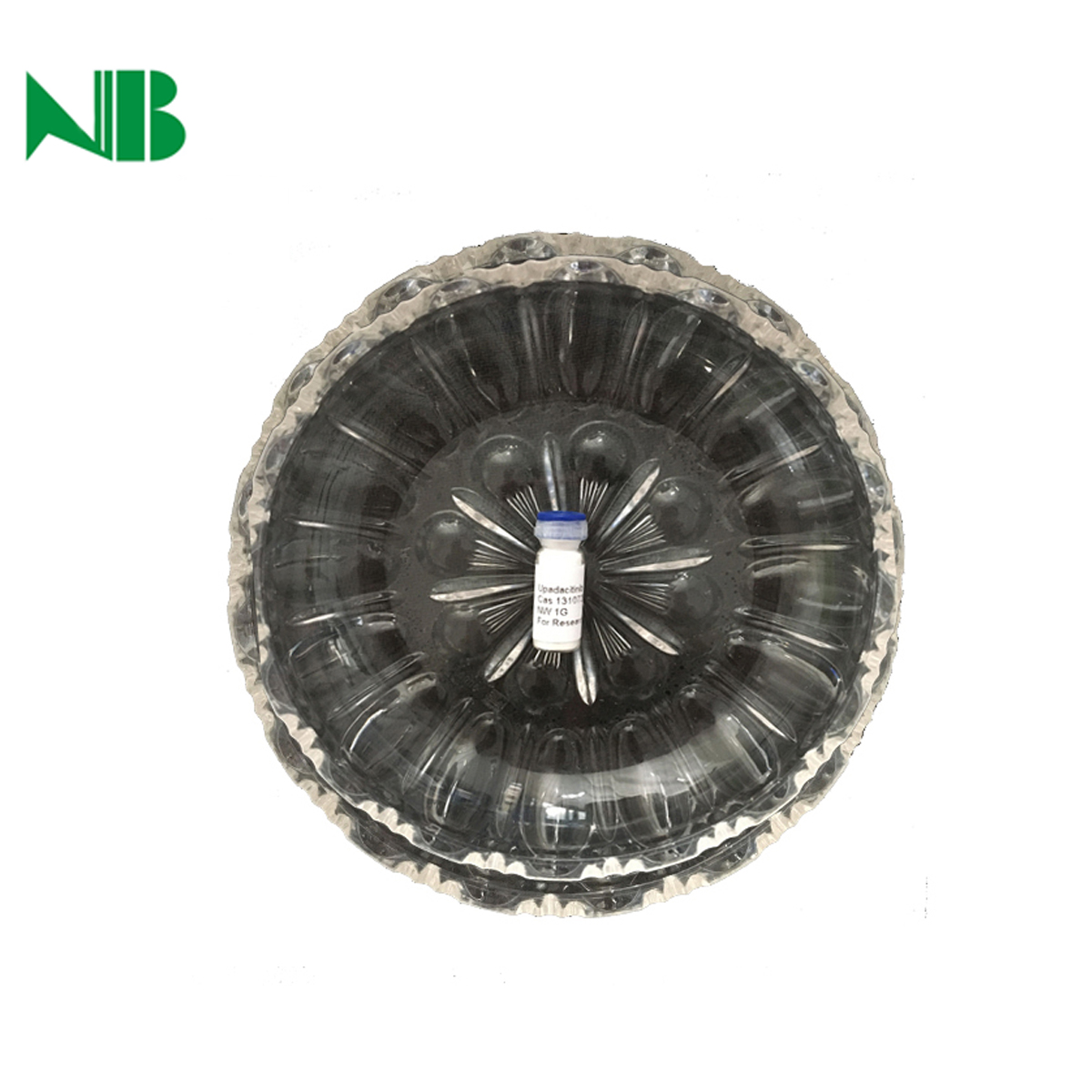
Upadacitinib CAS 1310726-60-3
Selective JAK1 Inhibitor (ABT-494)
A next-generation, orally bioavailable selective Janus kinase 1 (JAK1) inhibitor engineered by AbbVie and marketed as Rinvoq. Upadacitinib preferentially blocks JAK1 and JAK1/JAK3 mediated STAT phosphorylation over JAK2/JAK2 signaling, shutting down IL-6, IL-23, IL-4/IL-13 and interferon-gamma driven inflammation. A cornerstone tool compound for rheumatoid arthritis, psoriatic arthritis, psoriasis, atopic dermatitis, ulcerative colitis, Crohn's disease and ankylosing spondylitis research.
Molecular Information
CAS: 1310726-60-3
Formula: C17H19F3N6O
MW: 380.37 g/mol
Purity: ≥98% (HPLC)
SMILES: CC[C@@H]1CN(C[C@@H]1
C2=CN=C3N2C4=C(NC=C4)N=C3)
C(=O)NCC(F)(F)F
InChIKey: WYQFJHHDOKWSHR
-MNOVXSKESA-N
Appearance: White to off-white powder
Solubility: DMSO (~42 mg/mL)
Synonyms: ABT-494 / Rinvoq
Storage: -20°C, sealed, protect from light
Upadacitinib Technical Specifications & QC Data
Complete physicochemical properties and quality control parameters for research-grade Upadacitinib powder (CAS 1310726-60-3, ABT-494)
📋 Physicochemical Properties
- Product NameUpadacitinib
- IUPAC Name(3S,4R)-3-Ethyl-4-(3H-imidazo[1,2-a]pyrrolo[2,3-e]pyrazin-8-yl)-N-(2,2,2-trifluoroethyl)pyrrolidine-1-carboxamide
- CAS Number1310726-60-3
- Code NamesABT-494 / Rinvoq
- Molecular FormulaC17H19F3N6O
- Molecular Weight380.37 g/mol
- Exact Mass380.158 Da
- SMILESCC[C@@H]1CN(C[C@@H]1C2=CN=C3N2C4=C(NC=C4)N=C3)C(=O)NCC(F)(F)F
- InChIKeyWYQFJHHDOKWSHR-MNOVXSKESA-N
- Stereocenters2 defined (3S,4R)
- AppearanceWhite to off-white crystalline powder
- LogP / tPSA~3.06 / 78.3 Ų
- MDL NumberMFCD30502663
- PubChem CID58557659
- UNII4RA0KN46E0
🔬 Quality Control & Handling
- Purity (HPLC)≥98%
- Chiral Purity(3S,4R) isomer, ee ≥98%
- FormCrystalline solid / free-flowing powder
- ColorWhite to off-white
- Storage Condition-20°C, sealed, dry, protect from light
- ShippingAmbient with ice pack; cold chain on request
- SolubilityDMSO ~42 mg/mL; ethanol ~76 mg/mL; DMF ~30 mg/mL; poorly water soluble
- GHS ClassificationGHS07; H302 (harmful if swallowed)
- QC DocumentationCOA / HPLC / NMR / MS / MSDS
- Pack Sizes1g / 5g / 10g / 100g / 1KG
- Stock StatusIn Stock
- Use StatementResearch use only; not for human/clinical use
Molecular Targets & JAK Family Selectivity Profile
Upadacitinib was rationally designed for JAK1 selectivity — inhibiting JAK1 and JAK1/JAK3 heterodimer signaling far more potently than JAK2 homodimer signaling that governs erythropoiesis
How Upadacitinib Works: Selective JAK1 Blockade of the JAK-STAT Pathway
A stepwise view of how ATP-competitive JAK1 inhibition translates into broad, multi-cytokine anti-inflammatory activity
Cytokine Receptor Engagement
Pro-inflammatory cytokines (IL-6, IL-23, IL-12, IFN-γ, IL-4/IL-13, common γ-chain cytokines) bind their type I/II receptors, driving receptor dimerization and juxtaposition of receptor-associated Janus kinases.
ATP-Competitive JAK1 Inhibition
Upadacitinib occupies the ATP-binding cleft of the JAK1 kinase domain. Its (3S,4R)-pyrrolidine carboxamide scaffold exploits subtle hinge-region differences to achieve functional selectivity for JAK1 over JAK2.
Loss of STAT Phosphorylation
Without active JAK1, receptor tyrosines are not phosphorylated, STAT1/STAT3/STAT5 recruitment fails, and phospho-STAT dimers cannot form — the key measurable readout in leukocyte pSTAT assays.
Blocked Nuclear Transcription
STAT dimers never translocate to the nucleus, so transcription of inflammatory gene programs (acute-phase proteins, chemokines, matrix metalloproteinases, RANKL) is suppressed at source.
Multi-Axis Immune Modulation
Because JAK1 is shared by Th1, Th2 and Th17 cytokine receptors, a single JAK1-selective agent dampens all three inflammatory axes simultaneously — the pharmacological basis for its breadth across autoimmune indications.
JAK2 Sparing Rationale
Erythropoietin and thrombopoietin signal through JAK2 homodimers. Relative JAK2 sparing is the design rationale intended to limit hematologic effects seen with less selective pan-JAK inhibitors.
Research Applications & Disease Models for Upadacitinib
From rheumatology to dermatology and gastroenterology — where a selective JAK1 inhibitor is the tool compound of choice
Rheumatoid Arthritis Research
The flagship indication. Used in collagen-induced arthritis and adjuvant arthritis models to probe IL-6/STAT3-driven synovitis, osteoclastogenesis via RANKL, pannus formation and cartilage degradation. Upadacitinib was FDA-approved for moderate-to-severe active RA in August 2019.
FDA Approved 2019Psoriasis & Psoriatic Arthritis
JAK1-dependent IL-23/IL-22 signaling drives keratinocyte hyperproliferation and Th17 skin inflammation. Applied in imiquimod-induced psoriasiform dermatitis models, enthesitis studies and dactylitis endpoints relevant to psoriatic arthritis pathology.
Th17 / IL-23 AxisAtopic Dermatitis & Itch Biology
IL-4, IL-13 and IL-31 all signal through JAK1, making selective JAK1 inhibition a powerful probe for type-2 skin inflammation and pruritus. Common readouts include EASI-equivalent lesion scoring, scratching behavior, filaggrin expression and skin barrier TEWL in mouse models.
Type 2 InflammationUlcerative Colitis & Crohn's Disease
Used in DSS-colitis, TNBS-colitis and T-cell transfer IBD models to interrogate mucosal healing, epithelial barrier integrity, colonic pSTAT3 and fecal calprotectin. Upadacitinib is approved for both ulcerative colitis and Crohn's disease in human medicine.
IBD ResearchAnkylosing Spondylitis & Axial SpA
A reference agent for axial spondyloarthritis studies covering sacroiliac joint inflammation, new bone formation, spinal MRI inflammation scores and the IL-23/IL-17 to JAK1 signaling interface in enthesis-resident immune cells.
SpondyloarthritisJAK-STAT Signaling Mechanism Studies
A benchmark chemical probe for dissecting JAK isoform contributions. Standard workflows include phospho-flow pSTAT1/3/5 profiling in whole blood, kinome selectivity panels, cytokine-stimulated PBMC assays and CRISPR JAK1-knockout comparisons.
Chemical ProbeAutoimmune & Interferonopathy Models
Applied in systemic lupus erythematosus, Sjögren's syndrome, dermatomyositis and type I interferonopathy research where JAK1/TYK2-driven interferon signatures dominate. Useful for evaluating interferon-stimulated gene (ISG) score suppression.
Interferon SignatureAlopecia Areata & Vitiligo
IFN-γ/CXCL10 mediated collapse of hair-follicle and melanocyte immune privilege is JAK1/JAK2 dependent. Selective JAK1 inhibitors are studied for hair regrowth (SALT score analogues) and repigmentation endpoints in preclinical dermatology models.
DermatologyADME, DMPK & Analytical Reference
Used as an analytical reference standard for LC-MS/MS bioanalysis, CYP3A4/CYP2D6 metabolism studies, acyl glucuronide (M4) metabolite identification, protein-binding determination and extended-release formulation development.
Reference StandardKey Publications & Landmark Clinical Literature
Pivotal papers documenting the discovery, JAK1 selectivity and clinical evaluation of upadacitinib (ABT-494)
Upadacitinib Pack Sizes & Ordering Information
Research-grade Upadacitinib powder (CAS 1310726-60-3) available in 1g / 5g / 10g / 100g / 1KG with full QC documentation and bulk custom synthesis support
| Tier | Pack Size | Stock Status | Suitable For | Lead Time & Shipping |
|---|---|---|---|---|
| Standard | 1 g | In Stock | Cell-based pSTAT assays, kinase profiling, method development | Same/next-day ship; ambient with ice pack |
| Medium | 5 g | In Stock | Rodent arthritis and colitis pharmacology, dose-ranging studies | Same/next-day ship; express courier |
| Large | 10 g | In Stock | Multi-arm in vivo programs, multi-lab collaborations, HTS libraries | Same/next-day ship; DHL/FedEx/UPS |
| Bulk | 100 g | In Stock | Formulation and process development, toxicology batches, scale-up | Quote to confirm; double-bagged HDPE drum |
| Industrial | 1 KG | Made to order | Pilot/production scale, CMO supply, long-term supply agreements | Scheduled batch delivery; palletized air/sea freight |
💡 Reference sizes shown above; for exact upadacitinib bulk pricing and current availability please contact us for a quote. Bulk orders qualify for tiered discounts.
Upadacitinib FAQ — Frequently Asked Questions
What is Upadacitinib (CAS 1310726-60-3) and what is it used for?
How is Upadacitinib different from tofacitinib? Is it really JAK1 selective?
What exactly is the JAK-STAT pathway that Upadacitinib blocks?
Which cytokines are affected by selective JAK1 inhibition?
Why do JAK inhibitors carry a boxed warning?
Is Upadacitinib used for inflammatory bowel disease (IBD) research?
How should Upadacitinib powder be dissolved and stored?
What is the stereochemistry of Upadacitinib and why does it matter?
Do you provide a COA, NMR and mass spec data for each lot?
What pack sizes are available and can you supply bulk kilogram quantities?
Need Upadacitinib (CAS 1310726-60-3) for Your Research?
Research-grade Upadacitinib / ABT-494 powder — purity ≥98% HPLC, COA included, 1g to 1KG
The benchmark selective JAK1 inhibitor for autoimmune, dermatology and IBD research — request a quote today