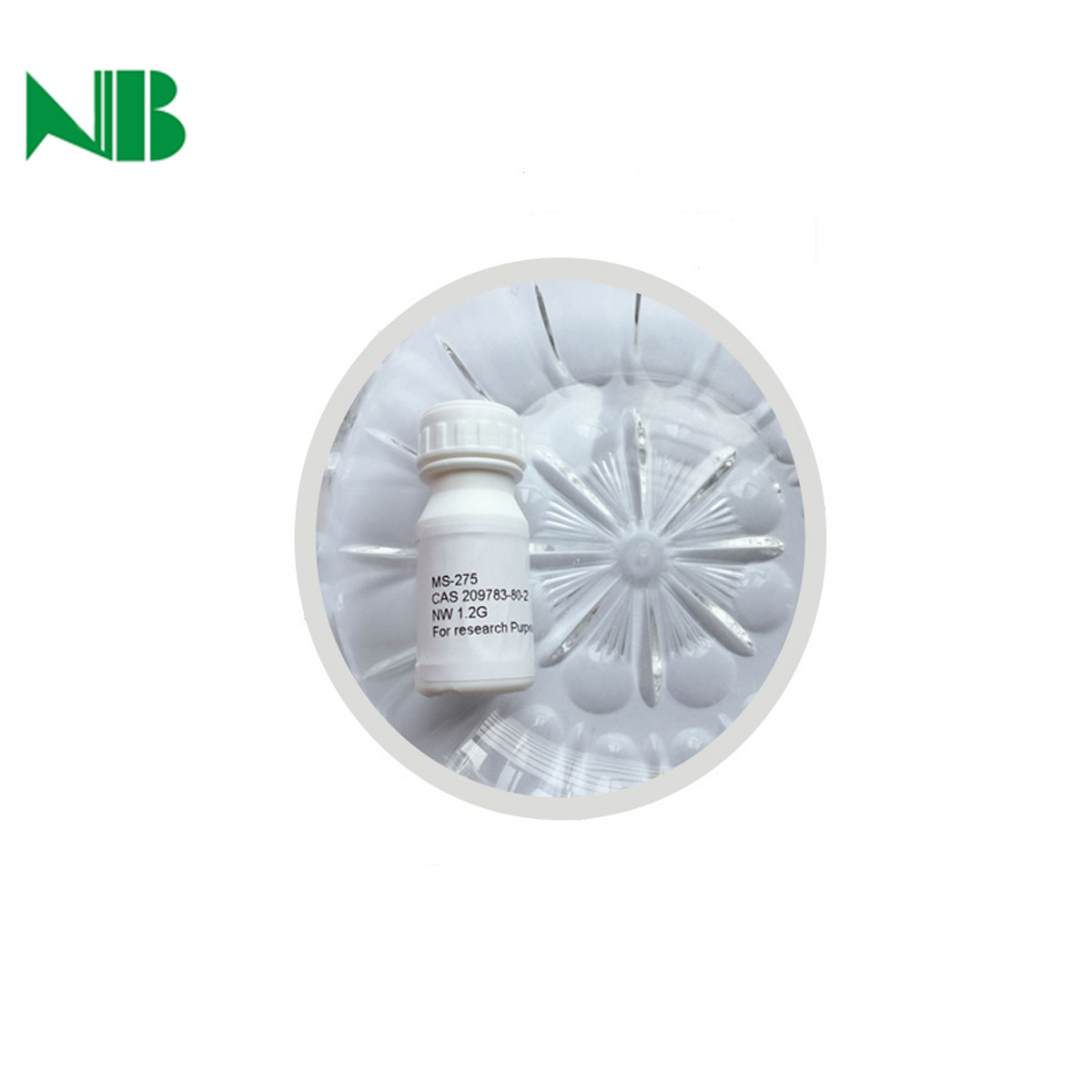
Entinostat CAS 209783-80-2
Class I HDAC Inhibitor (SNDX-275, MS-275)
Entinostat (CAS 209783-80-2), also SNDX-275 / MS-275, is an orally bioavailable benzamide inhibitor of class I histone deacetylases HDAC1 and HDAC3 (IC50 ~0.18-0.51 and ~0.74-1.7 uM respectively), with selectivity over HDAC8. By restoring histone acetylation it reactivates silenced tumor-suppressor genes and modulates the immune microenvironment. Molecular formula C21H20N4O3, MW 376.41. Research-grade with COA.
Molecular Information
CAS: 209783-80-2
Formula: C21H20N4O3
MW: 376.41 g/mol
Class: Benzamide HDAC inhibitor
Core: (2-aminophenyl)benzamide carbamate
Target: Class I HDAC (HDAC1/HDAC3)
IC50: HDAC1 0.18-0.51 uM
MP: 159-160 C
Appearance: White to beige powder
Synonyms: SNDX-275 / MS-275
Storage: -20 C
Product Technical Specifications
Complete physicochemical properties and QC parameters for Entinostat (CAS 209783-80-2)
📋 Physicochemical Properties
- Product NameEntinostat (SNDX-275 / MS-275)
- IUPAC Corepyridin-3-ylmethyl N-[[4-[(2-aminophenyl)carbamoyl]phenyl]methyl]carbamate
- CAS Number209783-80-2
- SynonymsSNDX-275; MS-275; MS 27-275; NSC-706995
- Molecular FormulaC21H20N4O3
- Molecular Weight376.41 g/mol
- SourceSynthetic small molecule (Syndax)
- AppearanceWhite to beige powder
- Melting Point159-160 C
- Water SolubilityVery low
- Organic SolubilityDMSO ~38 mg/mL; ethanol ~2 mg/mL
- Compound Class2-aminophenyl benzamide / class I HDAC inhibitor
- HS Code2933.99
🔬 Quality Control & Handling
- Purity (HPLC)≥98%
- FormCrystalline powder
- Primary TargetClass I HDAC (HDAC1, HDAC3)
- Pathway ReadoutHistone H3/H4 acetylation; re-activated transcription
- SelectivityHDAC1/HDAC3 >> HDAC8 (IC50 >100 uM)
- Storage Condition-20 C, sealed, protect from light
- Solution StabilityDMSO stock stable ~1 week at -20 C
- ShippingBlue ice / cold chain recommended
- QC DocumentationCOA / HPLC / NMR / MS / MSDS
- Pack Sizes1g / 5g / 10g / 100g / 1KG
- Stock StatusIn Stock
- Use StatementResearch use only; not for human/clinical use
Key Molecular Targets & Pathway Nodes
Entinostat's reach is the epigenetic machinery and the transcriptional programs — plus the immune microenvironment — that HDAC1/HDAC3 tone controls.
How Entinostat Works: Reopening Silent Chromatin
Entinostat blocks class I HDACs, letting histones stay acetylated so repressed genes can be read
HDAC1/HDAC3 Catalytic Blockade
Entinostat binds the catalytic zinc pocket of class I HDACs, preferentially inhibiting HDAC1 (IC50 ~0.18-0.51 uM) and HDAC3 (~0.74-1.7 uM), while sparing HDAC8 (IC50 >100 uM). This stops removal of acetyl groups from lysine residues on histone tails.
Histone Hyperacetylation & Open Chromatin
With deacetylation blocked, histones H3 and H4 accumulate acetyl marks, weakening histone-DNA interaction and converting compact heterochromatin toward transcriptionally permissive euchromatin. Promoters previously locked by HDAC-driven silencing become accessible to the transcription machinery.
Reactivation, Cell-Cycle Arrest & Immune Modulation
Re-expressed tumor-suppressor and differentiation genes drive G1 arrest, apoptosis and differentiation. Clinically, entinostat also remodels the tumor microenvironment — reducing regulatory T cells and enhancing anti-tumor immunity — which underlies its synergy with endocrine therapy and immune approaches.
⚖️ Entinostat vs Vorinostat vs Romidepsin
- Entinostat (this product)Class I (HDAC1/3) benzamide; oral; long half-life
- Vorinostat (SAHA)Pan-HDAC (class I + II) hydroxamate
- RomidepsinClass I (HDAC1/2) natural depsipeptide
- HDAC8Entinostat sparing; others vary
- Selectivity EdgeClass I focus reduces some pan-HDAC toxicities
- Combination NicheEndocrine & immune combination partner
♻️ Downstream Biological Consequences
- ChromatinHistone H3/H4 hyperacetylation
- TranscriptionReactivation of silenced suppressor genes
- Cell CycleG1 arrest; p21/p27 induction
- SurvivalApoptosis & differentiation in tumor cells
- ImmuneTreg reduction; enhanced anti-tumor response
- Hormone AxisSensitization to endocrine therapy
Research Applications & Models
Entinostat is a founder of epigenetic combination therapy — from breast cancer to NSCLC and the emerging immuno-epigenetics field.
Breast Cancer & Endocrine Therapy
Studied with aromatase inhibitors and fulvestrant in hormone-receptor-positive metastatic breast cancer, where HDAC inhibition re-sensitizes resistant clones (e.g., the ENCORE 301 paradigm). A flagship epigenetic-combination model.
HR+ BCNon-Small-Cell Lung Cancer
Investigated with EGFR and chemotherapy backbones and, increasingly, with immunotherapy, to overcome epigenetic silencing of immune and tumor-suppressor programs in NSCLC.
NSCLCEpigenetic Reactivation Studies
A reference class I HDAC inhibitor for chromatin immunoprecipitation, histone-acetylation Western panels and reporter assays probing silenced-gene re-expression.
ChromatinImmuno-Oncology & Treg Modulation
Explored for reducing regulatory T-cell suppressive activity and improving checkpoint-inhibitor responses — the growing field of epigenetic priming of immunity.
Treg / IODifferentiation & Apoptosis Models
Used to induce myeloid differentiation and apoptosis in leukemic and solid-tumor lines, leveraging HDAC1/HDAC3 control of differentiation programs.
DifferentiationHDAC Selectivity Profiling
Benchmarked against pan-HDAC and class-I/II agents to map which HDAC isoforms drive specific phenotypes — important for isoform-selective drug discovery.
HDAC IsoformsCombination Screening
Deployed with hormonal, cytotoxic and immune agents to find synergy and overcome acquired resistance via chromatin remodeling.
Combo MatrixAging & Senescence Research
HDAC inhibition modulates cellular senescence and stress responses; entinostat is used in models of senescence-associated secretory phenotype and age-related epigenetic drift.
SenescenceKey Literature & Landmark Publications
Landmark papers on HDAC inhibition and entinostat clinical translation.
Available Sizes & Ordering
Research-grade Entinostat (CAS 209783-80-2) with full QC documentation; standard packs and bulk custom quantities supported.
| Tier | Pack Size | Stock Status | Suitable For | Lead Time |
|---|---|---|---|---|
| Standard | 1g | In Stock | HDAC / epigenetic cell assays | Same/next-day ship |
| Medium | 5g | In Stock | In vivo tumor & combination models | Same/next-day ship |
| Large | 10g | In Stock | Chromatin & immuno-oncology studies | Same/next-day ship |
| Bulk | 100g | In Stock | Formulation & process development | Quote to confirm |
| Industrial | 1KG | Made to order | Pilot/production scale, CMO supply | Batch delivery |
💡 Reference sizes shown above; for exact pricing and availability please contact us for a quote. Bulk orders qualify for tiered discounts.
Frequently Asked Questions (FAQ)
What is entinostat and what does it inhibit?
How does an HDAC inhibitor work as an anti-cancer agent?
Why is entinostat studied with endocrine therapy?
What distinguishes entinostat from vorinostat or romidepsin?
What readouts confirm HDAC inhibition?
How soluble is entinostat and how should it be prepared?
Is QC documentation provided?
Need Entinostat (Class I HDAC Inhibitor) for Your Research?
Research-grade Entinostat (CAS 209783-80-2) — purity ≥98% HPLC, COA included
SNDX-275 / MS-275 — the HDAC1/HDAC3 epigenetic agent that reopens silenced chromatin — request a quote today