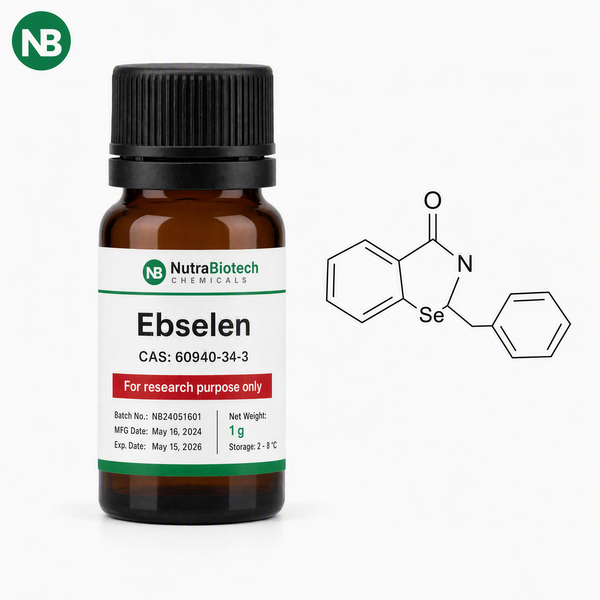
Ebselen CAS 60940-34-3
Multi-Target Organoselenium Antioxidant
A glutathione peroxidase (GPx) mimetic with broad pharmacological activity — antioxidant, anti-inflammatory, neuroprotective, and antiviral. Identified as the most potent SARS-CoV-2 Mpro inhibitor from a Nature 2020 screen of 10,000+ compounds. Also a validated ferroptosis inhibitor and IDO1 modulator. Extensively studied in human clinical trials (stroke Phase III, bipolar disorder, hearing loss, diabetes).
Molecular Information
CAS: 60940-34-3
Formula: C13H9NOSe
MW: 274.18 g/mol
SMILES: O=C1N([Se]c2ccccc12)
c3ccccc3
InChIKey: DYEFUKCXAQOFHX
-UHFFFAOYSA-N
MP: 176-184°C
Appearance: White to pale yellow powder
Synonyms: PZ-51 / DR-3305 /
2-Phenyl-1,2-benzisoselenazol-3(2H)-one
Storage: 2-8°C, protect from light
Product Technical Specifications
Complete physicochemical properties and QC parameters for Ebselen (CAS 60940-34-3)
📋 Physicochemical Properties
- Product NameEbselen
- IUPAC Name2-Phenyl-1,2-benzisoselenazol-3(2H)-one
- CAS Number60940-34-3
- Code NamesPZ-51 / DR-3305
- Molecular FormulaC13H9NOSe
- Molecular Weight274.18 g/mol
- SMILESO=C1N([Se]c2ccccc12)c3ccccc3
- InChI1S/C13H9NOSe/c15-13-11-8-4-5-9-12(11)16-14(13)10-6-2-1-3-7-10/h1-9H
- InChIKeyDYEFUKCXAQOFHX-UHFFFAOYSA-N
- AppearanceWhite to pale yellow powder or crystals
- Melting Point176-184°C
- MDL NumberMFCD00210937
- PubChem CID3194
- ChEBI IDCHEBI:47824
🔬 Quality Control & Handling
- Purity (TLC/HPLC)≥98%
- FormPowder or crystalline powder
- ColorWhite to yellow to green (trace)
- Storage Condition2-8°C, protect from light
- Storage Class6.1D (toxic)
- GHS ClassificationAcute Tox. 3 (Oral/Inhalation); STOT RE 2; Aquatic Acute/Chronic 1
- SolubilityDMSO; chloroform (~20 mg/mL); ethanol; methanol; acetone; acetonitrile
- QC DocumentationCOA / HPLC / NMR / MS / MSDS
- Pack Sizes1g / 5g / 10g / 100g / 1KG
- Stock StatusIn Stock
- Use StatementResearch use only; not for human/clinical use
Key Molecular Targets & Enzyme Inhibition Profile
Ebselen's unique selenium atom enables covalent modification of protein cysteine residues, endowing it with a remarkably broad target spectrum
How Ebselen Works: Triple Pillars of Pharmacological Action
Ebselen exerts its effects through three distinct biochemical mechanisms, making it one of the most versatile small-molecule tool compounds available
GPx Enzyme Mimicry
Ebselen catalytically reduces H2O2, lipid hydroperoxides, and peroxynitrite (ONOO–) using glutathione (GSH) or other thiols as the reducing co-substrate, functionally replacing GPx1 and GPx4.
Covalent Cysteine Modification
The selenium atom forms a reversible selenosulfide (-Se-S-) bond with active-site cysteine residues on target proteins (e.g. Mpro Cys145, IDO1, lipoxygenases), modulating activity.
Free Radical Scavenging
Directly neutralizes reactive oxygen and nitrogen species (ROS/RNS) such as superoxide, hydroxyl radicals and peroxynitrite, providing immediate cellular protection during oxidative stress.
Research Applications & Disease Models
Ebselen's polypharmacology makes it relevant across neuroscience, virology, oncology, immunology and beyond
SARS-CoV-2 / COVID-19 Research
Identified as the #1 Mpro inhibitor in Nature 2020 (Jin et al., screen of >10,000 compounds); binds both catalytic and allosteric sites (Science Advances 2020). Also attenuates NF-κB-driven inflammatory cytokines relevant to COVID-19 lung pathology.
Nature 2020Stroke & Cerebral Ischemia
Completed Phase III clinical trials for acute ischemic stroke in Japan. Neuroprotective effects via GPx-like activity, reducing post-ischemic lipid peroxidation and glutamate-induced excitotoxicity at NMDA receptors.
Phase III ClinicalFerroptosis Research
Functions as a GPx4 mimetic, reducing lipid hydroperoxides that drive ferroptotic cell death. A critical tool compound for ferroptosis studies — an iron-dependent, non-apoptotic form of regulated necrosis with implications in cancer, neurodegeneration, and ischemia-reperfusion injury.
Ferroptosis InhibitorInflammation & Oxidative Stress
Dual inhibition of 5-lipoxygenase and cyclooxygenase, suppression of NF-κB activation, and reduction of pro-inflammatory cytokines (TNF-α, IL-6). Reduces LDL oxidation and atherosclerosis in preclinical models. Inhibits NADPH oxidase and inducible NOS.
Anti-inflammatoryAntimicrobial & Antiviral
Active against multidrug-resistant Staphylococcus aureus (MRSA) and clinically resistant Gram-negative bacteria (when combined with silver). Inhibits HCV helicase and SARS-CoV-2 Mpro. Also active against fungi and inhibits trypanothione reductase (Trypanosoma).
AntimicrobialOncology & Cancer Biology
Induces apoptosis in cancer cells; inhibits receptor tyrosine kinases; downregulates IDO1 (indoleamine 2,3-dioxygenase) — a key immunosuppressive enzyme in the tumor microenvironment. Chemopreventive activity in inflammation-associated carcinogenesis models.
OncologyMetabolic & Organ Protection
Clinically investigated for Type 1 and Type 2 diabetes mellitus; hepatoprotective against drug-induced liver injury; inhibits gastric H+/K+-ATPase (pump inhibitor activity). Protects against cisplatin-induced nephrotoxicity and ototoxicity.
Clinical TrialsHearing Loss & Meniere's Disease
Clinically studied for Meniere's Disease (inner ear disorder) and noise-induced hearing loss. Antioxidant and anti-inflammatory effects in the cochlea; protects auditory hair cells from ROS-mediated damage.
AudiologyBipolar Disorder & Psychiatry
Investigated in clinical trials for bipolar disorder; proposed mechanism involves modulation of the inositol monophosphatase pathway (lithium-mimetic effect) and attenuation of neuroinflammation via inhibition of microglial activation.
PsychiatryKey Literature & Landmark Publications
Seminal papers on Ebselen's discovery, mechanism, and therapeutic application
Available Sizes & Ordering
Research-grade Ebselen (CAS 60940-34-3) with full QC documentation; research packs and bulk custom quantities supported
| Tier | Pack Size | Stock Status | Suitable For | Lead Time |
|---|---|---|---|---|
| Standard | 1 g | In Stock | Biochemical / cell-based assays | Same/next-day ship |
| Medium | 5 g | In Stock | In vivo pharmacology, long-term studies | Same/next-day ship |
| Large | 10 g | In Stock | Multi-lab collaborations, HTS | Same/next-day ship |
| Bulk | 100 g | In Stock | Process development, scale-up | Quote to confirm |
| Industrial | 1 KG | Made to order | Pilot/production scale, CMO supply | Batch delivery |
💡 Reference sizes shown above; for exact pricing and availability please contact us for a quote. Bulk orders qualify for tiered discounts.
Frequently Asked Questions (FAQ)
What is Ebselen (CAS 60940-34-3), and what makes it unique?
Why is Ebselen considered a SARS-CoV-2 Mpro inhibitor?
How does Ebselen differ from conventional antioxidants like NAC or Vitamin C?
What clinical trials has Ebselen been in?
What is the relationship between Ebselen and ferroptosis?
How should Ebselen be dissolved for biological assays?
What is Ebselen's role as an IDO1 inhibitor?
What safety precautions are needed when handling Ebselen?
Can Ebselen be combined with silver for antimicrobial applications?
Is QC documentation provided? Can I request a sample?
Need Ebselen for Your Research?
Research-grade Ebselen (CAS 60940-34-3) — purity ≥98%, COA included
A GPx mimetic, Mpro inhibitor, and ferroptosis inhibitor — request a quote today