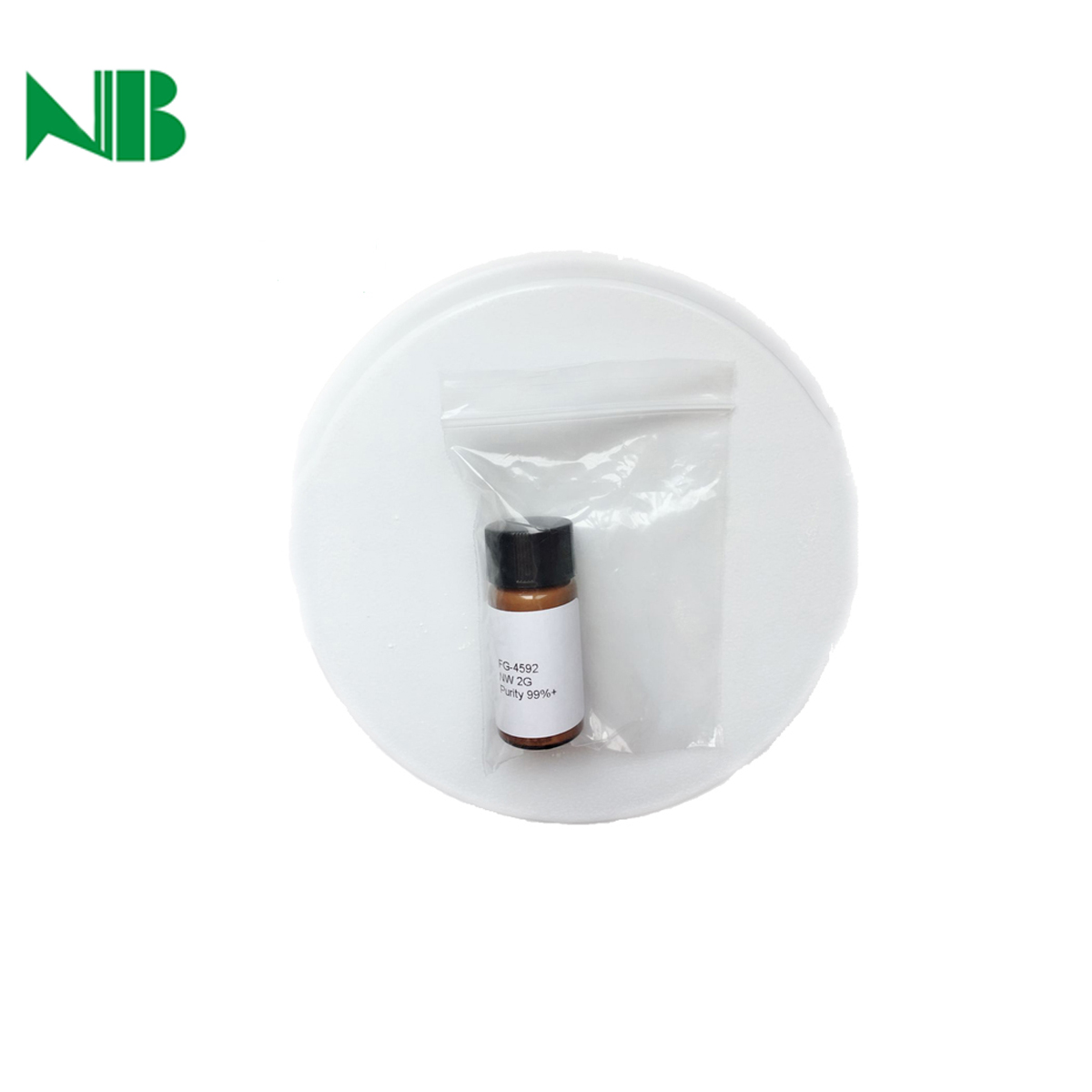
FG-4592 (Roxadustat) CAS 808118-40-3
HIF Prolyl-Hydroxylase (HIF-PH / PHD) Inhibitor — Anemia & Hypoxia Research
FG-4592 (roxadustat; CAS 808118-40-3) is a potent, orally active hypoxia-inducible factor prolyl-hydroxylase (HIF-PH / PHD) inhibitor that stabilizes HIF-1α/2α (PHD2 IC50 ~1.7 µM; Ki ~20 nM vs α-KG) and stimulates erythropoietin. Molecular formula C19H16N2O5, MW 352.34. Research-grade with COA.
Molecular Information
CAS: 808118-40-3
Formula: C19H16N2O5
MW: 352.34 g/mol
Class: 4-Hydroxyisoquinoline glycinamide
Core: 4-hydroxy-1-methyl-7-phenoxyisoquinoline-3-carboxamide glycine conjugate
Target: HIF prolyl-hydroxylase (PHD1/2/3)
IC50: PHD2 ~1.7 µM
Appearance: White to beige powder
Synonyms: Roxadustat / ASP1517
Storage: -20 C
Product Technical Specifications
Complete physicochemical properties and QC parameters for FG-4592 (Roxadustat) (CAS 808118-40-3)
📋 Physicochemical Properties
- Product NameFG-4592 (Roxadustat)
- IUPAC Core2-[(4-hydroxy-1-methyl-7-phenoxyisoquinoline-3-carbonyl)amino]acetic acid
- CAS Number808118-40-3
- SynonymsRoxadustat; ASP1517; AZD9941; FG4592
- Molecular FormulaC19H16N2O5
- Molecular Weight352.34 g/mol
- SourceSynthetic small molecule (FibroGen / Astellas / AstraZeneca)
- AppearanceWhite to beige powder
- Melting PointNot reported
- Water SolubilityLow
- Organic SolubilityDMSO ~17-46 mg/mL; ethanol (warmed)
- Compound Class4-Hydroxyisoquinoline HIF-PH inhibitor
- HS Code2934.99
🔬 Quality Control & Handling
- Purity (HPLC)≥98%
- FormSolid powder
- Primary TargetHIF prolyl-hydroxylase (PHD1/2/3 / EGLN1-3)
- Pathway ReadoutStabilized HIF-1α/2α; ↑ EPO, VEGF; ↓ hepcidin
- SelectivityHIF-PH vs FIH (>150 µM); α-KG-competitive
- Storage Condition-20 C, sealed, protect from light
- Solution StabilityAliquot DMSO stocks; avoid freeze-thaw
- ShippingBlue ice / cold chain recommended
- QC DocumentationCOA / HPLC / NMR / MS / MSDS
- Pack Sizes1g / 5g / 10g / 100g / 1KG
- Stock StatusIn Stock
- Use StatementResearch use only; not for human/clinical use
Key Molecular Targets & Pathway Nodes
FG-4592 targets the HIF prolyl-hydroxylases (PHD1/2/3, also EGLN1-3) that normally mark HIF-α for destruction; inhibition stabilizes HIF and re-activates the hypoxia response.
How FG-4592 Works: Stabilizing HIF by Inhibiting its 'Oxygen Sensor'
FG-4592 competitively blocks HIF prolyl-hydroxylase (PHD), so HIF-α escapes degradation and switches on the hypoxia-response program
α-KG-Competitive PHD Inhibition
Under normoxia, PHD enzymes use O2 and α-ketoglutarate (α-KG) to hydroxylate HIF-α, marking it for VHL-mediated degradation. FG-4592 is α-KG-competitive (Ki ~20 nM) and blocks PHD1/2/3 (PHD2 IC50 ~1.7 µM), preventing this hydroxylation.
HIF-α Stabilization
With hydroxylation blocked, HIF-1α and HIF-2α are no longer recognized by VHL and are stabilized, accumulating in the nucleus to form active HIF transcription complexes.
Hypoxia-Response Program: EPO, Iron & Angiogenesis
Stabilized HIF drives erythropoietin (EPO) production, improves iron metabolism (lowering hepcidin) and induces VEGF and glycolytic genes. This is the basis of anemia and ischemia/hypoxia research using FG-4592.
⚖️ FG-4592 vs Other HIF-PH Inhibitors
- FG-4592 / Roxadustat (this product)PHD1/2/3 inhibitor; Ki ~20 nM vs α-KG; PHD2 IC50 ~1.7 µM
- Deferoxamine (DFO)Iron chelator; indirect HIF stabilizer
- CoCl2Prolyl-hydroxylase inhibitor (metal-based)
- Shared PathwayHIF stabilization / hypoxia response
- Key DistinctionSelective PHD vs FIH (>150 µM)
- OutputEPO ↑, hepcidin ↓, VEGF ↑
♻️ Downstream Biological Consequences
- EnzymePHD1/2/3 blocked (α-KG-competitive)
- FactorHIF-1α / HIF-2α stabilized
- HematologyEPO ↑; erythropoiesis ↑
- IronHepcidin ↓; iron availability ↑
- VasculatureVEGF ↑; angiogenesis
- MetabolismGlycolysis genes ↑ (pseudo-hypoxia)
Research Applications & Models
A central tool for probing oxygen sensing, with direct relevance to anemia, ischemia and iron metabolism.
Anemia & Erythropoiesis Models
The flagship use: FG-4592 stabilizes HIF to induce EPO and stimulate red-cell production; benchmarked in CKD-anemia and hypoxia models.
HIF / EPOHypoxia & Ischemia Research
Used to mimic and study the hypoxia response, tissue adaptation and ischemic preconditioning.
Hypoxia responseIron Metabolism & Hepcidin
Investigated for lowering hepcidin and improving iron availability in anemia-of-inflammation models.
Iron / HepcidinHIF / PHD Biology
A fiducial α-KG-competitive PHD inhibitor for hydroxylases, VHL recognition and HIF stability assays.
HIF-PHDAngiogenesis
Studied for VEGF induction and vessel formation in regenerative contexts.
VEGF / AngioOxygen-Sensing Panel
Benchmarked against DFO and CoCl2 to separate direct PHD inhibition from indirect stabilizers.
Oxygen panelKey Literature & Landmark Publications
The nonclinical pharmacology and clinical development of roxadustat (FG-4592).
Available Sizes & Ordering
Research-grade FG-4592 / Roxadustat (CAS 808118-40-3) with full QC documentation; standard packs and bulk custom quantities supported.
| Tier | Pack Size | Stock Status | Suitable For | Lead Time |
|---|---|---|---|---|
| Standard | 1g | In Stock | HIF-PHD & EPO assays | Cold chain |
| Medium | 5g | In Stock | Hypoxia, anemia & iron models | Cold chain |
| Large | 10g | In Stock | Long-term in vivo & formulation studies | Cold chain |
| Bulk | 100g | In Stock | Formulation & process development | Quote to confirm |
| Industrial | 1KG | Made to order | Pilot/production scale, CMO supply | Batch delivery |
💡 Reference sizes shown above; for exact pricing and availability please contact us for a quote. Bulk orders qualify for tiered discounts.
Frequently Asked Questions (FAQ)
What is FG-4592 (roxadustat) and what does it do?
How is FG-4592 different from deferoxamine or cobalt chloride?
What is the mechanism in anemia research?
What are the key experimental readouts?
How soluble is FG-4592 and how prepared?
Is QC documentation provided?
Need FG-4592 / Roxadustat (HIF-PH Inhibitor) for Your Research?
Research-grade FG-4592 / Roxadustat (CAS 808118-40-3) — purity ≥98% HPLC, COA included
The HIF prolyl-hydroxylase inhibitor that stabilizes HIF to drive EPO and anemia research — request a quote today