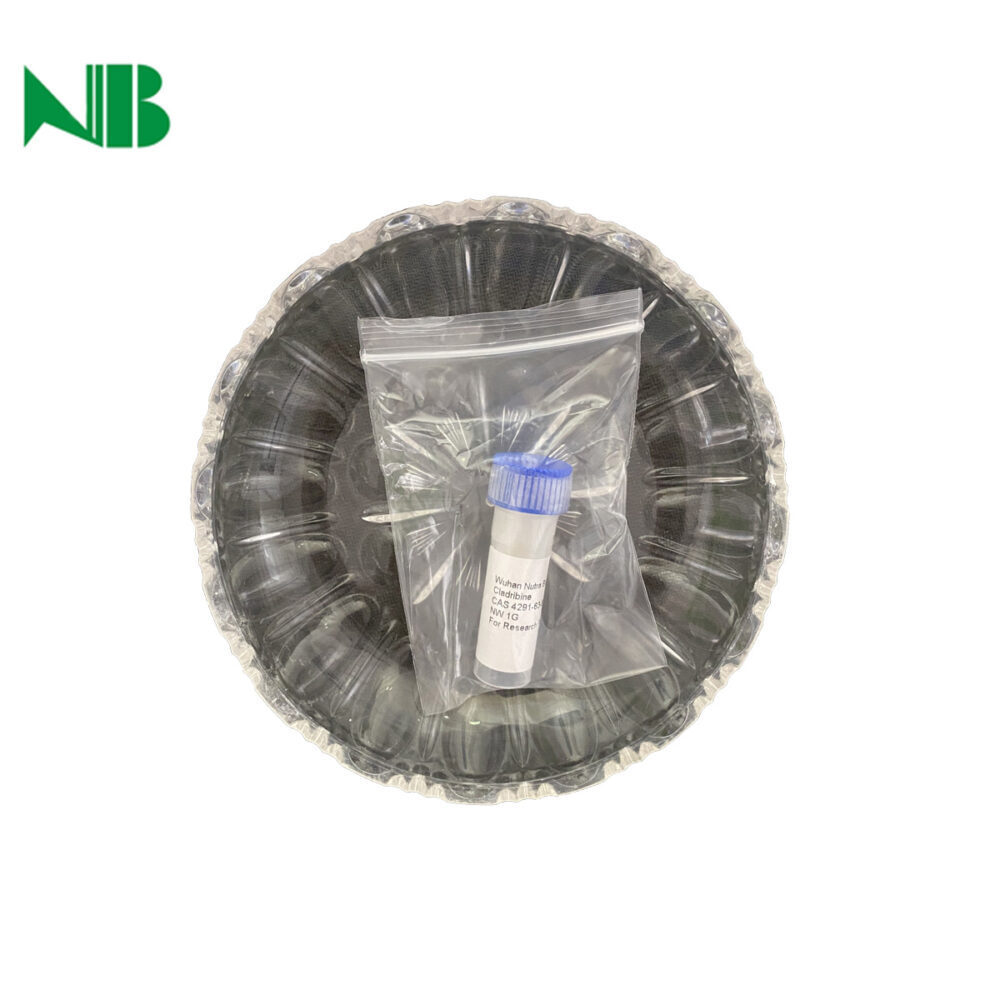
Cladribine CAS 4291-63-8
Purine Nucleoside Analog & Lymphocyte-Depleting SIRT
A deoxyadenosine-mimic purine nucleoside analog, also known as 2-chlorodeoxyadenosine (2-CdA). Cladribine is resistant to adenosine deaminase (ADA) and acts as a prodrug: intracellular phosphorylation by deoxycytidine kinase (dCK) yields the active triphosphate CdATP, which preferentially accumulates in lymphocytes (high dCK, low 5'-nucleotidase) and disrupts DNA synthesis and repair, triggering apoptosis. FDA-approved (2019, brand Mavenclad) as an oral selective immune reconstitution therapy for relapsing multiple sclerosis; first-line in hairy cell leukemia with an 84% complete response rate.
Molecular Information
CAS: 4291-63-8
Formula: C10H12ClN5O3
MW: 285.69 g/mol
SMILES: C1C(C(OC1N2C=NC
3=C(N=C(N=C32)Cl)N)CO)O
InChIKey: PTOAARAWEBMLNO
-KVQBGUIXSA-N
Appearance: White to off-white crystalline
Synonyms: 2-CdA / 2CDA / Mavenclad
Storage: 0-4°C short, -20°C long term
Product Technical Specifications
Complete physicochemical properties and QC parameters for Cladribine (CAS 4291-63-8)
📋 Physicochemical Properties
- Product NameCladribine
- IUPAC Name5-(6-Amino-2-chloropurin-9-yl)-2-(hydroxymethyl)oxolan-3-ol
- CAS Number4291-63-8
- Synonyms2-CdA / 2CDA / Mavenclad
- Molecular FormulaC10H12ClN5O3
- Molecular Weight285.69 g/mol
- SMILESC1C(C(OC1N2C=NC3=C(N=C(N=C32)Cl)N)CO)O
- InChIKeyPTOAARAWEBMLNO-KVQBGUIXSA-N
- AppearanceWhite to off-white crystalline powder
- HS Code2934.99
- PubChem CID451164
🔬 Quality Control & Handling
- Purity (HPLC)≥98%
- FormCrystalline powder
- ColorWhite to off-white
- Bioavailability100% IV; 37-51% oral
- Half-life5.4-19.7 h (dose route)
- Protein Binding20-25%
- SolubilityWater ~6.35 g/L; DMSO
- Storage Condition0-4°C short; -20°C long term
- QC DocumentationCOA / HPLC / NMR / MS / MSDS
- Pack Sizes1g / 5g / 10g / 100g / 1KG
- Stock StatusIn Stock
- Use StatementResearch use only; not for human/clinical use
Key Molecular Targets & Enzyme Interactions
Cladribine's chlorinated deoxyadenosine scaffold engages nucleotide metabolism and DNA synthesis machinery with lymphocyte selectivity
How Cladribine Works: From dCK Activation to Lymphocyte Apoptosis
Cladribine acts as a prodrug whose selectivity arises from the cellular enzyme balance of lymphoid cells
ADA Resistance & Cellular Uptake
Cladribine mimics deoxyadenosine but is resistant to adenosine deaminase (ADA), so it is not rapidly degraded. It enters cells via nucleoside transporters and persists long enough to be metabolically activated.
dCK-Dependent Activation to CdATP
Within cells, deoxycytidine kinase (dCK) phosphorylates cladribine to its active triphosphate, CdATP. Lymphocytes have high dCK and low 5'-nucleotidase, so CdATP preferentially accumulates in B and T cells.
DNA Disruption & Apoptosis
Incorporated CdATP disrupts DNA synthesis and repair (inhibiting DNA polymerase, ribonucleotide reductase, and repair enzymes), triggering lymphocyte apoptosis and producing the selective immune reconstitution (SIRT) effect.
Research Applications & Disease Models
Cladribine's lymphoid selectivity spans neurology, hematology, oncology and immune-metabolism research
Multiple Sclerosis
FDA-approved (2019) oral selective immune reconstitution therapy (SIRT) for relapsing MS (brand Mavenclad). The CLARITY trial demonstrated reduced relapse rate and MRI activity via preferential B/T lymphocyte depletion.
CLARITY TrialHairy Cell Leukemia
First-line therapy with an ~84% complete response rate. Cladribine's durable lymphodepletion is highly effective against this indolent B-cell malignancy, establishing its foundational clinical profile.
84% CRB-Cell CLL
Used as second-line therapy in chronic lymphocytic leukemia. Its dCK-dependent activation makes it active against proliferating and quiescent lymphoid clones alike.
Second-linePurine Metabolism
A classic tool for studying the dCK / 5'-nucleotidase ratio, nucleoside analog pharmacology, and the determinants of lymphoid versus myeloid sensitivity to antimetabolites.
Nucleoside AnalogDNA Damage Response
CdATP incorporation and inhibition of DNA repair enzymes make cladribine a model compound for investigating replication stress, mismatch repair, and apoptosis-linked DNA damage pathways.
DNA RepairLymphocyte Biology
Enables selective B- and T-cell depletion and the study of immune reconstitution kinetics — foundational for SIRT concepts and tolerogenic immune remodeling.
Immune ReconstitutionAutoimmune Disease
Investigated in other autoimmune conditions where pathogenic lymphocyte clones drive disease, leveraging the same lymphoid-selective depletion validated in MS.
InvestigationalLangerhans Cell Histiocytosis
Explored as an orphan indication given its activity against dendritic-cell lineage malignancies, reflecting the breadth of its antilymphoid spectrum.
Orphan IndicationNucleoside Analog Pharmacology
A benchmark compound for comparing chlorinated vs fluorinated deoxyadenosine analogs (e.g., vs fludarabine) and for optimizing lymphoid selectivity in drug design.
SAR BenchmarkKey Literature & Landmark Publications
Seminal papers on cladribine's discovery, mechanism, MS efficacy, and pharmacokinetics
Available Sizes & Ordering
Research-grade Cladribine (CAS 4291-63-8) with full QC documentation; research packs and bulk custom quantities supported
| Tier | Pack Size | Stock Status | Suitable For | Lead Time |
|---|---|---|---|---|
| Standard | 1 g | In Stock | Biochemical / cell-based assays | Same/next-day ship |
| Medium | 5 g | In Stock | In vivo pharmacology, long-term studies | Same/next-day ship |
| Large | 10 g | In Stock | Multi-lab collaborations, HTS | Same/next-day ship |
| Bulk | 100 g | In Stock | Process development, scale-up | Quote to confirm |
| Industrial | 1 KG | Made to order | Pilot/production scale, CMO supply | Batch delivery |
💡 Reference sizes shown above; for exact pricing and availability please contact us for a quote. Bulk orders qualify for tiered discounts.
Frequently Asked Questions (FAQ)
What is Cladribine (CAS 4291-63-8), and what makes it unique?
How does Cladribine compare to fludarabine in potency?
Why is oral Cladribine bioavailable while many nucleotides are not?
What is the concept of selective immune reconstitution therapy (SIRT)?
How does lymphocyte recovery occur after Cladribine treatment?
How should Cladribine be dissolved and stored for research use?
Is QC documentation provided with each batch?
Need Cladribine for Your Research?
Research-grade Cladribine (CAS 4291-63-8) — purity ≥98%, COA included
A dCK-dependent purine nucleoside analog & lymphoid-selective SIRT — request a quote today