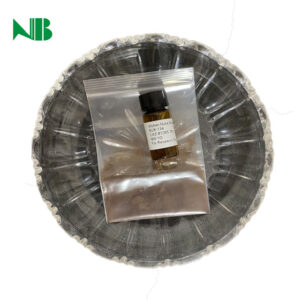
Ozanimod CAS 1306760-87-1
Selective S1P1 / S1P5 Receptor Modulator
Ozanimod (development code RPC1063; marketed as Zeposia) is an orally active, next-generation sphingosine-1-phosphate receptor modulator with an EC50 of approximately 0.41 nM at human S1P1 and 11 nM at S1P5, and minimal activity at S1P2, S1P3 or S1P4. It functions as a functional antagonist: sustained S1P1 internalisation renders lymphocytes blind to the egress gradient, sequestering them in lymph nodes and cutting immune infiltration into the central nervous system and intestinal mucosa. Approved for relapsing multiple sclerosis and moderately to severely active ulcerative colitis.
Molecular Information
CAS: 1306760-87-1
Formula: C23H24N4O3
MW: 404.46 g/mol
Purity: ≥98% (HPLC)
SMILES: CC(C)Oc1ccc(-c2nc
(-c3cccc4c3CC[C@@H]4
NCCO)no2)cc1C#N
InChIKey: XRVDGNKRPOAQTN
-FQEVSTJZSA-N
Appearance: White to off-white powder
Solubility: DMSO
Codes: RPC1063 / Zeposia
HCl salt CAS: 1618636-37-5
Storage: -20°C, sealed, desiccated
Ozanimod Technical Specifications & QC Parameters
Complete physicochemical data and quality-control profile for research-grade ozanimod (CAS 1306760-87-1)
📋 Physicochemical Properties
- Product NameOzanimod
- IUPAC Name5-[3-[(1S)-1-(2-Hydroxyethylamino)-2,3-dihydro-1H-inden-4-yl]-1,2,4-oxadiazol-5-yl]-2-propan-2-yloxybenzonitrile
- CAS Number1306760-87-1
- Hydrochloride CAS1618636-37-5
- SynonymsRPC1063 / Zeposia
- Molecular FormulaC23H24N4O3
- Molecular Weight404.46 g/mol
- SMILESCC(C)Oc1ccc(-c2nc(-c3cccc4c3CC[C@@H]4NCCO)no2)cc1C#N
- InChIKeyXRVDGNKRPOAQTN-FQEVSTJZSA-N
- Stereochemistry(S)-configured indane centre
- AppearanceWhite to off-white powder
- Chemical Class1,2,4-Oxadiazole indane benzonitrile
- Active MetabolitesCC112273 / CC1084037
🔬 Quality Control & Handling
- Purity (HPLC)≥98%
- FormCrystalline powder
- Potency (S1P1)EC50 ≈ 0.41 nM (human)
- Potency (S1P5)EC50 ≈ 11 nM (human)
- Receptor SelectivityMinimal activity at S1P2, S1P3, S1P4
- Functional ClassAgonist-driven functional antagonist (receptor internalisation)
- SolubilityDMSO; poorly soluble in water
- Storage Condition-20°C, sealed, desiccated, dark
- Stock Solution Storage-20°C to -80°C, aliquoted, avoid freeze-thaw
- QC DocumentationCOA / HPLC / chiral HPLC / NMR / MS / MSDS
- Pack Sizes1g / 5g / 10g / 100g / 1KG
- Stock StatusIn Stock
- Use StatementResearch use only; not for human or clinical use
Receptor Target Profile & S1P Subtype Selectivity
Five G-protein-coupled receptors read the sphingosine-1-phosphate signal; ozanimod deliberately engages only the two that govern lymphocyte egress and oligodendrocyte biology
Ozanimod Mechanism of Action: Agonism That Behaves Like Antagonism
How persistent S1P1 activation traps lymphocytes in lymph nodes and starves inflamed tissue of autoreactive cells
The S1P Egress Gradient
Sphingosine-1-phosphate is abundant in blood and lymph but kept low inside lymphoid tissue by S1P lyase. Lymphocytes sense this gradient through surface S1P1 and use it as the directional cue to exit lymph nodes into the circulation.
High-Affinity S1P1 Engagement
Ozanimod binds S1P1 as a full agonist with an EC50 of about 0.41 nM, triggering Gi/o signalling and β-arrestin recruitment. Its selectivity for S1P1 and S1P5 leaves S1P3-mediated cardiac and vascular effects largely untouched.
Receptor Internalisation & Degradation
Unlike the natural ligand, which allows rapid recycling, ozanimod drives sustained β-arrestin-dependent internalisation, ubiquitination and proteasomal degradation of S1P1 — converting an agonist into a durable functional antagonist.
Lymphocyte Sequestration
Without surface S1P1, the lymphocyte cannot read the egress gradient and remains trapped in the lymph node. Circulating naive and central memory T and B cells fall by roughly 50-65%, while effector memory and tissue-resident immunity is comparatively preserved.
Reduced Tissue Infiltration
With fewer autoreactive lymphocytes in circulation, trafficking across the blood-brain barrier into CNS lesions and into inflamed colonic mucosa falls. This is the shared basis of efficacy in relapsing multiple sclerosis and in ulcerative colitis.
Central S1P5 Component
S1P5 is expressed on oligodendrocytes, oligodendrocyte precursors and astrocytes. Because ozanimod and its major active metabolite CC112273 are CNS-penetrant, a direct glial contribution to remyelination and neuroprotection is an active research question.
Research Applications of the S1P1/S1P5 Modulator Ozanimod
A best-in-class chemical tool for lymphocyte trafficking, autoimmune inflammation and sphingolipid GPCR pharmacology
Relapsing-Remitting Multiple Sclerosis
The RADIANCE and SUNBEAM phase 3 programmes established ozanimod against interferon beta-1a on annualised relapse rate and MRI lesion burden. In the laboratory it is the reference S1P modulator in experimental autoimmune encephalomyelitis, cuprizone demyelination and blood-brain-barrier trafficking models.
NeuroimmunologyUlcerative Colitis & IBD
TOUCHSTONE and the pivotal TRUE NORTH trial demonstrated induction and maintenance of clinical remission in moderately to severely active ulcerative colitis. Widely used in DSS colitis, T-cell transfer colitis and mucosal-healing studies as an oral alternative to anti-integrin biologics.
GastroenterologyS1P Receptor Pharmacology & GPCR Biology
An essential selectivity benchmark in S1P1-S1P5 panels: GTPγS binding, cAMP inhibition, β-arrestin recruitment (PathHunter/Tango), receptor internalisation imaging and BRET-based conformational assays. Frequently paired with fingolimod-phosphate and siponimod as comparators.
Receptor PharmacologyLymphocyte Trafficking & Egress
Used to acutely and reversibly block lymph node egress in vivo, allowing researchers to separate the contribution of newly recruited circulating lymphocytes from that of tissue-resident populations in infection, transplantation and tumour immunology models.
Immune Cell TraffickingCrohn's Disease & Mucosal Immunology
Explored beyond ulcerative colitis into Crohn's disease and other mucosal inflammatory conditions, where reducing lymphocyte recruitment to the gut wall is the therapeutic goal. Useful for studying gut-homing integrin biology and epithelial barrier restoration.
Mucosal ImmunityVascular Barrier & Cardiac Safety Pharmacology
S1P1 maintains endothelial adherens junctions while S1P3 mediates bradycardia. Ozanimod's S1P3-sparing profile makes it the standard tool for dissecting which S1P subtype drives which vascular or cardiac phenotype in safety pharmacology research.
Safety PharmacologyRemyelination & Oligodendrocyte Biology
Because S1P5 is expressed on oligodendrocyte lineage cells and ozanimod is CNS-penetrant, it is applied in oligodendrocyte precursor differentiation assays, myelin sheath formation co-cultures and neuroprotection paradigms.
Glial BiologyMetabolism, DDI & Active-Metabolite Research
Ozanimod is a rich case study in complex metabolism: alcohol/aldehyde dehydrogenases, MAO-B, CYP3A4 and gut microflora generate the major circulating active metabolites CC112273 and CC1084037, with CC112273 cleared by CYP2C8 — the basis of its rifampin, gemfibrozil and MAO-inhibitor interactions.
DMPK / ADMEBroader Autoimmune & Inflammatory Models
Applied across psoriasis, rheumatoid arthritis, lupus, graft-versus-host disease, transplant rejection and acute lung injury models where lymphocyte egress blockade or endothelial barrier stabilisation is the mechanistic hypothesis under test.
AutoimmunityKey Publications on Ozanimod (RPC1063)
Discovery pharmacology and the pivotal multiple sclerosis and ulcerative colitis trials
Ozanimod Pack Sizes & Ordering Information
Research-grade ozanimod (CAS 1306760-87-1) supplied with full QC documentation — available in 1g / 5g / 10g / 100g / 1KG
| Tier | Pack Size | Stock Status | Typical Use Case | Shipping Notes |
|---|---|---|---|---|
| Standard | 1 g | In Stock | S1P receptor panels, β-arrestin and internalisation assays, EC50 determination | Same/next-day dispatch; amber vial with desiccant |
| Medium | 5 g | In Stock | EAE and DSS colitis cohorts, lymphocyte-count pharmacodynamic studies | Same/next-day dispatch; sealed foil pouch, ambient shipping |
| Large | 10 g | In Stock | Chronic in vivo dosing, PK/PD and active-metabolite profiling, multi-site studies | 1-2 business days; double-sealed, light-protected |
| Bulk | 100 g | In Stock | Formulation development, salt-form and polymorph screening, analytical standards | Quote to confirm; HDPE container, cool-chain option available |
| Industrial | 1 KG | Made to order | Pilot-scale campaigns, CRO/CMO supply agreements, chiral process development | Batch delivery on campaign schedule; per-lot COA, chiral purity and export documents |
💡 Reference pack sizes shown above; for current pricing, lot availability and bulk ozanimod quotations please contact us for a quote. Tiered discounts apply to 100 g and 1 KG orders.
Ozanimod Frequently Asked Questions (FAQ)
What is ozanimod (CAS 1306760-87-1)?
How does the S1P1 mechanism actually work?
How does ozanimod differ from fingolimod?
How does ozanimod compare with siponimod and ponesimod?
How is ozanimod metabolised, and which drug interactions matter?
Why does the same drug work in multiple sclerosis and in ulcerative colitis?
Is ozanimod CNS-penetrant?
What assays is ozanimod suitable for?
How should ozanimod be prepared and stored?
What QC documentation is supplied, and are bulk quantities available?
Need Ozanimod for Your S1P Receptor Research?
Research-grade ozanimod (CAS 1306760-87-1, RPC1063) — purity ≥98% HPLC with chiral purity data, COA included, 1g to 1KG
A selective S1P1/S1P5 modulator for MS, ulcerative colitis and lymphocyte trafficking research — request your quote today