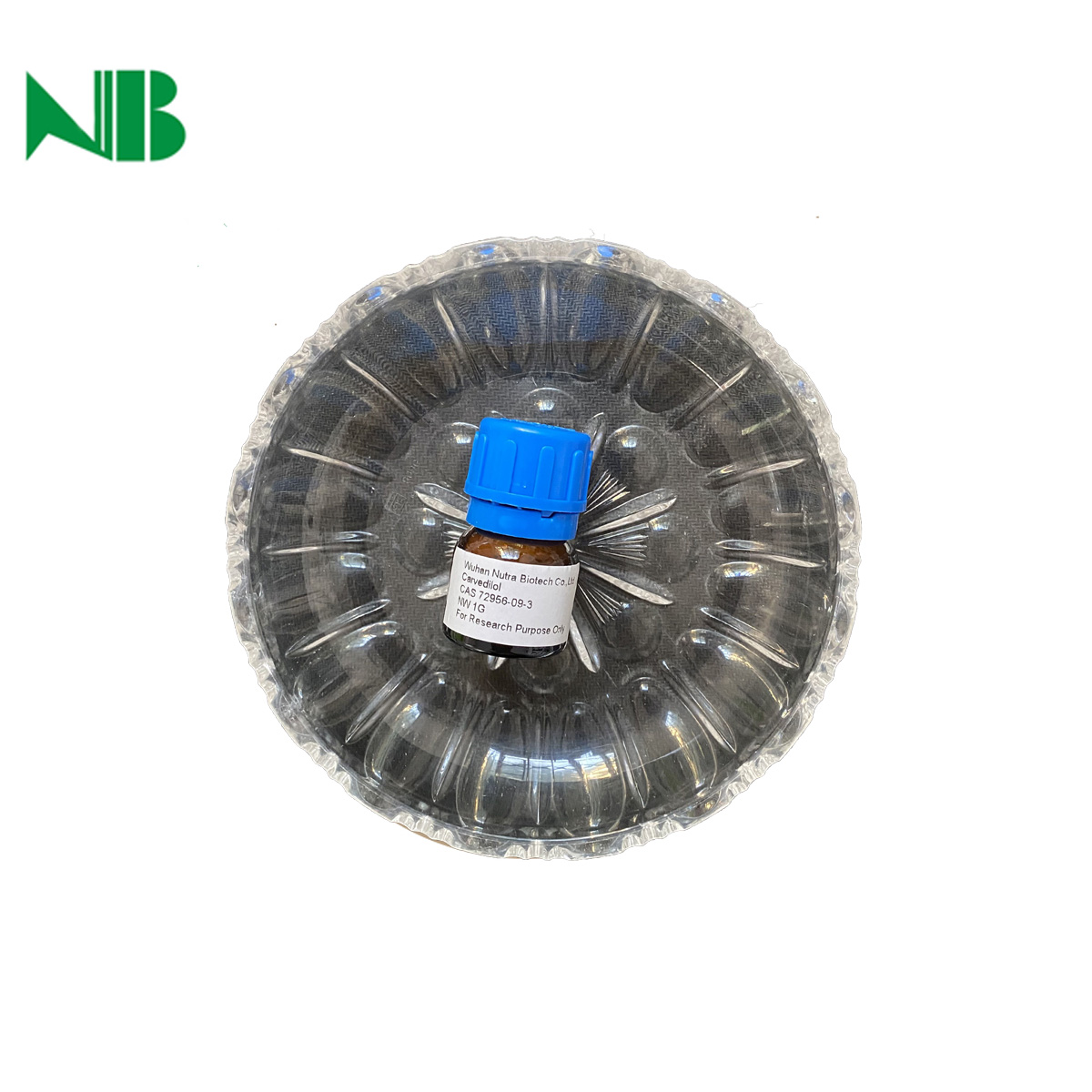
Carvedilol CAS 72956-09-3
Non-Selective β-Blocker with α1 Blockade & Antioxidant Activity
A third-generation vasodilating beta blocker (Coreg®, Dilatrend®) that simultaneously antagonises β1, β2 and α1 adrenoceptors while directly scavenging reactive oxygen species. Carvedilol is the benchmark tool compound for heart failure with reduced ejection fraction (HFrEF), hypertension, post-myocardial-infarction remodeling and cardiovascular redox biology, validated in the landmark COPERNICUS (NEJM 2001), US Carvedilol Heart Failure Program (NEJM 1996) and COMET (Lancet 2003) trials.
Molecular Information
CAS: 72956-09-3
Formula: C24H26N2O4
MW: 406.48 g/mol
Purity: ≥98% (HPLC)
Solubility: DMSO (>20 mg/mL), ethanol
SMILES: COc1ccccc1OCCNCC(O)
COc1cccc2[nH]c3ccccc3c12
InChIKey: OGHNVEJMJSYVRP
-UHFFFAOYSA-N
MP: 113-117°C
Appearance: White to off-white powder
Synonyms: Coreg / Dilatrend /
BM 14190 / DQ-2466
Storage: 2-8°C, protect from light
Carvedilol Technical Specifications & Quality Control Data
Complete physicochemical properties, analytical identifiers and QC release parameters for research-grade Carvedilol (CAS 72956-09-3)
📋 Physicochemical Properties
- Product NameCarvedilol
- IUPAC Name1-(9H-Carbazol-4-yloxy)-3-{[2-(2-methoxyphenoxy)ethyl]amino}propan-2-ol
- CAS Number72956-09-3
- Code NamesBM 14190 / DQ-2466
- Brand NamesCoreg / Dilatrend / Kredex
- Molecular FormulaC24H26N2O4
- Molecular Weight406.48 g/mol
- Exact Mass406.1893 Da
- SMILESCOc1ccccc1OCCNCC(O)COc1cccc2[nH]c3ccccc3c12
- InChIKeyOGHNVEJMJSYVRP-UHFFFAOYSA-N
- AppearanceWhite to off-white crystalline powder
- Melting Point113-117°C
- pKa (predicted)13.90 ± 0.20
- MDL NumberMFCD00864692
- PubChem CID2585
- ATC CodeC07AG02
🔬 Quality Control & Handling
- Purity (HPLC)≥98%
- Identity1H-NMR / 13C-NMR / LC-MS conform
- FormCrystalline powder
- ColorWhite to off-white
- Loss on Drying≤0.5%
- Residue on Ignition≤0.1%
- Heavy Metals≤20 ppm
- Storage Condition2-8°C, sealed, protect from light
- SolubilityDMSO >20 mg/mL; ethanol; methanol; practically insoluble in water (~0.45 mg/L)
- GHS ClassificationWarning; H411 (toxic to aquatic life with long-lasting effects)
- QC DocumentationCOA / HPLC / NMR / MS / MSDS
- Pack Sizes1g / 5g / 10g / 100g / 1KG
- Stock StatusIn Stock
- Use StatementResearch use only; not for human or clinical use
Molecular Targets & Receptor Binding Profile of Carvedilol
Unlike cardioselective beta blockers, carvedilol engages three adrenoceptor subtypes plus a set of ion channels and redox pathways — the pharmacological basis of its "third-generation" classification
How Carvedilol Works: Mechanism of Action Step by Step
Carvedilol is a multi-action cardiovascular agent. Its therapeutic profile in heart failure and hypertension arises from the convergence of beta blockade, alpha-1 vasodilation and direct antioxidant chemistry
β1/β2 Adrenoceptor Blockade
Carvedilol competitively occupies cardiac β1 and β2 adrenoceptors (Ki 0.81 and 0.96 nM) without intrinsic sympathomimetic activity, lowering heart rate, contractility and myocardial oxygen demand while suppressing renin release from the juxtaglomerular apparatus.
α1 Blockade → Vasodilation
Simultaneous antagonism of vascular α1 adrenoceptors (Ki 2.2 nM) relaxes arteriolar smooth muscle, reducing systemic vascular resistance and afterload. This offsets the negative inotropy of beta blockade and prevents the reflex tachycardia typical of pure vasodilators.
Sympathetic Tone Normalisation
Chronic blockade interrupts the maladaptive neurohormonal loop of heart failure: catecholamine-driven β1 downregulation is reversed, receptor density is restored, and adverse ventricular remodeling and apoptosis signalling are attenuated.
Direct ROS Scavenging
The carbazole ring system donates electrons to quench superoxide, hydroxyl and peroxyl radicals independently of receptor occupancy, inhibiting iron-initiated lipid peroxidation in myocardial and vascular membranes.
Active Antioxidant Metabolite
Hepatic hydroxylation generates SB 211475 (4'-hydroxyphenyl carvedilol), an order of magnitude more potent as a free radical scavenger than the parent drug, extending redox protection to the vascular endothelium and inhibiting LDL oxidation.
Biased β-Arrestin Signalling
At the β2 adrenoceptor carvedilol behaves as an inverse agonist for Gs-cAMP yet a partial agonist for β-arrestin-dependent EGFR/ERK1/2 transactivation — a textbook example of GPCR functional selectivity with proposed cardioprotective consequences.
Carvedilol Research Applications & Disease Models
From clinical cardiology to receptor pharmacology and redox biology, carvedilol serves as both a positive control and a mechanistic probe across a wide range of experimental systems
Heart Failure with Reduced Ejection Fraction (HFrEF)
The reference beta blocker in HFrEF research. In the COPERNICUS trial carvedilol reduced mortality by 35% in severe chronic heart failure, and the US Carvedilol Heart Failure Program reported a 65% reduction in mortality risk. Used routinely as a positive control in transverse aortic constriction (TAC), pacing-induced and doxorubicin cardiomyopathy models.
COPERNICUS NEJM 2001Hypertension & Vascular Pharmacology
Combined α1 blockade and beta blockade lowers total peripheral resistance without the reflex tachycardia of pure vasodilators. Widely used in spontaneously hypertensive rat (SHR), DOCA-salt and renovascular hypertension models, and in isolated aortic ring and mesenteric bed vasoreactivity studies.
AntihypertensiveAntioxidant & Redox Biology
Carbazole-mediated free radical scavenging makes carvedilol a rare "antioxidant beta blocker". Applied to lipid peroxidation assays, LDL oxidation studies, mitochondrial ROS quantification and ischemia-reperfusion injury protocols, with the metabolite SB 211475 used as a high-potency comparator.
ROS ScavengerAdrenergic Receptor Pharmacology
A canonical non-selective antagonist for radioligand binding, cAMP accumulation, GTPγS and BRET-based β-arrestin recruitment assays. Its biased signalling at β2 adrenoceptors makes it an essential probe for GPCR functional selectivity and receptor conformational studies.
GPCR ProbePost-Myocardial Infarction Remodeling
Attenuates infarct expansion, ventricular dilatation, interstitial fibrosis and cardiomyocyte apoptosis in coronary artery ligation models. Frequently combined with ACE inhibitors or angiotensin receptor blockers to dissect neurohormonal contributions to post-MI remodeling.
Cardiac RemodelingCardiomyopathy & Cardiotoxicity Protection
Studied extensively for protection against anthracycline (doxorubicin) cardiotoxicity, diabetic cardiomyopathy and alcoholic cardiomyopathy, where the combination of beta blockade and direct antioxidant activity produces effects not reproduced by metoprolol or atenolol.
CardioprotectionArrhythmia & Ion Channel Research
Blocks cardiac inward-rectifier K+ (KIR) channels and L-type voltage-dependent Ca2+ channels at higher concentrations, and suppresses store-overload-induced Ca2+ release from RyR2. Applied in atrial fibrillation and catecholaminergic polymorphic ventricular tachycardia (CPVT) models.
ElectrophysiologyMetabolic & Renal Studies
In contrast to conventional beta blockers, carvedilol is metabolically neutral in insulin sensitivity and lipid profile studies, and preserves renal blood flow. Used to compare metabolic and nephroprotective endpoints across beta blocker classes in diabetic and chronic kidney disease models.
Metabolic NeutralityAnalytical & Formulation Science
Serves as a reference standard for HPLC, UPLC-MS/MS and chiral separation method development. Its very low aqueous solubility (BCS Class II) makes it a favourite model compound for solid dispersion, nanocrystal, cyclodextrin and self-emulsifying drug delivery system research.
Reference StandardKey Publications & Landmark Clinical Trials
Seminal literature defining carvedilol's receptor pharmacology, antioxidant chemistry and clinical outcome data
Carvedilol Pack Sizes & Ordering Information
Research-grade Carvedilol (CAS 72956-09-3) supplied in 1g / 5g / 10g / 100g / 1KG with full QC documentation; custom bulk quantities supported
| Tier | Pack Size | Stock Status | Suitable For | Shipping & Lead Time |
|---|---|---|---|---|
| Standard | 1 g | In Stock | Receptor binding assays, cell-based cAMP and cardiomyocyte experiments | Ambient shipping; same/next-day dispatch |
| Medium | 5 g | In Stock | Rodent in vivo dosing, chronic heart failure and hypertension models | Ambient shipping; same/next-day dispatch |
| Large | 10 g | In Stock | Multi-arm animal studies, multi-lab collaborations, HTS libraries | Ambient shipping; same/next-day dispatch |
| Bulk | 100 g | In Stock | Formulation and solid-dispersion development, analytical standard production | Palletised or carton; quote to confirm dispatch |
| Industrial | 1 KG | Made to order | Pilot and production scale, CMO/CDMO supply, process validation batches | Drum shipment with batch COA; scheduled batch delivery |
💡 Reference pack sizes shown above; for exact pricing, lot availability and bulk carvedilol supply please contact us for a quote. Tiered discounts apply to bulk orders.
Carvedilol FAQ — Frequently Asked Questions
Common technical and scientific questions about carvedilol pharmacology, handling and sourcing
What is Carvedilol (CAS 72956-09-3) and what makes it a "third-generation" beta blocker?
Carvedilol vs metoprolol — what are the pharmacological differences?
What are carvedilol's binding affinities at the adrenergic receptors?
Is the antioxidant property of carvedilol clinically and experimentally meaningful?
Why is carvedilol the standard agent in heart failure (HFrEF) research?
How do I prepare carvedilol stock solutions for cell culture and animal work?
What is "biased agonism" and why is carvedilol famous for it?
Does carvedilol affect glucose and lipid metabolism differently from other beta blockers?
Is a Certificate of Analysis provided, and can I request a sample?
What pack sizes and bulk quantities of carvedilol can Nutrabiotech Chem supply?
Need Carvedilol for Your Cardiovascular Research?
Research-grade Carvedilol (CAS 72956-09-3) — C24H26N2O4, MW 406.48, purity ≥98% HPLC, COA included
Non-selective β-blocker with α1 blockade and antioxidant activity — available 1g to 1KG