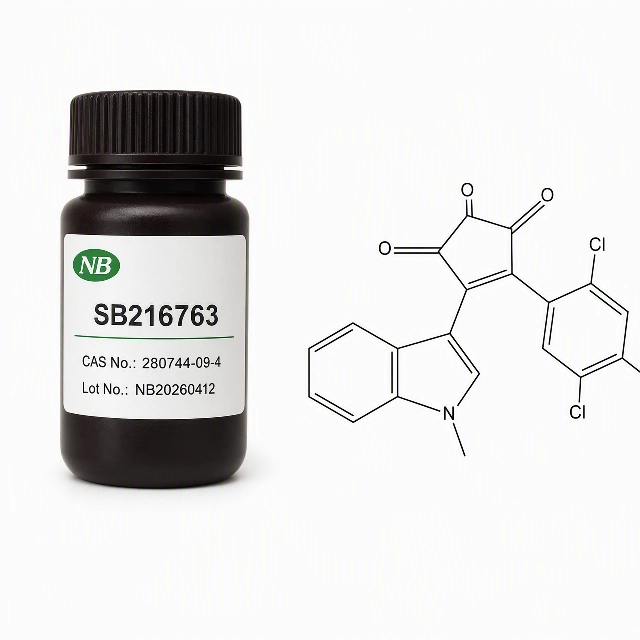
SB216763 CAS 280744-09-4
Potent ATP-Competitive GSK-3α/β Inhibitor
A cell-permeable maleimide-class small molecule that inhibits glycogen synthase kinase-3 (GSK-3α and GSK-3β) with an IC50 of approximately 34 nM. SB216763 is the reference chemical tool for stabilizing β-catenin, activating Wnt/β-catenin transcription, reducing tau hyperphosphorylation, driving stem cell self-renewal, and stimulating glycogen synthesis. Structurally related to SB415286 and highly selective across the wider kinome.
Molecular Information
CAS: 280744-09-4
Formula: C19H12Cl2N2O2
MW: 371.22 g/mol
Purity: ≥98% (HPLC)
SMILES: Clc1ccc(c(Cl)c1)
C1=C(C(=O)NC1=O)
c1cn(C)c2ccccc12
InChIKey: JCSGFHVFHSKIJH
-UHFFFAOYSA-N
Appearance: Orange to red-orange
crystalline powder
Solubility: DMSO (≥20 mg/mL)
Target: GSK-3α / GSK-3β
Storage: -20°C, desiccated, dark
SB216763 Technical Specifications & QC Parameters
Complete physicochemical data and quality-control profile for research-grade SB216763 (CAS 280744-09-4)
📋 Physicochemical Properties
- Product NameSB216763
- IUPAC Name3-(2,4-Dichlorophenyl)-4-(1-methyl-1H-indol-3-yl)-1H-pyrrole-2,5-dione
- CAS Number280744-09-4
- SynonymsSB 216763 / GSK-3 Inhibitor XV
- Molecular FormulaC19H12Cl2N2O2
- Molecular Weight371.22 g/mol
- Exact Mass370.027 Da
- SMILESClc1ccc(c(Cl)c1)C1=C(C(=O)NC1=O)c1cn(C)c2ccccc12
- InChIKeyJCSGFHVFHSKIJH-UHFFFAOYSA-N
- AppearanceOrange to red-orange crystalline powder
- Melting Point287-289°C (lit.)
- Chemical ClassArylindolylmaleimide
- MDL NumberMFCD09753369
- Related AnalogueSB415286
🔬 Quality Control & Handling
- Purity (HPLC)≥98%
- FormCrystalline powder
- Biological PotencyIC50 ≈ 34 nM (GSK-3); Ki ≈ 9 nM; ATP-competitive
- Kinase Selectivity>10 µM against 24 other protein kinases
- Cellular ActivityEC50 ≈ 3.6 µM (glycogen synthesis, Chang liver cells)
- SolubilityDMSO ≥20 mg/mL (~54 mM); insoluble in water
- Storage Condition-20°C, desiccated, protect from light
- Stock Solution Storage-20°C to -80°C, aliquoted, avoid freeze-thaw
- QC DocumentationCOA / HPLC / NMR / MS / MSDS
- Pack Sizes1g / 5g / 10g / 100g / 1KG
- Stock StatusIn Stock
- Use StatementResearch use only; not for human or clinical use
Molecular Targets & Downstream Signalling Nodes
SB216763 occupies the ATP pocket of both GSK-3 isoforms, which propagates through a dense network of substrates controlling metabolism, transcription, cytoskeletal stability and cell fate
SB216763 Mechanism of Action: From ATP Pocket to Wnt Output
How a single ATP-competitive binding event converts into β-catenin stabilization, tau dephosphorylation and metabolic reprogramming
ATP-Competitive Binding
The dichlorophenyl-indolylmaleimide scaffold inserts into the highly conserved ATP-binding cleft of GSK-3α and GSK-3β, hydrogen-bonding to the hinge region and displacing ATP with nanomolar affinity (IC50 ≈ 34 nM, Ki ≈ 9 nM).
Loss of Substrate Phosphorylation
With catalysis blocked, GSK-3 can no longer phosphorylate its priming-dependent substrates: β-catenin (Ser33/37/Thr41), tau (Ser396/404, Thr231), glycogen synthase (site 3a-c), eIF2B, cyclin D1 and c-Myc.
β-Catenin Escapes Degradation
Unphosphorylated β-catenin is not recognised by β-TrCP, so it evades ubiquitination and proteasomal destruction. Cytosolic β-catenin accumulates within 1-4 hours of treatment in most cell types.
Wnt/β-Catenin Transcription
Stabilized β-catenin enters the nucleus, displaces Groucho from TCF/LEF and switches on the canonical Wnt programme (AXIN2, LGR5, CCND1, MYC) — a pharmacological mimic of Wnt3a ligand stimulation.
Tau Dephosphorylation & Neuroprotection
Reduced tau phosphorylation at GSK-3-dependent epitopes limits paired-helical-filament formation, restores microtubule binding, and protects primary neurons from PI3K-inhibition or trophic-withdrawal induced apoptosis.
Metabolic & Cytoprotective Output
Dephosphorylated glycogen synthase becomes active, increasing glycogen synthesis independently of insulin, while GSK-3 inhibition raises the threshold for mitochondrial permeability-transition-pore opening — the basis of GSK-3-mediated cardioprotection.
Research Applications of the GSK-3 Inhibitor SB216763
From Alzheimer's tau pathology to pluripotent stem cell culture, SB216763 is a workhorse probe wherever GSK-3 sits at the centre of the pathway
Alzheimer's Disease & Tau Pathology
GSK-3β is the principal tau kinase generating hyperphosphorylated tau in neurofibrillary tangles. SB216763 lowers phospho-tau at Ser396/404 and Thr231 in neuronal cultures and transgenic models, making it a standard positive control in tau-directed drug discovery and neurodegeneration research.
NeurodegenerationWnt/β-Catenin Signalling Activation
Used as a small-molecule Wnt agonist to stabilize β-catenin and drive TCF/LEF reporter activity (TOPflash) without recombinant Wnt ligand. Ideal for developmental biology, organoid patterning, and dissecting canonical versus non-canonical Wnt outputs.
Wnt AgonistStem Cell Self-Renewal & Pluripotency
GSK-3 inhibition is one half of the classic "2i" ground-state condition for mouse embryonic stem cells. SB216763 sustains pluripotency marker expression (Oct4, Nanog, Sox2), supports clonal survival, and is applied in iPSC reprogramming, cardiomyocyte differentiation and intestinal organoid protocols.
Stem Cell BiologyInsulin Signalling & Glucose Metabolism
Relieves inhibitory phosphorylation of glycogen synthase and suppresses hepatic gluconeogenic gene expression (G6Pase, PEPCK), increasing glycogen deposition in liver and skeletal muscle cells. A key tool in type 2 diabetes and insulin-resistance research.
Metabolic ResearchCancer Biology & Tumour Signalling
GSK-3 acts as a context-dependent tumour suppressor or promoter. SB216763 is used to interrogate β-catenin-driven proliferation, cyclin D1/c-Myc turnover, NF-κB survival signalling in pancreatic and leukaemic cells, and GSK-3 dependence in MLL-rearranged leukaemia.
OncologyMood Disorders & Lithium-Mimetic Biology
Because lithium's therapeutic action is partly attributed to GSK-3 inhibition, SB216763 serves as a selective pharmacological surrogate to test the GSK-3 hypothesis of bipolar disorder and depression in behavioural paradigms and circadian rhythm studies.
PsychiatryCardioprotection & Ischemia-Reperfusion
GSK-3β inhibition at reperfusion desensitizes the mitochondrial permeability transition pore and limits infarct size. SB216763 is widely used in Langendorff-perfused heart and cardiomyocyte hypoxia/reoxygenation models of ischemic conditioning.
CardiovascularBone, Fibrosis & Regeneration
Canonical Wnt activation promotes osteoblast differentiation and bone formation, while GSK-3 modulation influences fibroblast activation and wound repair. SB216763 supports osteogenesis, chondrogenesis and tissue-regeneration studies.
Regenerative MedicineInflammation & Immune Modulation
GSK-3 inhibition shifts the CREB/NF-κB balance in monocytes and macrophages, reducing IL-6, IL-12 and TNF-α while raising IL-10. SB216763 is applied in innate-immunity, sepsis and neuroinflammation (microglia) models.
ImmunologyKey Publications Citing SB216763
Foundational papers on the discovery, selectivity and biological application of this GSK-3 inhibitor
SB216763 Pack Sizes & Ordering Information
Research-grade SB216763 (CAS 280744-09-4) supplied with full QC documentation — available in 1g / 5g / 10g / 100g / 1KG
| Tier | Pack Size | Stock Status | Typical Use Case | Shipping Notes |
|---|---|---|---|---|
| Standard | 1 g | In Stock | Enzyme assays, cell-based Wnt reporter screens, dose-response work | Same/next-day dispatch; ambient shipping, foil pouch |
| Medium | 5 g | In Stock | Primary neuron and stem cell culture, multi-week in vitro programmes | Same/next-day dispatch; desiccant included |
| Large | 10 g | In Stock | Rodent in vivo pharmacology, multi-lab collaborations, HTS libraries | 1-2 business days; amber container, light-protected |
| Bulk | 100 g | In Stock | Formulation development, large animal cohorts, process R&D | Quote to confirm; double-bagged HDPE drum, cool shipping option |
| Industrial | 1 KG | Made to order | Pilot-scale synthesis, CRO/CMO supply agreements, contract manufacturing | Batch delivery on campaign schedule; export documents and COA per lot |
💡 Reference pack sizes shown above; for current pricing, lot availability and bulk SB216763 quotations please contact us for a quote. Tiered discounts apply to 100 g and 1 KG orders.
SB216763 Frequently Asked Questions (FAQ)
What is SB216763 and why is it so widely used?
Is SB216763 selective for GSK-3α or GSK-3β?
How does SB216763 activate Wnt/β-catenin signalling?
Does SB216763 cross the blood-brain barrier?
How does SB216763 compare with lithium?
How does SB216763 differ from SB415286 and CHIR99021?
What concentrations of SB216763 are typically used?
How should I prepare and store SB216763 solutions?
What controls should I include when using SB216763?
What QC documentation is supplied, and can I order bulk quantities?
Need SB216763 for Your GSK-3 Research?
Research-grade SB216763 (CAS 280744-09-4) — purity ≥98% HPLC, COA included, 1g to 1KG
A potent ATP-competitive GSK-3α/β inhibitor and Wnt/β-catenin activator — request your quote today