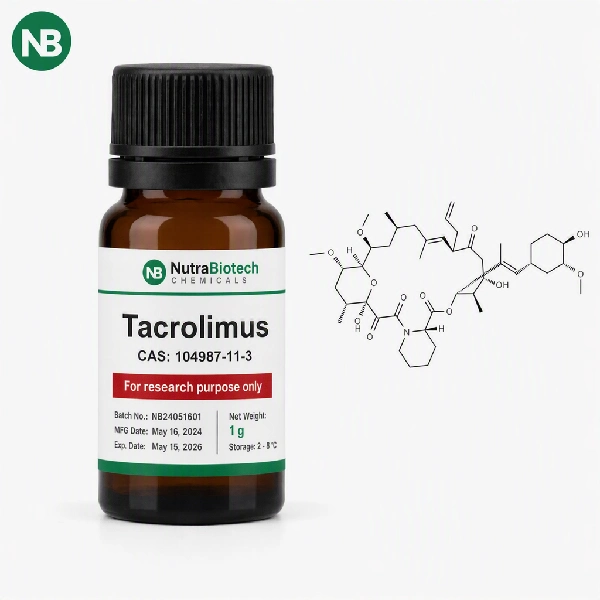
Tacrolimus (FK506) CAS 104987-11-3
Macrolide Calcineurin Inhibitor
A 23-membered macrolide lactam isolated from Streptomyces tsukubaensis fermentation. Tacrolimus binds the immunophilin FKBP12; the resulting FKBP12–FK506 complex inhibits calcineurin phosphatase, preventing NFAT dephosphorylation and nuclear translocation and shutting down IL-2 transcription and T-cell activation. Ten to one hundred times more potent than cyclosporine, it is the first-line calcineurin inhibitor in solid organ transplantation and the definitive pharmacological probe for calcineurin–NFAT signaling.
Molecular Information
CAS: 104987-11-3
Formula: C44H69NO12
MW: 804.02 g/mol
Class: 23-membered macrolide lactam
Motifs: Hemiketal + pipecolic acid
Source: Streptomyces tsukubaensis
MP: 113–133°C (polymorph-dep.)
[α]D: +62.2° (CHCl3)
LogP: ~3.3 | BCS: Class 2
Synonyms: FK506 / Fujimycin /
Tsukubaenolide / Prograf / Protopic
Storage: −20°C, sealed dry
Product Technical Specifications
Complete physicochemical, pharmacokinetic and QC parameters for Tacrolimus / FK506 (CAS 104987-11-3)
📋 Physicochemical Properties
- Product NameTacrolimus
- Chemical Class23-membered macrolide lactam bearing hemiketal and pipecolic acid moieties
- CAS Number104987-11-3
- SynonymsFK506; Fujimycin; Tsukubaenolide; Prograf; Protopic; Advagraf
- Molecular FormulaC44H69NO12
- Molecular Weight804.02 g/mol
- SourceStreptomyces tsukubaensis fermentation
- AppearanceWhite to off-white crystalline powder
- Melting Point113–133°C (polymorph-dependent)
- Optical Rotation+62.2° (CHCl3)
- LogP~3.3
- BCS ClassificationClass 2 (low solubility / high permeability)
- HS Code2934.99
🔬 Quality Control, PK & Handling
- Purity (HPLC)≥98%
- SolubilityDMSO >3 mg/mL; ethanol; acetone; practically insoluble in water
- Oral Bioavailability~24% (highly variable, 5–67%)
- Elimination Half-life~11.3 h in transplant patients (3.5–40.6 h)
- Plasma Protein Binding≥98.8%
- MetabolismHepatic & intestinal CYP3A4 / CYP3A5
- Efflux TransporterP-glycoprotein (ABCB1) substrate
- Storage Condition−20°C, sealed, dry, protect from light
- QC DocumentationCOA / HPLC / NMR / MS / MSDS
- Pack Sizes1g / 5g / 10g / 100g / 1KG
- Stock StatusIn Stock
- Use StatementResearch use only; not for human/clinical use
Key Molecular Targets & Immunological Pathway Profile
Tacrolimus acts through a composite-surface mechanism: it is inactive alone and becomes a potent inhibitor only after forming a complex with its immunophilin partner FKBP12
How Tacrolimus Works: The FKBP12–Calcineurin–NFAT Axis
Tacrolimus interrupts the calcium-dependent signal that converts T-cell receptor engagement into cytokine gene transcription
FKBP12 Complex Formation
Tacrolimus diffuses into the T cell and binds the abundant cytosolic immunophilin FKBP12 (FK506 Binding Protein-12). Free tacrolimus does not inhibit calcineurin; the drug–immunophilin complex creates a new composite surface that is the true pharmacophore.
Calcineurin Phosphatase Inhibition
The FKBP12–FK506 complex docks into a groove at the calcineurin A/B interface adjacent to the active site, sterically blocking substrate access. Calcineurin (PP2B), the only calcium/calmodulin-dependent serine/threonine phosphatase, is thereby silenced (Liu et al., Cell 1991).
NFAT Blockade & IL-2 Shutdown
Without calcineurin activity, cytoplasmic NFAT remains hyperphosphorylated and cannot translocate to the nucleus. Transcription of IL-2 and other NFAT-dependent cytokines (IL-3, IL-4, IFN-γ, TNF-α, GM-CSF) collapses, arresting T-cell activation and clonal proliferation.
⚖️ Tacrolimus vs Cyclosporine
- Immunophilin PartnerFKBP12 vs Cyclophilin A
- Convergent TargetCalcineurin (both)
- Relative Potency10–100× more potent (molar)
- Chemical ClassMacrolide lactam vs cyclic undecapeptide
- Guideline PositionKDIGO 2009 first-line CNI in kidney transplant
- Distinct ToxicitiesMore PTDM/neurotoxicity; less hirsutism & gingival hyperplasia
🧫 Broader Immunomodulatory Effects
- Cytokine SuppressionTNF-α, IL-1β, IL-6, IFN-γ, GM-CSF
- T-Cell ProliferationBlocked at G0→G1 transition
- IL-2 ReceptorReduced surface expression
- Mast Cells / BasophilsInhibits mediator release (topical relevance)
- Langerhans CellsReduced antigen-presenting activity in skin
- B-Cell EffectsIndirect via reduced T-helper support
Research Applications & Disease Models
Tacrolimus spans transplant immunology, dermatology, cell signaling, oncology and pharmacogenetics as both a therapeutic benchmark and a chemical probe
Solid Organ Transplantation
The first-line calcineurin inhibitor for kidney, liver and heart transplantation, recommended by KDIGO 2009 guidance for kidney recipients. Used as the reference immunosuppressant in rejection models, allograft survival studies, and comparative regimen trials with mycophenolate and corticosteroids.
First-Line CNIAtopic Dermatitis (Topical)
Topical tacrolimus ointment (Protopic) is a steroid-sparing treatment for moderate-to-severe atopic dermatitis. Because the 804 Da macrolide penetrates inflamed skin but is minimally absorbed systemically, it inhibits cutaneous T cells and Langerhans cells without causing skin atrophy.
Topical Calcineurin InhibitorCalcineurin / NFAT Signaling
The definitive pharmacological tool for interrogating the calcium–calcineurin–NFAT axis. Used to dissect NFAT-dependent transcription in T-cell activation, cardiac hypertrophy, skeletal muscle remodeling, osteoclastogenesis, and neuronal plasticity — usually paired with cyclosporine A as an orthogonal control.
Signaling ProbeVitiligo & Repigmentation
Topical tacrolimus is studied for repigmentation in vitiligo, particularly on the face and neck and in pediatric patients. Proposed mechanisms include suppression of autoreactive cytotoxic T cells against melanocytes and stimulation of melanocyte and melanoblast proliferation.
DermatologyAutoimmune & Refractory Disease
Investigated in refractory non-infectious uveitis, minimal change disease and steroid-resistant nephrotic syndrome, membranous nephropathy, myasthenia gravis, lupus nephritis, and Kimura's disease. Its rapid T-cell suppression makes it valuable where corticosteroid sparing is required.
AutoimmunityCancer Signaling Research
Used to probe NFAT function in tumor biology, including angiogenesis, invasion and immune evasion, as well as crosstalk with MAPK and p53 pathways. Also central to studies of post-transplant malignancy risk and calcineurin-dependent tumor-suppressive signaling in skin.
OncologyTransplant Tolerance & CNI Minimization
Central to research on steroid-free and steroid-withdrawal regimens, calcineurin-inhibitor minimization or conversion to mTOR inhibitors, regulatory T-cell induction, and operational tolerance protocols aimed at reducing chronic nephrotoxicity.
Tolerance ResearchPharmacokinetics & Pharmacogenetics
A textbook narrow-therapeutic-index drug. Research covers CYP3A5*1/*3 genotype-guided dosing, CYP3A4*22 effects, P-glycoprotein interactions, therapeutic drug monitoring assay development (LC-MS/MS vs immunoassay), and PBPK modelling of the 5–67% bioavailability range.
CYP3A5 GenotypingAnalytical & Reference Standard Use
Employed as an analytical reference standard for LC-MS/MS whole-blood assays, impurity and degradation profiling, polymorph and solid-state characterization (melting range 113–133°C), dissolution testing of modified-release formulations, and bioequivalence studies.
Reference StandardKey Literature & Landmark Publications
Seminal papers on the discovery, mechanism and clinical application of tacrolimus (FK506)
Available Sizes & Ordering
Research-grade Tacrolimus / FK506 (CAS 104987-11-3) with full QC documentation; research packs and bulk custom quantities supported
| Tier | Pack Size | Stock Status | Suitable For | Lead Time |
|---|---|---|---|---|
| Standard | 1 g | In Stock | Cell-based T-cell activation & NFAT assays | Same/next-day ship |
| Medium | 5 g | In Stock | In vivo transplant and autoimmune models | Same/next-day ship |
| Large | 10 g | In Stock | Multi-lab collaborations, long-term dosing | Same/next-day ship |
| Bulk | 100 g | In Stock | Formulation and process development | Quote to confirm |
| Industrial | 1 KG | Made to order | Pilot/production scale, CMO supply | Batch delivery |
💡 Reference sizes shown above; for exact pricing and availability please contact us for a quote. Bulk orders qualify for tiered discounts.
Frequently Asked Questions (FAQ)
What is Tacrolimus (FK506, CAS 104987-11-3)?
How does Tacrolimus compare with cyclosporine?
What is the difference between topical and systemic Tacrolimus?
Why is CYP3A5 genotype important for Tacrolimus dosing?
Why does Tacrolimus require therapeutic drug monitoring?
Why is Tacrolimus such a valuable research tool?
How should Tacrolimus be dissolved and stored?
Does Tacrolimus have a defined melting point?
What other cytokines does Tacrolimus suppress besides IL-2?
Is QC documentation provided? Can I request a sample?
Need Tacrolimus (FK506) for Your Research?
Research-grade Tacrolimus (CAS 104987-11-3) — purity ≥98% HPLC, COA included
A calcineurin inhibitor, FKBP12 binder and NFAT pathway probe — request a quote today